How we test VPS hosting providers


At Cybernews, we follow a structured testing methodology to evaluate VPS hosting providers under real-world conditions. Unlike shared or WordPress hosting, VPS hosting serves a much wider range of use cases. While many users rely on it for websites, VPS servers are also commonly used for hosting applications, development environments, VPNs, databases, AI models, and other resource-intensive projects.
This versatility requires a different approach to testing. Since VPS hosting provides dedicated resources and full root access, enabling the configuration and management of server environments to meet specific needs, assessing a VPS provider involves more than measuring website loading speeds.
To accurately evaluate VPS hosting services, our testing process combines hands-on technical benchmarking, structured research, and expert analysis. This approach allows us to assess performance across different workloads and use cases, providing you with comprehensive, well-rounded reviews, insights, and recommendations for specific providers.
Why our VPS testing is different
In total, we’ve assessed over 20 VPS providers. However, considering that some of them were tested under specific configurations or niche use cases, they aren’t included in our main VPS hosting comparison dataset. We currently test 10 VPS hosting providers as part of our regular quarterly evaluation cycle.
Our testing process needs to reflect real-world server usage across a variety of workloads. To achieve this level of accuracy and consistency, we rely on a combination of industry-standard benchmarking tools and custom testing scripts:
- Grafana – used for uptime monitoring and generalized K6 stress testing
- fio – used to measure disk writing and reading speed testing
- Iperf3 – used to evaluate network speed performance
- OpenSSL – used for benchmarking encryption, decryption, and hashing performance
- Custom compression script – used to measure compression and decompression speed across different workloads
VPS providers we test
We regularly evaluate 10 VPS hosting providers as part of our ongoing testing. Each provider is reviewed on a quarterly basis to ensure our findings reflect their current performance, infrastructure changes, and any potential product updates.
The VPS providers we currently test include:
- Hostinger
- Liquid Web
- ScalaHosting
- IONOS
- InterServer
- Kamatera
- DreamHost
- Cloudways
- Zynoo VPS
- Zynoo Dedicated hosting
Consistently retesting these providers throughout the year allows us to maintain up-to-date comparisons and provide reliable insights in our reviews.
VPS plans and server specs we use
We always purchase VPS hosting plans directly from each provider rather than rely on pre-configured demo environments. This allows us to evaluate performance exactly as a real customer would experience it.
All of our tests are conducted via the Linux terminal, so we exclusively choose unmanaged VPS hosting plans with full root access. This gives us complete control over the server environment and allows us to install, configure, and benchmark software without the restrictions of pre-installed control panels or managed layers.
When selecting a plan, we first consider the use case. In many instances, lightweight command-line applications don’t require significant resources, so entry-level VPS plans are usually sufficient for baseline performance testing.
However, when evaluating more demanding workloads, we carefully match the VPS configuration to the tested software's expected system requirements. This involves analyzing CPU performance, memory allocation, and storage type and capacity.
For example, a typical Minecraft server hosting setup requires around 8GB of RAM, at least 50GB of NVMe storage, and a strong single-core CPU to ensure stable gameplay and low latency. In such cases, we choose higher-tier VPS plans that match or exceed these specifications. This way, we can accurately assess how providers handle resource-intensive workloads under realistic conditions.
Performance, uptime, and reliability tests
For our performance testing, we use an Ubuntu 26 Linux VPS with a clean installation to ensure consistent, reproducible results across providers. Once the server is deployed, the first step is always to fully update and patch the system using the “sudo apt update && sudo apt upgrade -y” command.
After the system is up to date, we begin a series of structured performance, stress, and reliability tests:
- CPU and system overview. We start by inspecting the allocated processor using the “lscpu” command. This provides detailed information about the CPU model, architecture, and the number of cores assigned to the VPS. This serves as a baseline for all further performance comparisons.
- Encryption, hashing, and cryptography performance. Next, we run the “openssl speed” command to evaluate cryptographic performance. We focus on commonly used algorithms, such as RSA-4096, AES-256-CBC, and SHA-256, to measure how efficiently the server performs encryption, decryption, and hashing.
- Compression performance. We then execute a dedicated Bash script designed to benchmark compression and decompression performance. This test evaluates how effectively the VPS handles widely used algorithms, such as gzip and Brotli, which are common in modern web applications and data processing workflows.
- Network performance. To measure network throughput, we use the iperf3 tool between 2 VPS instances located in different data centers with at least 1Gbps connectivity. One server acts as the listener, and the other acts as the client. We then analyze total transfer volume and average bitrate to assess real-world network performance.
- Disk performance and IOPS. We measure storage performance using the fio tool, focusing on input/output operations per second (IOPS). This test simulates database-like workloads to evaluate how efficiently the VPS handles sustained read and write operations under load.
- Uptime and availability testing. For uptime monitoring, we deploy a simple Apache web server on each VPS and expose it via a public IP address. We then configure Grafana Synthetic Monitoring to send HTTP requests every 10 minutes from 3 global probe locations: Ohio, London, and Mumbai. This test runs for two weeks, during which we track uptime, availability, and request latency.
- Load and stress testing. Finally, we perform load testing using Grafana K6. We simulate 50 virtual users accessing the web server over a 5-minute period. After each test run, we analyze key metrics, such as total requests, requests per second (RPS), P95 response time, and HTTP failure rate.
Together, these tests provide a comprehensive overview of each VPS provider’s performance under both controlled benchmarks and realistic traffic conditions. You can find the link to our most recent VPS testing spreadsheet here.
Ease of use testing
Although most VPS management takes place through the Linux terminal, we also evaluate how hosting providers simplify key parts of the server management through their control panels and built-in tools.
When assessing ease of use, we focus on how well each provider supports essential management tasks without requiring advanced technical steps or support intervention. This includes verifying that users have full root access by default, allowing complete control over the server environment.
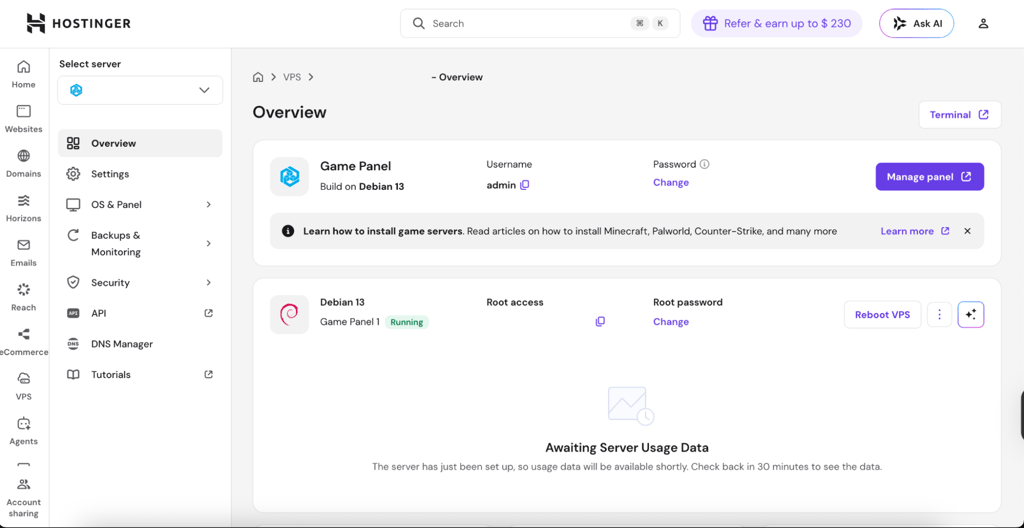
We also test the availability and quality of convenience features, such as:
- One-click application and software installation
- Operating system deployment and reinstallation through the VPS dashboard
- Pre-installed application templates and server images
- Easy server restart and power management options
- Password reset and SSH key management tools
- Browser-based web console access for emergency server interaction
- Resource scaling options for upgrading CPU, RAM, or storage
- Snapshot and backup creation and restoration tools
- Server performance and usage statistics dashboards
- Firewall configuration and basic security controls
Evaluating these features in practice helps us determine how straightforward it is to deploy, manage, and scale a VPS over time, beyond raw performance alone.
Security and backup testing
When evaluating VPS hosting security, we focus on the protection handled at the infrastructure level by the provider rather than that configured by the user. While tasks like operating system updates, firewall setup, web server configuration, and user permissions remain the responsibility of the VPS owner, providers are still responsible for ensuring a secure and stable underlying environment.
In our testing, we pay close attention to several key security and reliability factors that directly impact how safe and resilient a VPS platform is:
- Secure virtualization. It’s one of the most important elements, typically implemented using KVM. This ensures that each VPS runs in a fully isolated environment, preventing interference between different virtual machines on the same physical server.
- Infrastructure redundancy. This factor helps maintain service availability in the event of hardware failures or data center issues. This is closely tied to overall uptime reliability and system resilience under unexpected circumstances.
- Security compliance and certification, such as ISO 27001. These certifications indicate that the provider follows recognized industry standards for information security management and operational best practices.
- Automated backups. Finally, we assess the availability and functionality of automated backups. Reliable backup systems are essential for disaster recovery, enabling users to restore their servers to a previous state in case of data loss, misconfiguration, or system failure.
Support testing
Customer support is an important part of the overall VPS hosting experience, especially when users encounter technical issues, service interruptions, or configuration problems. When evaluating VPS providers, we assess both their self-service resources and their direct support channels.
Self-service resources review
For many VPS users, the first step in solving a problem is searching the provider's documentation. That's why we review the quality and depth of each provider's knowledge base, including setup guides, troubleshooting articles, tutorials, and optimization recommendations. We look for documentation that is easy to navigate, regularly updated, and detailed enough to help users resolve common issues on their own.
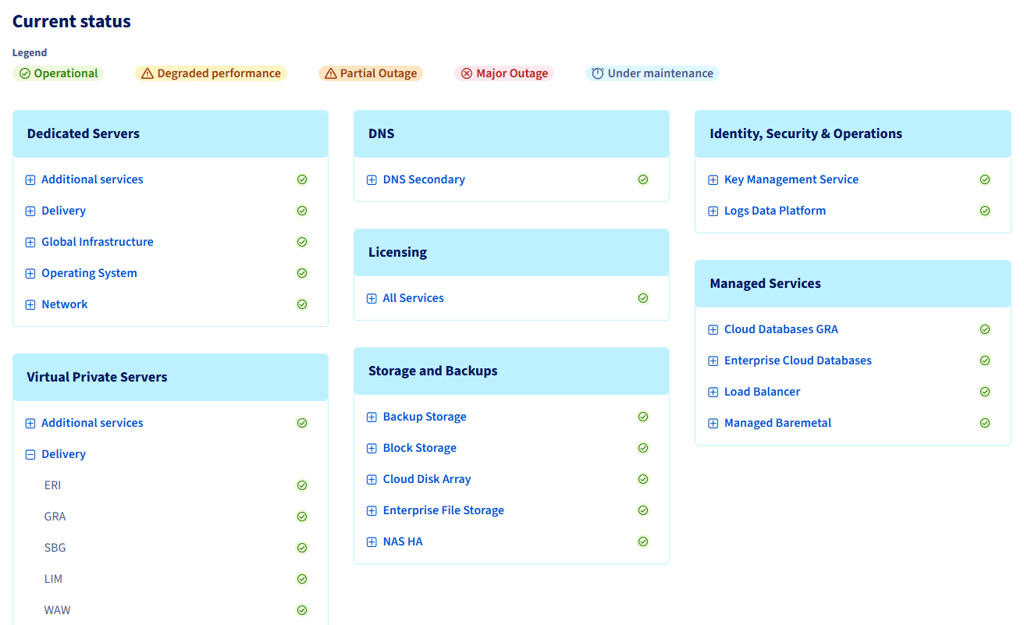
We also check whether the provider offers an infrastructure status page. These pages provide transparency about scheduled maintenance, outages, and performance issues affecting specific services or data centers. A well-maintained status page can help users quickly determine whether a problem is related to their server or a broader platform issue.
Chatbot and live support testing
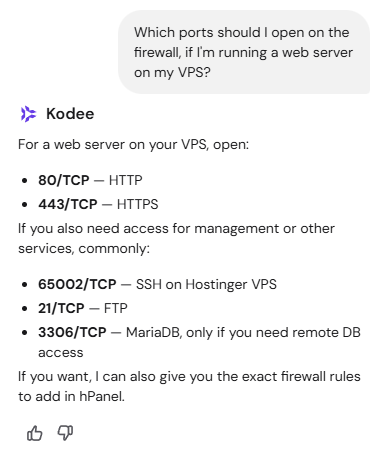
Many hosting providers now use AI-powered chatbots as the first point of contact. During our testing, we evaluate how accurately these chatbots understand requests, whether they provide relevant answers, and how effectively they surface information from the provider's documentation.
When contacting live support agents, we focus on several key factors:
- How quickly we can reach a human representative
- The quality and accuracy of the assistance provided
- Whether support agents can perform VPS-related actions, such as server reboots or root password resets
- How efficiently issues are escalated when additional technical support is required
- The overall time needed to resolve our request
Use-case testing
Performance benchmarks only tell part of the story when it comes to VPS hosting. Since VPS servers are commonly used to run applications, development environments, automation tools, websites, and business software, we also evaluate how well providers support specific real-world use cases. For each use case, we look at both the available deployment tools and the overall setup experience.
AI agent hosting
AI agents are becoming increasingly popular as VPS workloads, so we assess how easily providers support their deployment. We first check whether AI agent tools are available through the provider's application marketplace, Docker Manager, or other one-click installation systems.
The most user-friendly providers offer ready-made templates that deploy an AI agent with minimal configuration. Hostinger's OpenClaw support is a good example, as deployment takes just one click via a Docker Manager template. Some providers also bundle multiple AI and automation tools into a single application library, allowing users to quickly install software such as OpenClaw, Hermes Agent, GatorClaw, Claude Code, Ollama, or n8n.
If no dedicated installer is available, we review the provider's documentation to see whether it provides clear instructions for a manual setup. We also consider whether the available VPS plans offer enough resources for different AI workloads, from lightweight API-based agents to more demanding local model deployments.
Developer projects
For developer-focused hosting, we evaluate whether the VPS provides the flexibility and tools needed for building, testing, and deploying applications. This includes checking for full root access, Linux distribution options, KVM virtualization, Git compatibility, and one-click deployment tools for common development stacks.
We also assess how easy it is to set up containerized environments through Docker and whether the provider offers pre-configured templates for popular software stacks. One example is hosting.com's entry-level self-managed plan, marketed specifically for developers and staging environments. Alternatively, Kamatera lets you choose exact resources yourself rather than offering just a couple of fixed plans.
WordPress hosting
Although VPS hosting is often associated with developers, many users choose it for WordPress websites that require more resources and control than shared hosting can provide.
When testing WordPress support, we look for features such as one-click WordPress installation, staging environments, automatic updates, and WordPress-specific documentation. We also evaluate whether providers offer performance and security features tailored to WordPress, including caching solutions, malware protection, web application firewalls, and PHP version management.
If WordPress-specific tools are unavailable, we assess how straightforward the manual installation process is and whether users receive sufficient guidance throughout setup.
Business apps
Business applications often have unique hosting requirements, so we evaluate how well providers support popular platforms and frameworks. Depending on the application, we examine factors such as server resources, database compatibility, scalability, and deployment options.
We also check whether providers offer one-click installers or pre-configured environments for business software. When these are not available, we review the provider's documentation to determine how easily users can perform a manual deployment.
For example, Hostinger, Cloudways, and DigitalOcean provide VPS hosting for business applications, including Odoo's combination of customer relationship management, accounting, inventory, manufacturing, and purchasing. At the same time, eCommerce solutions such as Magento, PrestaShop, and WooCommerce are best suited with providers like Liquid Web, Cloudways, and ScalaHosting. Our testing focuses on how quickly these applications can be deployed and how well the hosting environment supports their ongoing operation.
How we score VPS providers
After completing our testing, we convert the results into category scores that allow us to compare VPS providers consistently and rank them fairly. Rather than focusing on a single metric, we evaluate multiple aspects of the hosting experience to create a balanced overall score.
For our general VPS rankings, providers are scored across six categories:
- Performance (35%). Server speed, uptime, network performance, and load handling.
- Ease of use (20%). Dashboard usability, setup experience, and documentation quality.
- Security features (15%). Virtualization security, backups, compliance, and infrastructure protections.
- Pricing and value (15%). How well the features and performance justify the cost.
- Support (10%). Availability, response quality, and technical expertise.
- Scalability (5%). Flexibility when upgrading or downgrading server resources.
This weighting reflects what matters most to the majority of VPS users, with performance receiving the highest share of the overall score.
However, not every VPS use case has the same requirements. A server optimized for AI workloads may have very different priorities than one used for Docker containers or business applications. For this reason, we also adjust our scoring methodology for specialized VPS rankings.
For example, AI and ChatGPT hosting places much greater emphasis on hardware acceleration, so GPU capabilities become the most important factor:
- GPU performance and VRAM (40%)
- Pricing and value (25%)
- Ease of deployment (15%)
- Reliability and infrastructure (10%)
- Security and control (10%)
For Docker hosting, we focus more heavily on virtualization quality, resource isolation, and infrastructure stability:
- Kernel and virtualization (20%)
- Resource isolation (20%)
- Docker installation experience (15%)
- Storage performance consistency (15%)
- Network reliability (15%)
- Snapshot and backup support (5%)
- Ease of scaling (5%)
- Price-to-performance ratio (5%)
Meanwhile, for business applications such as Odoo, reliability and long-term stability are key considerations:
- Server performance (30%)
- Reliability and uptime (25%)
- Security and backups (20%)
- Scalability (15%)
- Ease of deployment (10%)
By adapting our scoring system to each use case, we can provide rankings that better reflect the needs of the users who will actually run those workloads on their VPS servers.
How often we retest VPS providers
We review our core VPS provider lineup quarterly to keep our performance data, feature assessments, and rankings up to date. At the same time, our VPS testing methodology is continuously evolving. Since 2019, we have expanded our evaluations beyond general VPS performance by introducing new use-case categories as market demand shifts and new technologies emerge. For example, the growing adoption of AI agents has led us to develop dedicated testing criteria mentioned above for AI-focused VPS hosting.
This combination of regular provider retesting and ongoing methodology updates helps ensure our reviews remain relevant in a rapidly changing VPS hosting market.
Limitations of our testing
While we strive to make our VPS testing as comprehensive and objective as possible, no testing methodology can perfectly represent every real-world scenario. Some limitations of our testing include:
- Regional testing scope. Uptime, latency, and availability tests are typically performed using monitoring probes located in Ohio, London, and Mumbai. As a result, the findings are most representative of those regions and the specific testing period, rather than a guarantee of performance across all locations worldwide.
- Single-plan testing. Providers are usually evaluated using one VPS plan at a time. Performance, hardware specifications, and resource allocation can vary significantly between entry-level, mid-tier, and premium plans offered by the same provider.
- Limited server access. Some providers restrict root access or limit server-level controls. In these cases, we may not be able to perform all benchmarks or validate performance with the same level of detail as in fully accessible VPS environments.
- Support testing represents a sample. Our customer support evaluations are based on a limited number of interactions through live chat, tickets, or email. While these tests provide valuable insights, they do not fully represent every support agent, shift, topic, or time zone.
- Infrastructure changes over time. Hosting providers regularly update their services, hardware, data center locations, and product offerings. Rebrandings, infrastructure upgrades, and other changes may occur after our testing is complete and may not be reflected until the next review cycle.
- Rapidly evolving use cases. Some VPS categories change faster than others. For example, AI agent and LLM hosting can evolve quickly due to new frameworks, models, and hardware requirements. As a result, certain use-case-specific recommendations may require more frequent updates than traditional VPS workloads, such as WordPress hosting or general web hosting.
Despite these limitations, our methodology provides a consistent framework for comparing VPS providers and identifying their strengths, weaknesses, and suitability for different use cases.