Best consent management platforms for eCommerce in 2026

Online stores in 2026 rely heavily on analytics, ad attribution, personalization, and third-party apps, but they also need to collect consent correctly across regions. They must balance conversion tracking with strict privacy compliance to stay in line with regulations like GDPR and CCPA.
That’s where the best consent management platforms for eCommerce come in. They help you collect valid user choices across regions, all without breaking checkout flows or distorting paid ad attribution.
To help you choose the right option, I reviewed and evaluated leading CMP solutions based on store platform support, scanning automation, signal delivery, and ease of deployment.
Top 5 eCommerce consent management platforms
- Cookiebot – best overall consent management platform for eCommerce
- OneTrust – best for enterprise eCommerce compliance programs
- Termly – best for small stores and startups that need a simpler compliance solution
- Usercentrics – best for multi-region eCommerce and consent optimization
- iubenda – best for all-in-one policy generation and store compliance
What is a consent management platform for eCommerce?
A consent management platform (CMP) is software that manages how a site requests, records, and enforces user privacy preferences.
An eCommerce consent management platform works the same way, but is optimized for eCommerce businesses. For a regular online shop, a CMP doesn’t just display generic cookie pop-ups. It also scans your domain, finds dynamic scripts, blocks non-essential cookies until consent, and securely passes consent signals to analytics and ad tools.
eCommerce sites have a lot more moving parts than generic ones. A standard merchant runs embedded Shopify or WooCommerce apps, customer review widgets, abandoned cart trackers, and ad pixels from Google and Meta. A dedicated eCommerce CMP translates all visitor consent choices into rules, ensuring tracking tags execute only when a legal permission exists.
Why do eCommerce stores need a CMP?
Relying on a static, decorative banner creates major compliance and data-measurement risks. Global privacy laws like the various US state frameworks or the EU’s GDPR require explicit consent before non-essential tracking can begin. So, if your site drops marketing cookies automatically before the shopper even clicks to accept, you risk major regulatory penalties.
However, that’s not the full picture. Beyond the legal issues, poor consent handling can corrupt store analytics and hurt your paid marketing campaigns. That’s because ad ecosystems rely on frameworks like Google Consent Mode v2 for eCommerce to recover conversion data for users who don’t consent. If there’s no CMP to pass standardized consent signals, the ad platforms can’t properly attribute sales or optimize bidding strategies.
Best consent management platforms for eCommerce
There’s no one-size-fits-all CMP solution for eCommerce. The best CMP depends on store size, number of domains, supported regions, tech stack complexity, your need for policy generation, and how much internal technical support your business has.
For instance, a solo boutique needs only a plug-and-play app, whereas an enterprise brand operating across multiple regions requires granular governance and dedicated legal workflows.
1. Cookiebot – best all-around cookie consent tool for online stores

| Starting price: | From $10.00/month |
| Free plan/trial: | ✅ Yes, free plan for 1 domain and up to 50 subpages; also, a 14-day free trial |
| Best for: | Small to medium-sized, growth-focused Shopify and WooCommerce stores |
| Main eCommerce strength: | Patented cookie scanner with automated prior blocking |
My top choice is Cookiebot because it effectively pairs automated scanning technology with effortless storefront integration.
The scanner routinely indexes eCommerce catalogs, identifying hidden tracking scripts typically loaded by marketing plugins and review widgets. Unlike basic scanners, Cookiebot keeps non-essential scripts unexecuted until the user explicitly grants permission.
It’s ideal for small and medium-sized businesses that need a recognizable CMP (it’s owned by Usercentrics, another one of my top picks) with automated cookie scanning, consent storage, multi-language support, Google Consent Mode support, and broad CMS/tag-manager compatibility.
This consent platform for Shopify and WooCommerce is also easy and quick to deploy and works well with standard store setups. In essence, if your business needs a CMP for focused cookie compliance rather than a massive governance suite, Cookiebot fits that bill.
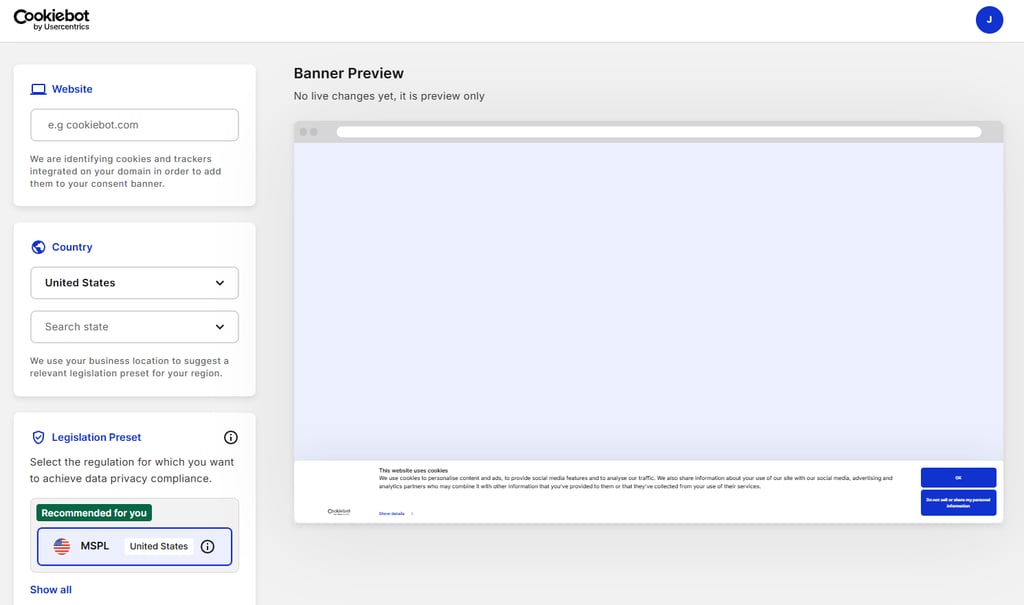
Bear in mind that Cookiebot is the plug-and-play option, built for small and medium-sized stores that want automated compliance without a heavy setup. Larger organizations that need enterprise features like A/B testing, cross-device consent sharing, API-based configuration, and advanced analytics will be redirected by Cookiebot to Usercentrics Web CMP.
2. OneTrust – enterprise privacy workflows for multinational retailers

| Starting price: | Custom pricing |
| Free plan/trial: | ❌ No, demo on request only |
| Best for: | High-volume enterprise retailers and multinational brands |
| Main eCommerce strength: | Global regulatory database and cross-channel consent |
OneTrust is an excellent fit for many large eCommerce brands, multi-market retailers, and other organizations with established legal and compliance teams. It handles comprehensive legal governance across multinational storefronts extremely well.
OneTrust goes beyond website banners by linking cookie selections to internal privacy operations. This includes vendor risk assessments, automated consumer rights management, and data mapping.
One of its best features is its comprehensive compliance coverage. It automatically tracks more than 800 global privacy and data laws like CCPA, GDPR, and LGPD.
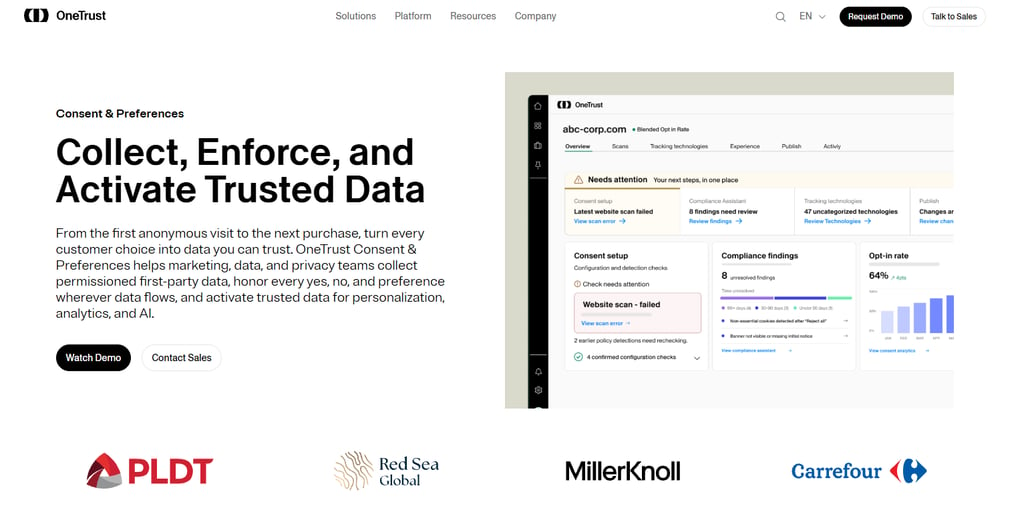
OneTrust excels at managing consent across domains and channels. It lets enterprise merchants synchronize consent across mobile shopping apps, progressive web apps, and desktop storefronts. It also integrates consent telemetry with enterprise marketing clouds like Salesforce and Adobe Experience Platform, helping you maintain customer data integrity across millions of user sessions.
Its primary flaw is that it’s overkill for basic needs. It’s too complex and has a steep learning curve, mainly because it’s not designed for small or medium businesses, and even some larger ones. It’s not for companies that mainly focus on website consent and tag control.
3. Termly – straightforward consent and policy tools for small stores

| Starting price: | From $10.00/month |
| Free plan/trial: | ✅ Yes, free plan with 1 site and 10,000 monthly cookie banner views |
| Best for: | Independent Shopify, Wix, and Squarespace stores |
| Main eCommerce strength: | Combined cookie consent and automated policy generators |
Termly is a top practical choice for small stores, startups, and non-technical teams, especially if they need cookie consent and policy generation in a single, simple package.
What sets this tool apart and makes it one of the best CMPs for Shopify is its bundled legal documentation toolkit. Beyond a compliant cookie banner, Termly generates legally sound privacy policies and terms of service tailored for online shops.
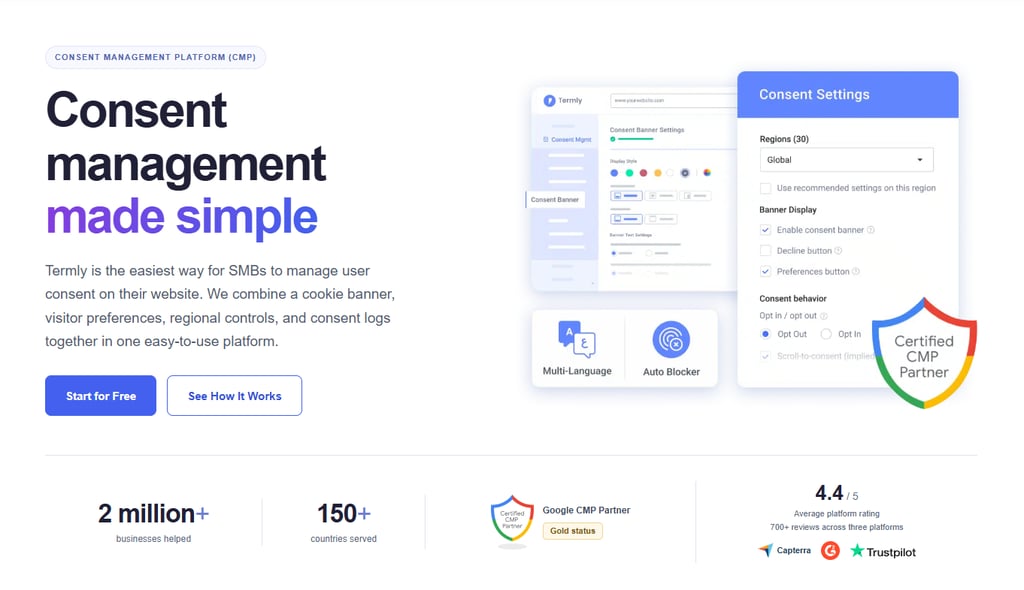
The best part is that you only need a few minutes to install Termly on platforms like Shopify and WooCommerce. Its scanner automatically categorizes tracking scripts, and the banner adapts smoothly to mobile screens.
This works best for smaller shops and standard businesses. It’s less suited for complex, multi-brand, or highly customized eCommerce companies.
4. Usercentrics – flexible consent controls for growing international stores

| Starting price: | From $8.00/month |
| Free plan/trial: | ✅ Yes, free plan with up to 1,000 sessions; 14-day free trial |
| Best for: | Fast-growing brands focused on consent opt-in rates |
| Main eCommerce strength: | Built-in A/B testing for opt-in rate optimization |
Usercentrics is a good option for eCommerce teams that need scalable consent handling across multiple regions. However, it excels if your organization focuses heavily on consent rate optimization, which is why data-driven eCommerce marketers favor it.
Usercentrics is Cookiebot’s parent company, built for larger, more complex organizations that need deeper governance and customization than Cookiebot’s SMB-focused platform provides.
If your organization needs more robust customization, reporting, and optimization than most lighter tools offer, Usercentrics is a strong choice.
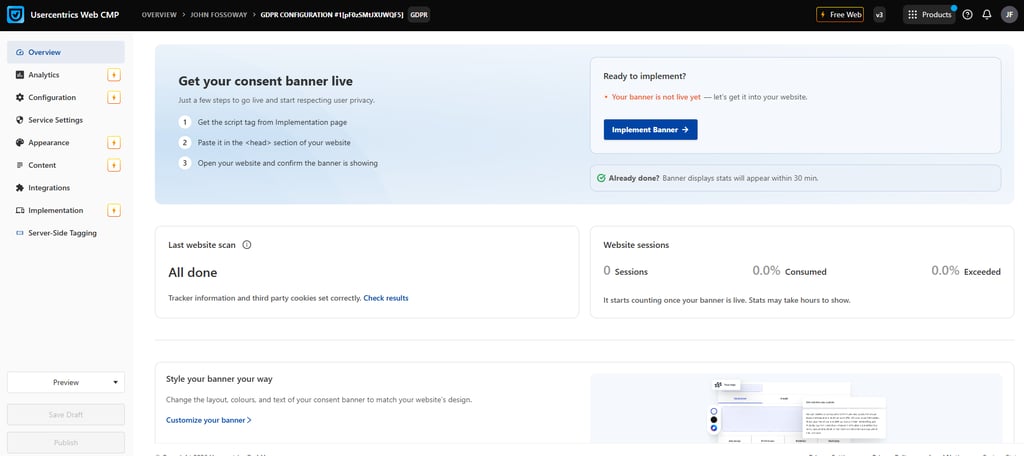
The platform can recognize that lost consent means degraded ad retargeting and blind spots in analytics. It solves this by giving you built-in A/B testing tools that let you test banner layouts, color palettes, and button placements, among other things.
Its main drawback is that it requires more hands-on technical coordination than other tools, making it best suited to mid-market and enterprise teams
5. iubenda – bundled legal document and consent management

| Starting price: | From $5.99/month |
| Free plan/trial: | ✅ Yes, free plan available; 14-day money-back guarantee |
| Best for: | Cross-border European merchants and agencies |
| Main eCommerce strength: | Auto-updating legal policies in multiple languages |
iubenda offers a cost-effective compliance package tailored specifically to European and cross-border retailers. It’s a strong fit for eCommerce companies that need consent management and legal document support from a single vendor.
Its defining feature is a lawyer-crafted policy engine that generates policies in multiple languages. When international privacy frameworks change, iubenda automatically updates your store documents.
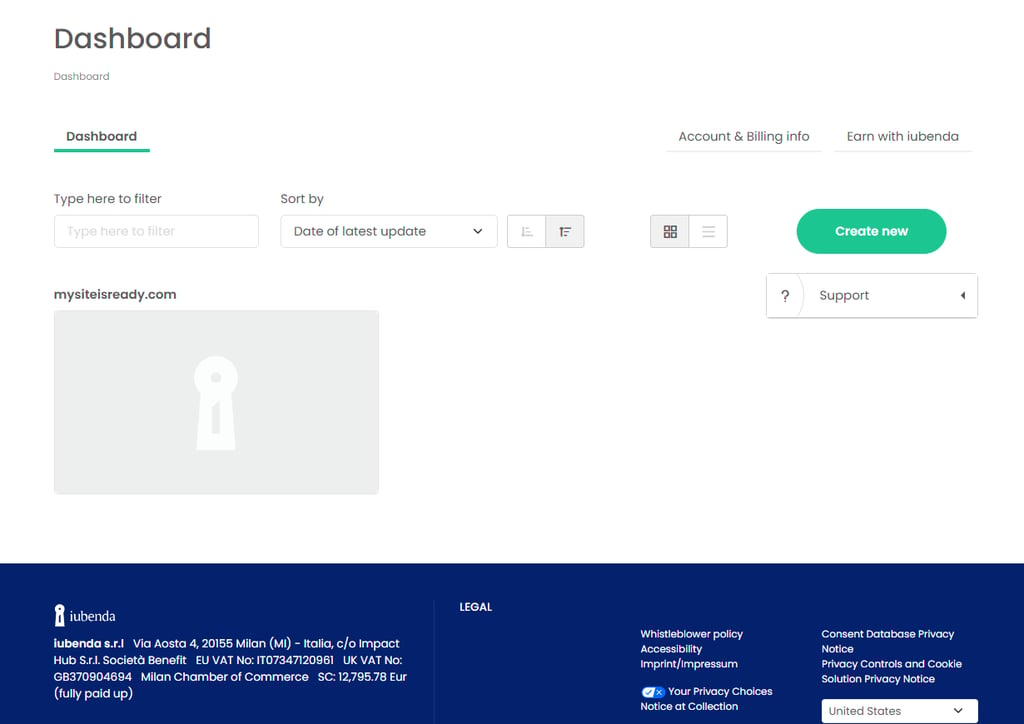
iubenda also includes prior script blocking and customizable banners. It’s fully compatible with Google Consent Mode v2 and integrates with popular eCommerce platforms through a WordPress plugin and Magento extension.
Unfortunately, advanced technical teams may find tag orchestration less flexible than in other tools, and they may need deeper integrations and more granular enterprise controls. The configuration dashboard may also feel fragmented because it uses a modular design, so you have to switch between separate tool views.
Consent management platform comparison
If you’re unsure which eCommerce cookie consent tool is best for your business, the table below can help you compare them side by side. I’ve compiled key data on my top 5 picks, including pricing, best fit, and notable limitations, to help you narrow your choice and find the solution that meets your needs.
| Provider | Best for | Key eCommerce strength | Notable limitation | Shopify or CMS friendliness | Ideal company size | Price |
| Cookiebot | Growth-focused online retailers | Automated script discovery and prior consent blocking | Domain-based pricing | Native Shopify app, WooCommerce plugin | Small to mid-sized | From $10.00/month |
| OneTrust | Multinational enterprise brands | Cross-channel consent orchestration | Extreme complexity | Enterprise connectors, custom setup | Large enterprise | Custom pricing |
| Termly | Non-technical stores | Integrated legal policies with a cookie banner | No advanced consent optimization | Simple code snippet and standard Shopify app | Startups and small businesses | From $10.00/month |
| Usercentrics | Multi-region scaling stores | Built-in A/B testing for opt-in rate optimization | A/B testing and full brand customization are only available on higher plans | Shopify integration plus web, mobile and CTV SDKs | Mid-market to enterprise | From $8.00/month |
| iubenda | European cross-border merchants | Lawyer-backed policy generator with multi-language sync | Fragmented dashboard navigation | Direct WooCommerce, Shopify, Magento plugins | Small to mid-sized | From $5.99/month |

How to choose the best CMP for an eCommerce store
Choosing the right CMP means aligning your tech stack with international privacy requirements. You have to verify how a platform interacts with ad networks, tag managers, and checkout scripts. To help you make an objective selection, here’s what I’ve evaluated:
- Google Consent Mode v2 support (25%). The CMP should always transmit standardized consent signals to Google Tag Manager automatically, which ensures your Google Ads and Google Analytics properties can model conversions for unconsented traffic.
- Prior consent automation (25%). Under EU data laws, non-essential scripts shouldn’t execute before a customer accepts them. The tool should automatically scan and quarantine third-party tags without requiring complex manual tag triggers.
- eCommerce platform compatibility (20%). The tool should have plug-and-play integrations for Shopify, WooCommerce, Magento, and BigCommerce. It should load fast to prevent layout changes and cart abandonment.
- Multi-jurisdiction geo-targeting (20%). A good CMP detects user location and switches between opt-in (GDPR) and opt-out (US state laws) automatically.
- Pricing predictability (10%). Review the pricing of the tool. Does it scale with the number of URLs, monthly sessions, or domains? You need to know this, especially if you have deep catalog filters, where the price can surge as inventory grows.
CMP vs basic cookie banner for eCommerce
A cookie banner is only a cosmetic notification layer that informs you about the site’s cookies. It doesn’t stop trackers from activating in the background as soon as a user lands on the page.
A true CMP is the gatekeeper between the shop’s code and third-party scripts. It handles scanning, consent logic, storage, audit readiness, and integration with the marketing stack.
This distinction matters most for online stores that use analytics, personalization tools, ad pixels, and other third-party scripts. If you have them and use a basic banner, nothing can control the scripts, and your business becomes exposed under GDPR. Moreover, you don’t get conversion data in Google Ads.
Bottom line
Choosing the right tool for consent management for online shops can protect your site from severe regulatory fines while preserving essential marketing attribution.
Large multinational retailers can benefit from OneTrust's deep governance workflows, while non-technical stores can get set up quickly with Termly or iubenda. Fast-growing brands can use Usercentrics to improve opt-in rates through layout testing.
For most merchants, the best choice is Cookiebot. Its patented scanner automatically quarantines marketing scripts, while native Google Consent Mode v2 supports consent-aware measurement when correctly configured. It balances rigorous compliance, easy installation, and reliable marketing measurement.
FAQ
What is the best consent management platform for eCommerce?
Cookiebot is the overall best CMP for online shops. It offers automated monthly cookie scanning, reliable prior consent script blocking, full Google Consent Mode v2 support, and native Shopify and WooCommerce apps.
Do eCommerce stores need more than a cookie banner?
Yes, eCommerce stores need a full consent management platform. Basic banners only display a notice, while a CMP actively blocks tracking scripts until consent is given. This ensures the shop passes the necessary signals to Google Consent Mode v2.
Which CMP is best for Shopify stores?
Cookiebot is one of the best CMPs for Shopify stores. It has a dedicated Shopify App Store integration that deploys in mere minutes and categorizes store apps automatically.
What should an online store look for in a consent management platform?
It should look for Google Consent Mode v2 support, pre-consent script blocking, geolocation and multi-region rules, eCommerce stack integrations, and continuous cookie scanning.
Does a CMP affect analytics and ad tracking?
Yes, a CMP directly controls tracking scripts. When a visitor declines cookies, the CMP blocks tracking pixels. However, if the CMP is certified for Google Consent Mode v2, it can recover conversion modeling through cookieless pings.