Every law enforcement data request crosses his desk: Microsoft’s Barbosa speaks on global data battle
There were 27k+ of them in just 6 months.

Microsoft headquarters in Redmond. By Shutterstock

 Follow us
- Microsoft received 27,412 law enforcement data requests between July and December 2025, rejecting 20% entirely.
- Microsoft handed over emails, photos, or documents from consumer accounts in 5% of cases.
- Barbosa said Microsoft gives no government direct access to customer data or its data centers.
- Newman said US law has no standing kill switch to cut off global technology access.
Key Takeaways by nexos.ai, reviewed by Cybernews staff.
Government requests for customer data keep flying Microsoft’s way. In 5% of cases, the tech giant must comply and hand over documents, emails, and images from consumer accounts.
“My team sees every demand that comes from any other in the world,” Norman Barbosa, Vice President and Deputy General Counsel for Global Affairs, Law Enforcement and National Security at Microsoft, told a room full of journalists in Dublin.
Together with David A. Newman, Partner and Co-Chair of the National Security and Crisis Management Practice at the global law firm Morrison & Foerster, he addressed the question of the kill switch – can Europe really be switched off from US technology as simply as the push of a button?
When Microsoft shared data with the US law enforcement





One of the big drivers behind Europe’s push for tech sovereignty is concerns over data sharing. Microsoft has more than once found itself accused of acting on the US government’s behalf.
In May, for example, it was accused of leaking the data of civil servants working for the Netherlands' regulatory agencies to the US House of Representatives.
Numerous countries, including major economies like Germany and France, have replaced Microsoft software with local, open-source alternatives. Meanwhile, Microsoft repeatedly tries to reassure users that its allegiance is with its customers only.
It says it supports Europe’s sovereignty push and can help the continent become independent from the US (while working with Microsoft).
“Whether a demand is based on criminal law or national security, we apply the same principles and the same promises to our customers. We don't provide any government with direct access to our customer data. No government equipment is ever allowed in our data centers. [...] We did not provide any government with the ability to break our encryption or our platform encryption switch,” Barbosa said.
Data in transit is encrypted, so it can’t be intercepted.
However, there have been reports of Microsoft sharing data encryption keys with the FBI.
Governments, he explained, have to be very specific about what evidence they need.
When we see a problem with an order, we’re not afraid to go to court. Microsoft has a strong track record in doing that,Norman Barbosa said.
Between July and December 2025, Microsoft received 27,412 law enforcement requests for data. As you can see from Microsoft’s chart, only 20% of these requests were completely rejected.
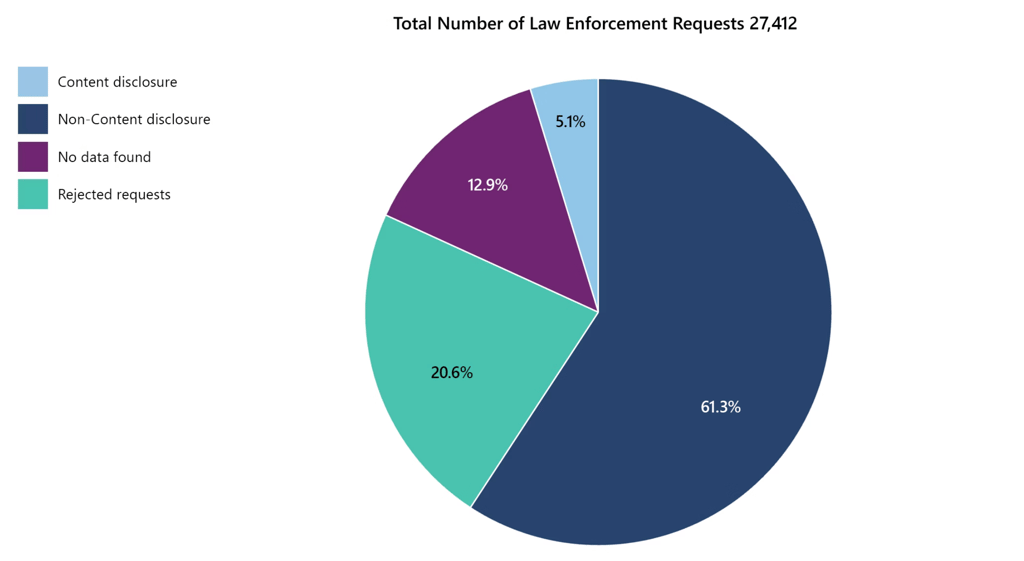
Over 60% of the cases involved non-content disclosure, which means that Microsoft shared “basic subscriber information”: email address, name, state, country, ZIP code, and IP address at the time of registration. It could also include such information as IP connection history and billing information, among other things.
In 5% of cases, Microsoft handed user content over to law enforcement. By its own definition, this could entail emails, photographs, and documents.
Beef with the ICC
Microsoft has also attracted criticism when it reportedly blocked the email of the International Criminal Court (ICC) Chief Prosecutor Karim Khan in 2025, after the US imposed sanctions on him.
Microsoft denied the allegations, and yet, the whole incident further spurred fears that Donald Trump could trigger a so-called kill switch. The ICC has since moved from Microsoft to a European alternative, openDesk.
“There simply is no standing kill switch under US law that allows the US government to turn on and off access to technology anywhere in the world. The United States government, like governments across the world, has the legal authority to impose sanctions, to impose export controls and other economic countermeasures,” Newman noted.
Those measures, he emphasized, have been “focused overwhelmingly on actions against US adversaries.”
“The US government, across administrations, has had powerful reasons not to repurpose those countermeasures to cut off existing access to advanced technology by US partners. For those of us who work in this space, it is very clear that any effort to do so would raise fundamental legal and policy questions of first impression under US law, and would assuredly end up in the courts, if such efforts were tried,” Newman said.