TikTok showdown with White House showcases Chinese-owned app's controversial history
After weeks of anticipation, CEO Shou Chew takes the stand on Capitol Hill to defend the video app's data privacy policies, as lawmakers rally for a ban to become nationwide.

Reuters/Shutterstock

 Follow us
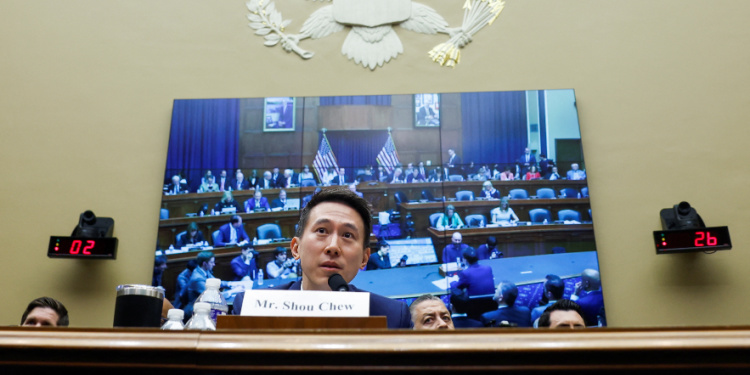
TikTok's future in the US hangs in the balance amid data security and privacy concerns over China and outrage at its child content policies. After weeks of anticipation, its CEO, Shou Chew, took the stand on Capitol Hill to defend the video app as lawmakers rally for a ban to become nationwide.
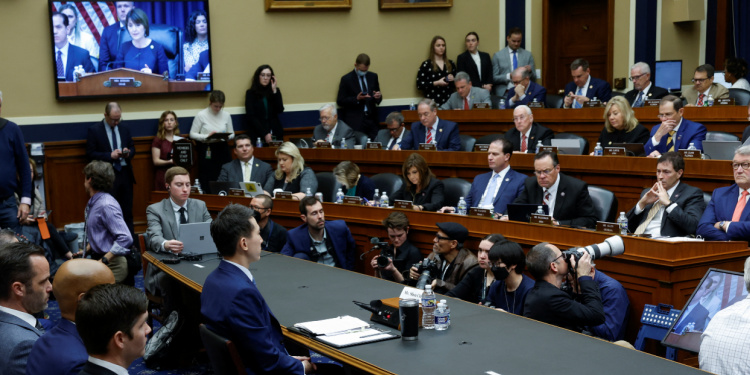
House Energy and Commerce Committee Chair Cathy McMorris Rodgers led the charge Thursday, kicking off the widely anticipated testimony from Chew.
Lawmakers grilled the CEO on not only the app's invasive data collection practices, but the platform's impact on teens, children, and its relationship with the Chinese Communist Party (CCP).
The hearing was titled "TikTok: How Congress Can Safeguard American Data Privacy and Protect Children from Online Harms,” and it is Chew’s first appearance before a congressional committee.
After five hours of intense questioning, the drama seemed to end with lawmakers digging their heels in even harder against the video-sharing platform.




One commented that Chew was a "good dancer with words" and accused the CEO of avoiding tough questions on the evidence presented by the committee.
Another representative asked Chew point blank if ByteDance had ever spied on Americans at Beijing's request.
Chew’s answer – a resounding "no."
The day begins
The day began with Chew releasing a 10-page written copy of his planned testimony before the hearing, to lay out his talking points.
Chew said he welcomed the chance to update lawmakers about TikTok’s “efforts to develop cutting-edge, multi-pronged initiatives to address national security concerns.”
“TikTok has empowered millions of Americans to express their voices in their own authentic way and has provided a global stage for their creativity in a way that cannot be replicated on any other platform or in any other medium,” Chew pointed out in his testimony.
More than 150 million people in the United States use TikTok on a monthly basis according to recent numbers.
In her opening remarks, Chair McMorris Rodgers, a Republican who publicly supports the ban, addressed the room. "TikTok collects nearly every data point imaginable - from people's location to what they type and copy, who they talk to, to biometric data and more," she said.
"We do not trust TikTok will ever embrace American values - values for freedom, human rights and innovation," and added that the CCP "is able to use [TikTok] as a tool to manipulate America as a whole," she said.
It's all about the data
US lawmakers have been alarmed by the massive amount of personal data ByteDance, the company that owns TikTok, has been collecting on the millions of Americans who use the app.
There are worries that the Chinese government could force ByteDance to hand over the sensitive data posing a threat to national security, something Chew vehemently denied throughout the hearing.
As questions began to fly at the CEO, Chew defended TikTok staunchly, pointing to everything it has done in the past two years to appease the US government.
"We do not promote or remove content at the request of the Chinese government," Chew said.
"It is our commitment to this committee and all our users that we will keep [TikTok] free from any manipulation by any government," he said.
Last week, President Joe Biden pressed ByteDance to sell its 50% stake in TikTok to an American buyer as a good-faith solution to wrest control of the company from the Communist regime.
When questioned about the possibility of divestiture, Chew responded that the issue was "not about the ownership," but where TikTok’s collected data is being stored.
TikTok has built "what amounts to a firewall to seal off protected US user data from unauthorized foreign access. Only vetted personnel operating in a new company, called TikTok US Data Security, can control access to this data," Chew explained.
“The bottom line is this: American data stored on American soil, by an American company, overseen by American personnel," said Chew.
TikTok has said it has spent more than $1.5 billion on what it calls rigorous data security efforts under the name "Project Texas."
Of TikTok's seven thousand US full-time employees, about 1,500 are contracted with cloud platform Oracle to store the data of American users on US soil.
Responding to the proceedings, China’s Ministry of Commerce said it would oppose the forced sale of TikTok assets in the US. "Forcing the sale of TikTok will seriously damage the confidence of investors from all over the world, including China, to invest in the United States," it said. "If the news is true, China will firmly oppose it."
Chinese spy games
A contentious exchange between Republican Congressman Neal Dunn from Florida and Chew about spying was in full swing by the second part of the day.
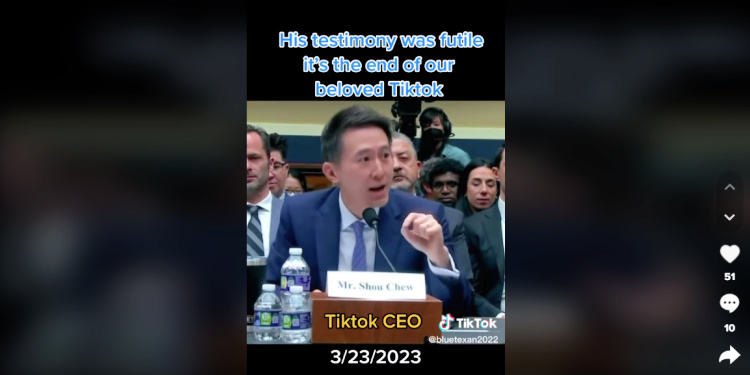
Dunn pressed Chew about US media reports that ByteDance employees based in China were planning to use the app to track the locations of certain US citizens.
"I don't think that spying is the right way to describe it," Chew said.
While trying to describe the situation as an "internal investigation," he was cut off by Dunn, who called TikTok's widespread use "a cancer."
Director of US Federal Bureau of Investigation (FBI) Christopher Wray spoke out about his security concerns at a Senate intelligence meeting earlier this month.
"This is a tool that is ultimately within the control of the Chinese government – and it, to me, it screams out with national security concerns," Wray said.
The FBI Chief said if given access, the Chinese government could use TikTok to control software on millions of devices and drive campaigns of disinformation to millions of unsuspecting Americans.
“The difference between the public sector and the private sector – that’s a line that is non-existent in the way the CCP operates,” Wray said.
TikTok was even slammed by privacy rights groups for introducing a dubious feature on the app last October called Focused View.
The feature is said to track a user's emotional reaction while watching certain advertisements on the app, by monitoring facial expressions and other biometrics, such as eye-movements and heart rate.
It's all about the children
During the first half of Thursday’s testimony, congresswoman Diana DeGette from Colorado questioned Chew on what TikTok was doing to prevent the spread of misinformation on the platform.
Chew told Congress that TikTok rigorously screens content that could harm children, a sticking point for many of the lawmakers.
He went on to explain that TikTok was investing in content moderation and artificial intelligence to limit such content.
"You have current controls, but the current controls are not working to keep this information mainly from young people, but [also] from Americans in general," Rep. DeGette said.
"The vast majority of our users come to our platform for entertaining safe content, but there are people who do spout some dangerous misinformation and we need to take that very seriously," Chew said.
DeGette said she was disappointed with what the company had done so far.
"You gave me only generalized statements that you're investing, that you're concerned, that you're doing work. That's not enough for me. That's not enough for the parents of America," Rep. DeGette shot back.
Rep. Bob Latta, a Republican from Ohio, took his turn at the mic to confront Chew about the dangers of user content that can harm children, such as viral TikTok challenges that turn deadly.
Latta brought up a case involving a 10-year old girl who suffocated herself after attempting a so-called "blackout challenge" she saw posted on the app.
Another Republican, Rep. Gus Bilirakis from Florida, played the committee a compilation of short TikTok videos that appeared to glorify self-harm and suicide, or outright tell viewers to kill themselves.
"Your technology is literally leading to death. We must save our children from big tech companies like yours, who continue to abuse and manipulate them for your own gain," Rep. Bilirakis said.
"As a father myself, when I hear about the tragic deaths, its heartbreaking," said Chew. TikTok takes the issue of suicide and self-harm "very, very seriously," he said.
Latta argued that TikTok should be held accountable for the content created by its users, but instead is protected by Section 230 of the Communications Decency Act of 1996, a law that gives immunity to online platforms in these cases.
Recently, TikTok has rolled out more parental-control tools and said the company is currently developing a feature to allow parents to block videos on the app that contain specific words or hashtags.
Supporters unite
Chew called many of the subjects raised in the hearing "complex" issues that all social media platforms are trying to navigate.
Wednesday, lawmakers opposing the ban led a rally on the steps of Capitol Hill with dozens of TikTok creators to voice their support for the app.
Representative Jamaal Bowman from New York called for broad-based privacy legislation that would address all big tech platforms.
"Why the hysteria and the panic and the targeting of TikTok?" Rep. Bowman asked. "Let's do the right thing here - comprehensive social media reform as it relates to privacy and security."
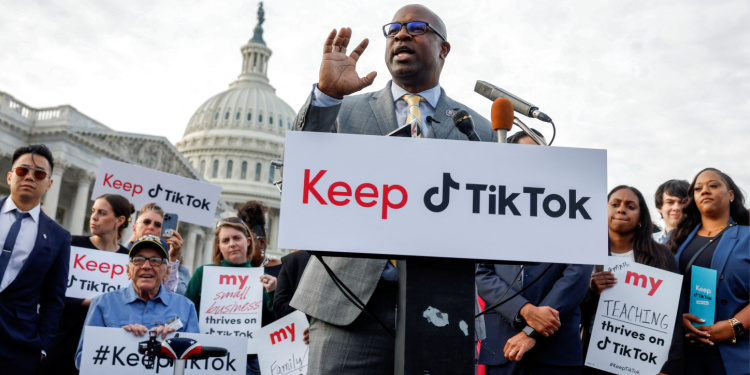
"I am asking our politicians – don't take away the community that we've all built – a community that lasts, that loves," said one TikTok creator at the gathering.
Chew also took to his own app this week, posting a personal video message to drum up support from loyal TikTok users.
Challenges await
Meanwhile, legal experts say any move to push a TikTok ban through the White House will face a multitude of challenges.
And that’s besides a public backlash that could come from the five million US businesses on the app – many of them small and medium sized – that depend on TikTok posts for advertising and promotions.
Earlier this month, both the Congress and Senate introduced new legislation that if passed could help lawmakers enact the ban.
The Senate’s RESTRICT Act, if passed, would give the Commerce Secretary the power to ban TikTok and other foreign-based technologies threatening national security.
The House also voted on legislation in March that would give President Biden the ability to ban the app.
In 2020, the then president Donald Trump enthusiastically tried to enact legislation banning TikTok, but failed when the courts struck down the executive order based on free-speech protections.
Trump's bid would have granted the Commerce Department similar authorities to the RESTRICT Act, a move deemed necessary as a precursor to the ban, according to experts.
"Realistically, I don't see this tool coming into play until 2024," said Nicholas Klein, an attorney with global law firm DLA Piper and who has advised on national security cases before the US Committee on Foreign Investment in the past.
"And there will most likely be a legal challenge if its used to ban TikTok," Klein said.
The White House already passed a law in December banning TikTok from all federal devices – giving employees a March 28 deadline to do so.
About half of the nation's fifty state governments have also banned use of the app in the past year, along with many educational institutions across the country.
Chew, who was born and raised in Singapore, took on the role of TikTok CEO in 2021. Before that he worked as chief financial officer for Chinese consumer electronics giant Xaomi.
Chew, 40, is married with two children he does not allow on TikTok because “they are too young.”