Onslaught of Linux kernel bugs forces cyber pros to rethink security boundaries
Malware trapped in Docker or other containers now has no shortage of Linux kernel vulnerabilities to pave its escape route.

Image by Cybernews.

 Follow us
- XBOW’s AI system found a high-severity Linux kernel flaw that can let some users gain root privileges.
- The bug affects SMC-D code that now runs on ordinary x86 Linux machines through loopback connections.
- Researchers warn malware inside privileged containers could use kernel flaws to compromise the host.
- Experts suggest running untrusted workloads in microVMs, which use hardware virtualization for stronger isolation.
Key Takeaways by nexos.ai, reviewed by Cybernews staff.
An AI agent picks up a seemingly irrelevant Linux kernel bug that human reviewers had overlooked, and shazam, it’s a privilege-escalation vulnerability. The bug is just the latest one in a growing pile of Linux kernel flaws unveiled this year, as security researchers warn that containers shouldn’t be treated as an isolation boundary.
Security researchers at XBOW, an autonomous offensive security platform, discovered a high-severity vulnerability in the “Linux kernel code that human researchers had largely overlooked.”
Any unprivileged user with access to system-wide network administration capabilities (CAP_NET_ADMIN) can gain root privileges.
For human code reviewers, the primitive looked too weak to matter.






“But it wasn’t,” the report reads.
“A 16-byte write became root.”
An autonomous, AI-powered system handled most of the threat modeling, code auditing, vulnerability discovery, validation, and up to exploit development.
The vulnerable code was in SMC-D, an IBM Z mainframe code, which lets virtual machines communicate directly over shared memory. Historically, SMC-D could not run on a typical x86 system, and only a few people scrutinized the code. However, recent Linux kernels restructured SMC-D on top of an abstraction called DIBS (Direct Internal Buffer Sharing), and introduced a virtual device called dibs_loopback.



Stay updated with our latest stories and follow us on social media
Be the first to discover new stories, ideas, and updates from our team.
“Because of that device, the relevant kernel paths now run on any ordinary x86 Linux machine, reached by opening an SMC-D connection over loopback,” the report explains.
The bug, tracked as CVE-2026-72018, received a severity rating of 7.8 out of 10 and was patched in July. The researchers held back the technical details.
Many privileged containers require network administration capabilities, meaning that, in theory, malware running in such a container could leverage the vulnerability and compromise the entire host and all its tenants.
Researchers repeat the warning: containers are not a security boundary
Just a week ago, Depthfirst, an AI-powered security company, issued a warning that “Containers are no longer a security boundary.” AI redraws the security landscape – since the start of the year, 5,976 unique vulnerabilities in the Linux Kernel have been published.
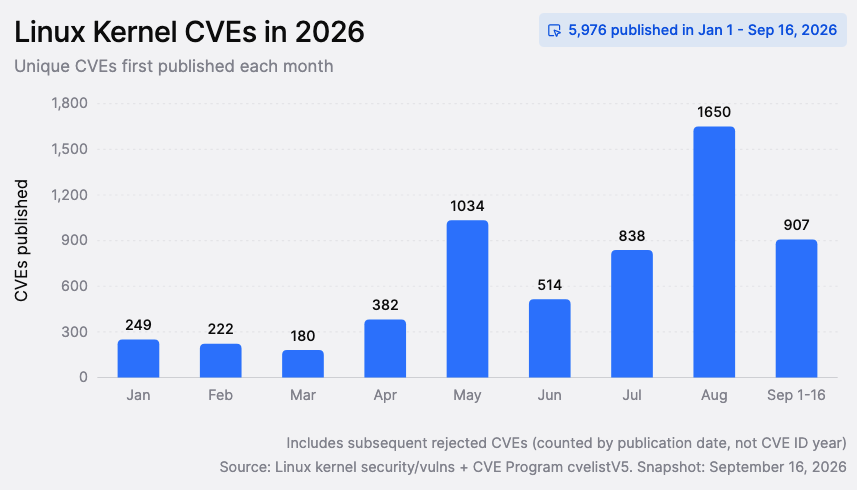
“The escalation is staggering,” the report reads.
“Major Linux distributions are lagging significantly in backporting patches. There is a massive backlog of unpatched bugs in production systems, and we have no idea what new zero-days will be disclosed tomorrow.”
The report further explains that containers, despite all the isolation measures and defenses, still share a single kernel with the host operating system.
Copy Fail, Dirty Frag, and Fragnesia are just a few names of Linux kernel bugs discovered in 2026.
Attackers with access to a single container can exploit kernel vulnerabilities to elevate privileges to root, completely bypassing any isolation. This essentially gives control over the host machine and access to other containers.

Check if your data was exposed
Find out if your email and related personal information have appeared in known data breaches.
“Containers are not a safe security boundary anymore. The industry’s long-standing reliance on the Linux kernel as a strong security boundary has been completely dismantled by the rapid advancement of AI,” the report warns.
Depthfirst itself, in August, unveiled a kernel vulnerability, CVE-2026-80521, which enables attackers to escape containers and other unprivileged interfaces.
“As of today, it is still unpatched in the latest Ubuntu 26.04 release,” the company said last week.
“With frontier AI models now capable of one-shotting exploit generation, attackers with little resources can easily develop one-day exploits for these unpatched systems the moment a bug is disclosed.”
The report suggests that administrators must pivot away from containerized environments dependent on a shared kernel. Researchers suggested migrating untrusted workloads to microVMs that use hardware virtualization features, such as Firecracker or Kata Containers.
Cybersecurity engineer and YouTuber Ed Woodruff, known as Low Level, explained that virtual machines provide a stronger isolation boundary. While they’re not invulnerable, hypervisors have a smaller attack surface that might make isolation escapes less likely than with the large Linux kernel.
“Just to be clear, people are doing this. Hyunwoo Kim has found not 1, not 2, but 4 different vulnerabilities in KVM, one of them giving him a bounty for kvmCTF,” Low Level noted in a recent video.
The researcher argues that the Linux kernel contains orders of magnitude more vulnerabilities.
Cybernews previously reported on a critical bug in KVM, a Linux virtualization technology that powers most of the cloud. The researcher earned a $250,000 bug bounty for its discovery.