Popular games on Google Play contain trackers from Russia, China, and Israel, study finds
The mobile gaming industry is built on an insidious surveillance network, Proton says.

Image by Shutterstock.

 Follow us
- Proton found 81 of the top 100 free Android games in the US share user data with Chinese companies.
- Seventy-one of the games also send data to Russia, and 95 send data to Israel.
- The average game contained 29 trackers, and seven games actively tracked user location.
- Proton advises users to use an ad blocker that can make tracking and ad domains unreachable.
Key Takeaways by nexos.ai, reviewed by Cybernews staff.
Most popular free games on the Google Play Store contain multiple trackers, and many of them actively share user data with Russia and China, a study by Proton has revealed.
Proton, a Swiss technology company, analyzed the 100 most-downloaded Android mobile games in the US and found that 95 of them send data to Israel, 81 share user data with China, and 71 also share data with Russia.
Nearly all of the games, 98 out of 100, also send data to entities in Five Eyes countries (the US, the UK, Canada, Australia, and New Zealand).
“Most American mobile gamers would likely be alarmed to learn their location data may be accessible not just to advertisers, but also to US government agencies,” a research by Proton reads.






Seven of the games are actively tracking user geolocation. One of them, Pokémon Go, has a legitimate reason to do this – its core mechanic depends on location. However, puzzle or coloring games were also found to be accessing location data.
On average, one game had 29 trackers embedded, collecting a “considerable chunk” of user personal data.
The researchers noted that the most popular games have collectively been downloaded nearly 20 billion times globally.
In just one month, the 10 most popular games in the US have been downloaded 20 million times, and nearly 16 million of these downloads are actively sharing data with Chinese companies, while nearly 14 million beam data to Russia.
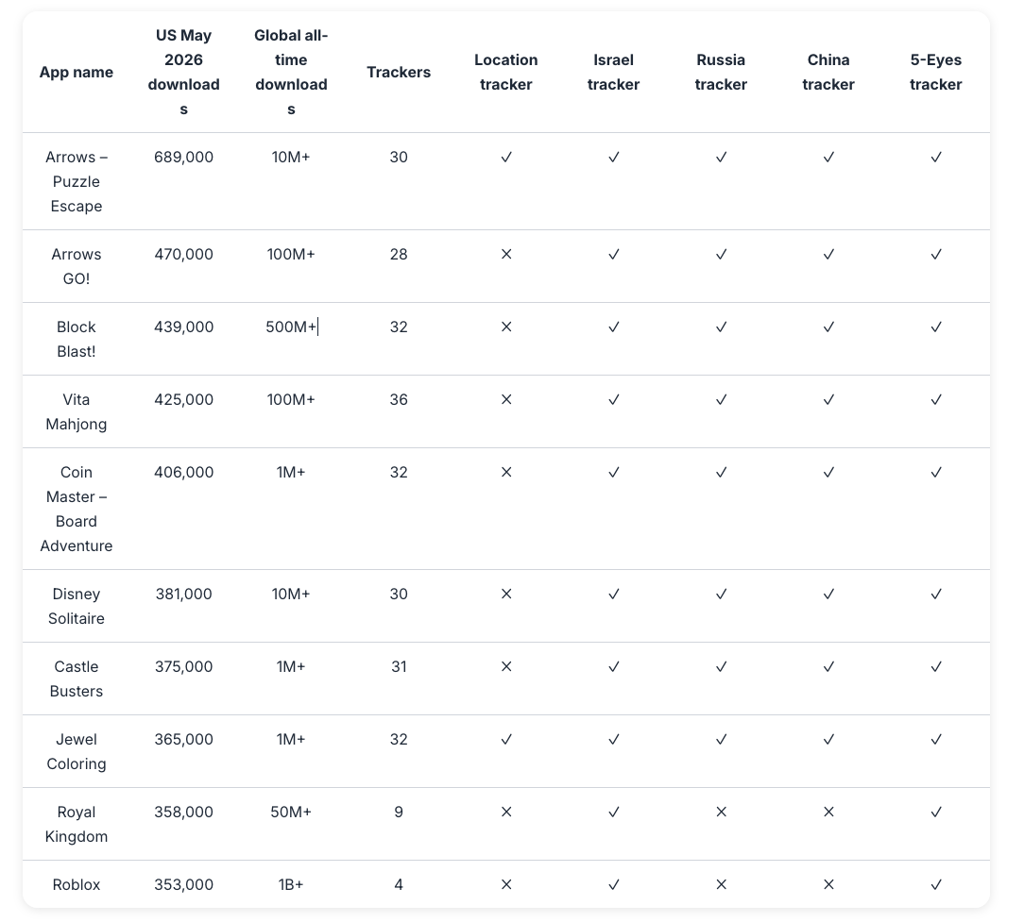
“While most gamers understand this monetization model, they are unlikely to grasp the sheer scale and intrusiveness of the tracking performed, or that their data … ends up in China, Russia, and Israel,” Proton researchers said.
The situation is similar in other countries – most of the top games in the UK, Germany, and France were also found to share data with entities in Five Eyes countries, Israel, Russia, and China.
The Cybernews community is talking about this. Be a part of the conversation.
The researchers warn that this is unlikely to change anytime soon – tech and data-broker networks power the entire free-to-play ecosystem, and people are unwilling to pay upfront for the games they play on the smartphone.



Stay updated with our latest stories and follow us on social media
Be the first to discover new stories, ideas, and updates from our team.
“The mobile gaming industry is built on an insidious surveillance network with extraordinary reach into the daily lives of hundreds of millions of people — all with very little transparency and no meaningful oversight,” the report concludes.
To protect themselves, users are advised to use an adblocker that filters DNS requests, making tracking and advertising domains unreachable.