What sovereignty? Internet traffic of millions of Europeans flows through Chinese routers
Despite Europe stepping up its efforts to achieve its digital sovereignty, most of the continent’s internet traffic flows through Chinese-made routers, putting Europeans at risk of cyber espionage.
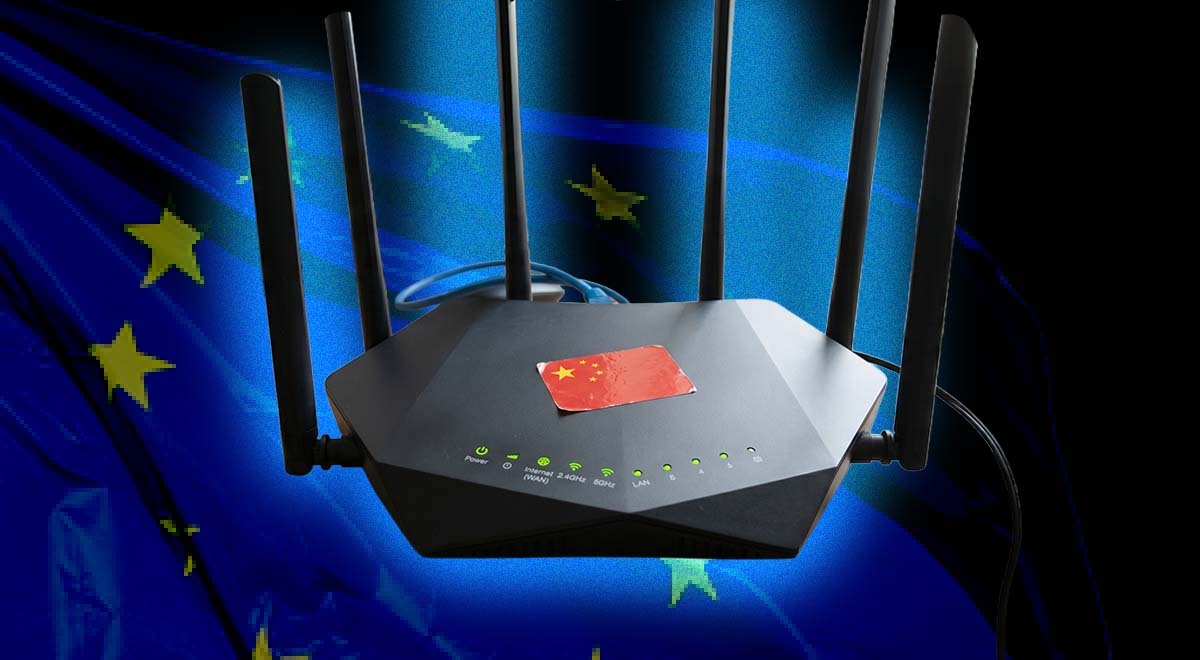
Image by Cybernews

 Follow us
Despite Europe stepping up its efforts to achieve its digital sovereignty, a lot of the continent’s internet traffic flows through Chinese-made routers, putting Europeans at risk of cyber espionage.
- A new study has found that Chinese manufacturers account for 37% of home networking devices in the EU.
- This exposes users to the risks of cyber espionage and of having their devices turned into botnets.
- There’s currently no EU framework that would address the vast dependence on Chinese routers.
The European Union (EU) lacks a sovereignty framework to address dangerous dependence on China-made routers, according to a new study by the Sovereignty Alliance for European Network Technology (SAFENet) and Innovate Europe Foundation (IE.F).
Chinese manufacturers, such as ZTE, Huawei, TP-Link, Xiaomi, and Tenda, account for around 37% of home networking devices in the EU, which gives them theoretical access to an estimated 95 million European households.












The study authors argue that a compromised router could open a window to the entire digital activity of a household or business,
This raises the risk of data interception at the firmware level, which could potentially affect even encrypted communications.
Moreover, compromised routers can be hijacked to form botnets, which are networks of internet-connected devices, controlled remotely by hackers. They can be used to commit scams or cyberattacks.
The study also emphasizes the risk of legal exposure, as China’s National Intelligence Law requires companies to assist and cooperate with national intelligence work.
The Cybernews community is talking about this. Be a part of the conversation.
This has long fueled concerns over Chinese technologies being used to spy on foreign nationals and companies. For example, the EU is working to phase out Huawei and Chinese companies from its 5G networks and other critical infrastructure.
Cyber agencies from 16 countries, including the US and the UK, have recently warned that China-linked hackers are hijacking home routers and smart devices to build covert networks that hide cyberattacks targeting critical sectors globally.
Routers, regardless of where they are made, are common targets of malicious actors. Last year, for example, China-linked hackers turned 50,000 Taiwanese-made ASUS home routers into an espionage network.
Europeans want European routers
The study comes as Europeans hold a great distrust of foreign router manufacturers.
According to a YouGov survey commissioned by German electronics maker FRITZ!, 67% of Europeans are distrustful of Russian router makers, 52% of Chinese manufacturers, and 38% of American router makers.
The study authors argue that customer network devices, including routers, represent “the single most glaring gap in the EU’s digital sovereignty architecture,” and closing it is “among the lowest-friction, highest-leverage policy moves available” to the bloc.
“While Europe legislated for cloud sovereignty and semiconductor supply chains, the literal first and last hardware hop of European digital activity became a critical supply chain blind spot,” the study reads.
Unlock more exclusive Cybernews content on YouTube.