Streamers have turned Chatroulette and OmeTV into a political arena
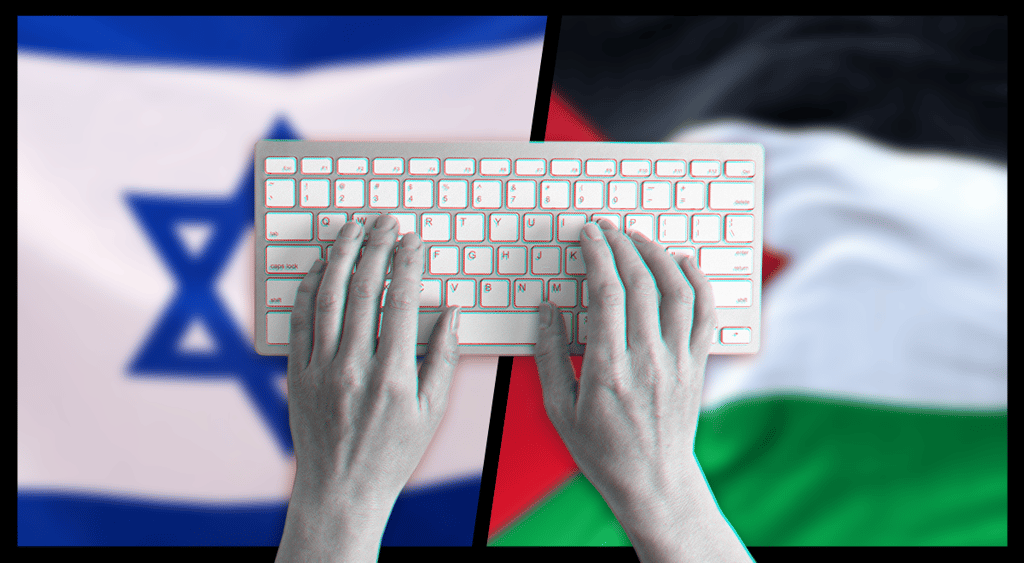
Online streamers are exploiting platforms like OmeTV and Chatroulette to “expose” the worst of their political opponents, leaving no space for real-life nuance and moderate voices.

Image by Cybernews.

 Follow us
Online streamers are exploiting platforms like OmeTV and Chatroulette to “expose” the worst of their political opponents, leaving no space for real-life nuance and moderate voices.
“We kill your babies, and it’s very funny,” a woman tells Hamzah Saadah, a Palestinian-American digital content creator with over seven million followers who connects to Israelis on OmeTV, a video chat platform.
The woman appears to be one of many Israelis cursing Saadah, sending him death threats, and celebrating the killings of Gazans. Emotions fly high in these videos, leaving the viewer shocked by violence coming from the general population.
However, if the viewer’s Instagram or TikTok algorithms take them to the accounts of Israeli streamers speaking to Muslim or Arabic users on Chatroulette-like platforms, they suddenly see a completely different picture.




“You (Jewish) are all a piece of shit,” Tal Oran, a streamer and activist, hears from a woman who identifies as Iraqi and quickly disconnects after he threatens to show the video to Swedish police.
Oran is one of the many Israeli streamers filming their confrontations with strangers that involve cursing, threats, and occasional Nazi-related signs.
When the conversation is civilized enough to discuss the state of Israel and the history of Palestine, well-articulated English-proficient streamers delve into the intricacies of history and holy books, the Quran and Torah, only to see their opponents leave the conversation.






The streamer is always a winner
Political divisions and differing realities on the same social media platforms are hardly a new phenomenon. However, streamer-stranger interactions take polarization to a new level.
Markus Kemmelmeier, a professor of sociology at the University of Nevada, notes that people engaging with streamers, who are skilled communicators, may not possess the same level of language, expertise, and historical context.
They sometimes express themselves in ways that are easily recognized as incoherent, uninformed, or racist or otherwise morally unacceptable. Meanwhile, the streamer walks away as the winner, having demonstrated the inferiority of the other side.
Kemmelmeier tells Cybernews, “This is not an open debate, where interaction partners' goal is to convince each other. It is more like a pro-wrestling match, where the outcome is fixed but where audiences love to see their own guy win.”
“A distorted picture of reality”
The videos are designed to look spontaneous and representative, but in reality, they are highly curated – streamers decide who gets featured, what questions are asked, and which clips are shared, says Naomi Levy, an associate professor of political science at Santa Clara University.
Because the exchanges feel unscripted and emotional, they come across as authentic and credible, even when they’re presenting a very narrow or distorted picture of reality. Meanwhile, careful curation highlights the most provocative answers.
“Viewers are encouraged to see entire groups through the lens of a few extreme statements, which reinforces stereotypes and an ‘us versus them’ mindset,” Levy says.
The decades-long conflict between Israelis and Palestinians escalated in 2023, when Hamas, the group controlling the Gaza Strip, launched attacks into Israel, leaving over 1,200 dead and taking 251 people hostage.
This is not an open debate, where interaction partners' goal is to convince each other. It is more like a pro-wrestling match, where the outcome is fixed but where audiences love to see their own guy win.Markus Kemmelmeier
Israel responded by launching a large-scale military campaign in the Gaza Strip, which, according to the Hamas-controlled ministry, killed over 67,000 people, and was classified as genocide by the United Nations, allegations Tel Aviv denies.
Both the Hamas attack and Israel’s military campaign caused widespread condemnation. Protests erupted across the world, leading to polarization even among those living far from the Middle East.
While there’s undoubtedly hostility between the two sides, conversations on OmeTV often fail to reflect the complex real-life nuances, even amid deadly conflict.
They don’t represent moderate voices, such as Jewish Israeli human rights organizations working to support Palestinians. Streamers rarely bother speaking to Gaza activists who criticize Hamas while also condemning Israel’s bombing campaigns.
Support, but not convince
It’s not only streamers, however, who make video chat platforms political.
Colombian-Venezuelan musical group Los Iankovers has turned to Chatroulette to spread their music. Because the band's leader, Ianko Bohdan Penfort, has Ukrainian roots, they decided to surprise Ukrainians with the country’s traditional songs.
However, the platform started connecting them with Russians, including soldiers in military attire, in now Russia-occupied Ukrainian territories, to whom the band performs while recording strangers’ reactions.
The realization that the song is Ukrainian is often met with profanity and threats, while other users quietly vanish from the conversation, based on the videos the band shares on their social media.
Ukrainians, who have lived under constant air raids since the start of a full-scale invasion in 2022, appear deeply touched, as these songs may serve as an acknowledgement of their struggle.
The Los Iankovers’ case shows that you may use video chat platforms to show support, but not to convince.
Kemmelmeier says people who view each other as being on different sides of an issue tend to hate each other, regardless of whether they know much about what the other side actually believes or wants.
He tells Cybernews, “Each side tends to have an exaggerated stereotype of the other side. And they don’t listen to each other closely because they already know that they hate each other.”
Unlock more exclusive Cybernews content on YouTube.