Chamelo Shield review: smart electrochromic sunglasses for outdoor performance

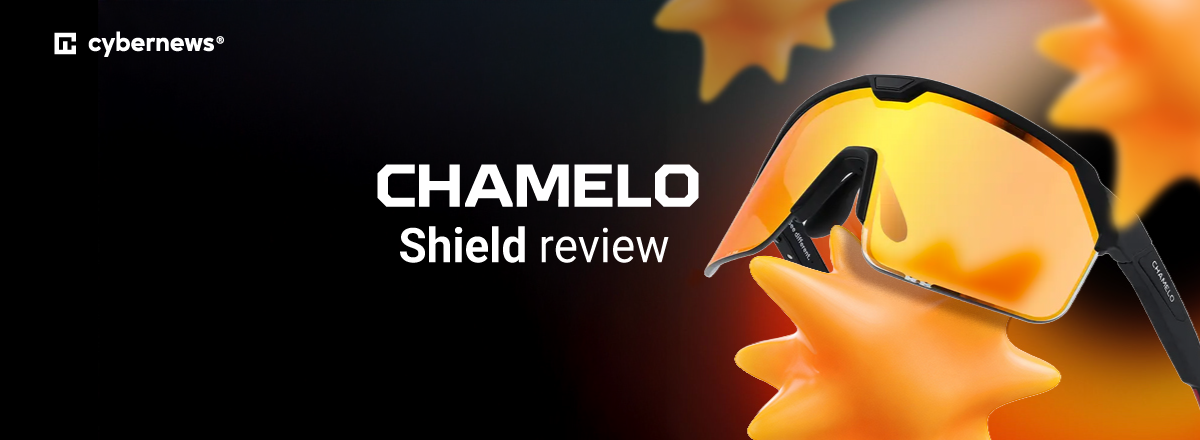
Chamelo Shield is a sporty, rechargeable sunglasses model with adjustable electrochromic tint technology. What distinguishes them is the technology: you can instantly change the lenses’ shade, and there’s an automatic mode that adapts to ambient light.
Buyers considering these sunglasses are wondering what makes them better than traditional sports sunglasses, and whether Chamelo technology is truly useful. I’ll answer that in this Chamelo Shield review.
I, together with the Cybernews research team, reviewed Chamelo Shield’s official specifications, electrochromic technology claims, and consistent user feedback to evaluate how these sunglasses perform in real life. At Cybernews, I’ve covered smart wearables, augmented reality (AR) glasses, and privacy concerns around wearable tech.
Below, I’ll tell you all about these sunglasses: frame design, comfort, how the tint technology works, battery performance, and finally whether they’re worth it.
Quick overview of Chamelo Shield
Before I dive deeper, I’ve compiled some essential information about the Chamelo Shield. Here’s a quick overview table showing you the price, key features, and my overall rating:
| Overall rating: | 4.1/5 |
| Description: | Dual-tint, IPX4-rated sports sunglasses with electrochromic “Eclipse” lenses, with near-instant manual and automatic tint adjustment |
| Pricing: | $199 |
| Key features: | 54%-17% visible light transmittance (VLT), 0.1-second tint-change speed, 52 hours battery life (tint-adjustment), 100% UV protection, 32g weight, impact-resistant lenses, multiple colorways available (including signature editions) |
Our methodology
When reviewing the Chamelo Shield, I didn’t conduct any hands-on testing. Instead, I relied on official Chamelo specifications, public demonstrations, and recurring online user feedback. To fairly score the product, I used Cybernews weighted evaluation criteria:
- Tint technology transparency (30%): I noted tinting VLT range and speed of change. I considered how useful the tinting range is in daytime conditions.
- Design and comfort (25%): I researched fit, weight, materials, sports readiness. I compared these aspects to rivals.
- Battery and power management (15%): I checked battery life per charge and standby behavior. I also checked real users’ battery performance remarks.
- Ease of use (15%): I analyzed on-frame controls and transition behavior. I considered the ease of use of the on-frame controls.
- Value for money (10%): I compared its value to premium sport sunglasses. I noted where it proved genuinely valuable.
- User sentiment consistency (5%): I inspected recurring user comments online. I ignored isolated comments.
Chamelo Shield glasses: design, style and feel
Based on the product images, these are large, wraparound, sport-focused sunglasses built for high-intensity activity use. The sunglasses have no-slip grip elements to remain stable during intense movement.
Chamelo says they are lightweight, but doesn’t specify frame materials. I found a Chamelo Shield user manual online that specifies a high-strength TR-90 frame and PC (polycarbonate) lenses with a flexible liquid crystal film.
The specified weight is 32g, which is around the same as classic non-tech sports sunglasses, so they’re not heavy. The tint controls and battery are discreet, so these aren't bulky like some other “tech glasses.”
Chamelo also describes 100% UV protection, while the frame is rated IPX4, meaning it’ll resist sweat and light rain (but no swimming). According to users, they are also comfortable for all-day casual wear, not only for intense activity. I think they look quite trendy, like a pair of premium cycling or running sunglasses, especially when specced with the highly reflective “Fire” lenses.
Electrochromic tint technology
Electrochromic (electronic) lenses change tint when powered, so the tint shade shifts on-demand, instead of relying on sunlight. Photochromic lenses darken in response to UV rays and may be slower, depending on UV exposure. Traditional, static sunglasses stay at one fixed shade. Chamelo says Shield is “unlike photochromic lenses which react slowly (and often not at all).”
The Chamelo Shield’s tint adjustment is frame-based: there’s a slider that sets tint in manual mode, and Autopilot that uses an ambient light sensor to adjust automatically. Chamelo lists a 54%-17% VLT range and changes under 0.1 seconds. The manual control is a stepless slider.
Higher VLT is when the lenses are more transparent and let more light through, while lower VLT makes the sunglasses darker. The technology is useful when your light conditions change, like when you bike among trees, or suddenly drive into the bright sun. Chamelo says to adjust tint manually only while stationary.
Practical usage scenarios
Adjustable lens tinting is genuinely useful in outdoor scenarios when light is very dynamic. Chamelo claims that adjustment happens in under 0.1 seconds. You can adjust the slider for either manual adjustments or activate Autopilot so it does it for you. Here are some common scenarios:
| Situation | Static sunglasses | Chamelo Shield advantage? |
| Mountain biking | One tint has to “work well enough” in forest shade and open sun | Adjust tint up/down as the trail shifts between shade and sun |
| Road cycling | You either must use a darker lens or carry a lighter backup set | Manual slider or Autopilot adapts to changing light |
| Running at dawn/dusk | Too dark early, too light later | Raise/lower tint as the sky brightens or dims |
| Driving through varied lighting | Fixed tint can feel risky in tunnels or heavy shade | Set tint before driving, Autopilot handles gradual lighting changes |
Charging and battery power
Chamelo Shield’s adjusting lenses run off of a built-in 52mAh battery. You get up to 52 hours of tint-adjustment battery life per charge. To charge them, you use a pogo-pin cable. A charge up to 80% takes 30 minutes, according to Chamelo. The user manual I found says red is for charging, flashing red is low battery, while green is fully charged.
Chamelo doesn’t specify whether the lenses revert to a default shade when the battery dies. Based on that, make sure your Chamelo Shield is charged up before long bike rides or drives. The manual also says not to dismantle or attempt to repair the built-in battery. I couldn’t find a battery-replacement policy either.
Compared to other smart glasses competitors, Chamelo Shield’s direct rival is Povec C1. Povec claims 28 days of use on a single charge (about 112 hours at four hours per day). Ray-Ban Meta (a smart glasses competitor) gets up to 8 hours of mixed use, but without tint control.
Bottom line: are Chamelo Shield glasses worth the hype?
Chamelo Shield glasses are very practical if you’re in dynamic outdoor environments where you move through sun and shade. They are appreciated by outdoor adventurers, runners, cyclists, and even some casual commuters who don’t like swapping lenses. They’re not for casual wearers who prefer classic sunglasses without electronics.
Stylish wearables aren’t mandatory. Whether it’s worth it entirely depends on your lifestyle and budget.
Confirm battery life matches your activity patternsCompare with other premium photochromic sport lensesWeigh cost vs ordinary sport sunglasses
If you’re looking for a camera function in your sunglasses, read Cybernews’ camera glasses guide. For more information about the audio-enabled Chamelo Music Shield model, check out Chamelo Music Shield review. To explore more models from this brand, check out our Chamelo glasses review.
FAQ
How long does the Chamelo Shield battery last?
Chamelo states that the Chamelo Shield battery lasts for up to 52 hours on a single charge. That figure is purely for tint adjustment per charge. The battery charges to 80% in 30 minutes via a pogo-pin cable, according to Chamelo.
What does electrochromic tint mean?
Electrochromic tint means lenses that electronically change darkness. Electrochromic lenses typically use a low-voltage current that’s applied to a liquid crystal film layer.
Are Chamelo Shield glasses polarized?
Chamelo doesn’t clearly state whether the Chamelo Shield series is polarized or not. However, Chamelo offers other models (like Dusk Classic) that are explicitly described as polarized.
Can the lenses work if the battery dies?
The lenses still block UV even when the battery dies, but the tint function stops. Typically, the sunglasses will default to a high-VLT (clear) state when the battery dies.
Are Chamelo Shield sunglasses suitable for cycling and driving?
Not for driving, but Chamelo Shield is recommended for cycling and high-intensity activities thanks to the adjustable tinting technology that controls light (manually or automatically). Chamelo also sells cycling and running bundles. Chamelo warns not to adjust tint while driving. Only adjust tint while stationary.