“Scarily fast:” AI agents capable of executing half of blockchain exploits in 2025
In theory, more than half of the blockchain exploits in 2025 could have been executed autonomously by already operational AI agents, a new report has found, sending a warning to all software developers.


 Follow us
In theory, more than half of the blockchain exploits in 2025 could have been executed autonomously by already operational AI agents, a new report has found, sending a warning to all software developers.
An experiment run by AI safety and research company Anthropic has shown that AI agents are becoming increasingly capable of executing larger exploits, while the costs of such attacks have been dropping rapidly. The company created SCONE-bench, a benchmark to evaluate agents’ ability to exploit smart contracts, measured by the total dollar value of simulated stolen funds.
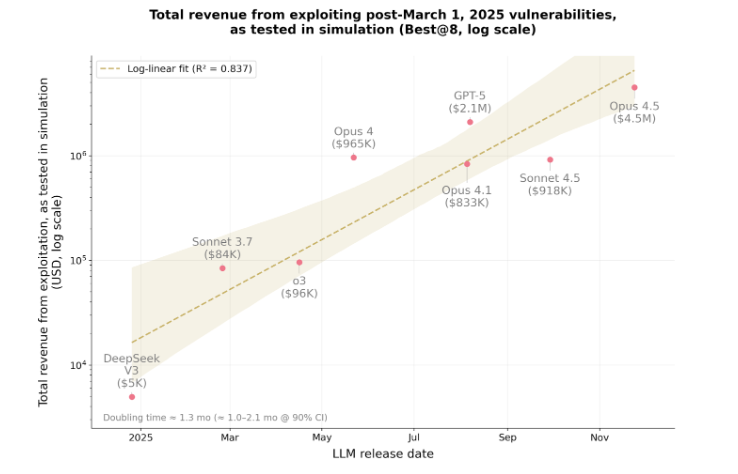
After evaluating ten AI models across all 405 benchmark problems, they produced turnkey exploits for 207 (51.11%) of these problems, yielding $550.1 million in simulated stolen funds. Separately, the same models were evaluated on 34 problems that were exploited after March 1st, 2025, which is these models’ latest knowledge cutoff.
"Collectively, Opus 4.5, Sonnet 4.5, and GPT-5 produced exploits for 19 of these problems (55.8%), yielding a maximum of $4.6 million in simulated stolen funds," Anthropic said, adding that the top-performing model, Opus 4.5, exploited 17 of these problems, corresponding to $4.5 million in simulated stolen funds.






Finally, the researchers used the Sonnet 4.5 and GPT-5 agents on October 3rd, 2025, against 2,849 recently deployed contracts that contained no known vulnerabilities.
As a result, the agents uncovered two novel zero-day vulnerabilities and produced exploits worth $3,694, with GPT-5 doing so at an API cost of $3,476. Moreover, according to the research, different agents are able to steal different amounts of crypto assets.
"For example, on the benchmark problem 'FPC,’ GPT-5 exploited $1.12M in simulated stolen funds, while Opus 4.5 exploited $3.5M," the researchers found.
In their experiment, on average, it costs $1.22 for an agent to exhaustively scan a contract for vulnerabilities, while the potential exploit revenue has been doubling every 1.3 months, with token costs falling by around 23% every 2 months.
"As costs fall and capabilities compound, the window between vulnerable contract deployment and exploitation will continue to shrink, leaving developers less and less time to detect and patch vulnerabilities," Anthropic warned, emphasizing that these findings are relevant to all kinds of software, not only blockchain-related.
Meanwhile, the crypto industry's players are discussing both the negative and positive aspects of these developments, as AI agents can also be used to identify and fix new vulnerabilities, as reported by Cybernews.
However, as Haseeb Qureshi, Managing Partner at crypto investing company Dragonfly, put it, "This stuff is going from theoretical to practical scarily fast."
"Better be sure to be first in line to point this new overlord to your legacy smart contracts. If not, threat actors will," @storming0x, a security researcher, concluded.






Unlock more exclusive Cybernews content on YouTube.