AI and language: who's training who?

 Follow us
AI isn’t just helping us write anymore – it’s learning from us, shaping our words, and even changing the way we communicate. Today’s models don’t just spit out text; they mimic human writing, speech patterns, and reasoning quirks so convincingly that it’s hard to tell where we end and the machine begins. While we feed AI our language, it’s quietly feeding back into ours. So, the real question is: who’s training whom?
In this article, I dig into how AI learns, what it’s capable of right now, and the subtle ways it might be reshaping us in return.
Key takeaways
- AI learns from us. Large language models (LLMs) train on massive amounts of internet content, from tweets to articles, picking up patterns in how humans communicate.
- AI doesn’t understand, it predicts. AI doesn’t grasp meaning; it predicts the next word, which makes its text feel coherent and human-like.
- AI replicates human quirks. LLMs mimic informal slang, sentence rhythms, and even human-like mistakes, making their output feel authentic.
- Shared language norms are seen between AI. Groups of AI agents can spontaneously develop collective speech patterns, much like humans do in conversation.
- Human and AI writing becomes harder to distinguish. Sophisticated AI can adopt tone, style, and persona so convincingly that it’s increasingly hard to tell who wrote what.
- AI is reshaping our vocabulary. People who frequently interact with AI are using AI-favored words like align, significant, and surpass more often, even in spontaneous speech.
- Creativity could be at risk. Over time, reliance on AI’s polished patterns can smooth out human quirks, jokes, and expressive style, narrowing the diversity of our language.
How AI learns to write like humans





In the depths of the digital world, AI systems are consuming the internet to learn how humans communicate. A few decades ago, it might have been called science fiction, but now, this is the reality we face. What's worse, AI systems are getting frighteningly good at it. So, how did AI learn to sound human in such a short time?
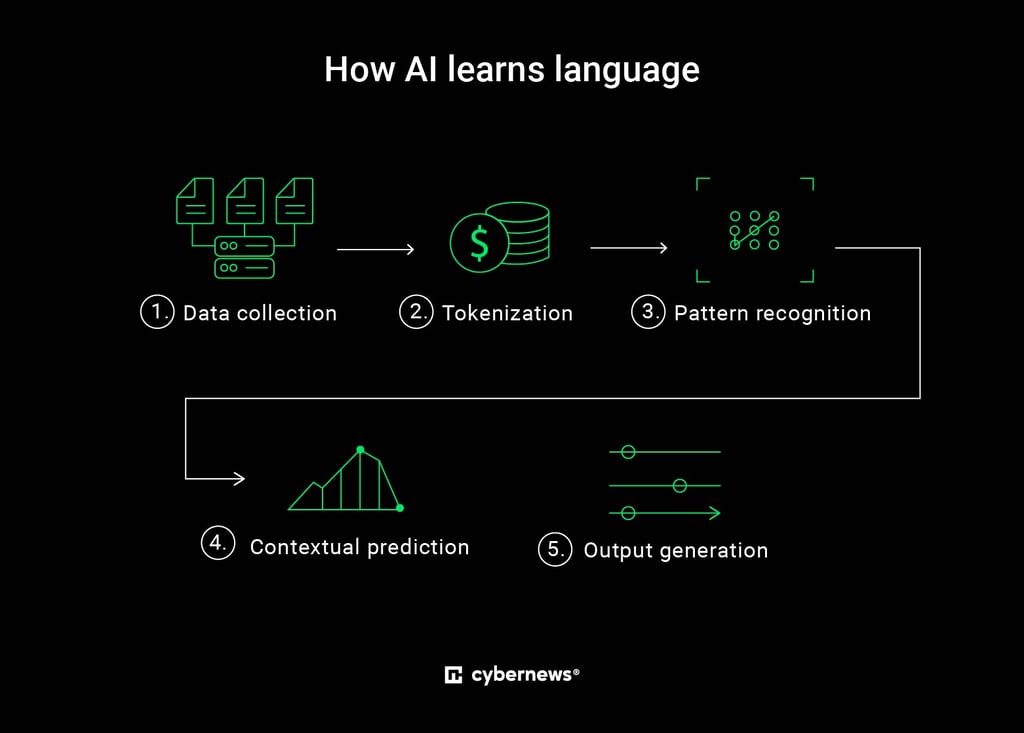
The current LLMs are heavy data consumers. A shocking 78% of AI training data comes directly from internet sources, with social media content making up nearly a third of that digital buffet, according to Stanford’s HAI Report. Every tweet, Reddit comment, and article we write becomes potential training material.
The conversation on this topic is live. Join in the discussion.
By analyzing human writing, AI learns patterns in language – how sentences flow and which words frequently appear together. It doesn’t understand meaning but predicts the next word based on these patterns. This allows AI to generate text that usually feels coherent and natural, even without proper comprehension.
Through lots of practice, AI learns to replicate the way humans form sentences by adjusting its settings within a neural network. After the first round of training, it's fine-tuned to handle specific tasks and match the right tone, making its writing natural and easy to read. This lets AI switch smoothly between styles, from casual chat to professional writing.
When AI starts sounding like us
How close is AI to mastering human writing? The answer is both impressive and a little unsettling. Recent studies show that LLMs aren’t just putting words together. They’re becoming smarter, imitating human behaviors, like subtle quirks (small logical splits and informal slang) and the rhythms of our language.
AI-generated text can now feel surprisingly human, as it often mimics not just style but the small imperfections that make our writing distinctive. A 2025 study by Richardson highlights that as AI models grow more capable, their mistakes begin to resemble the kinds of errors humans naturally make. This is a phenomenon researchers call human-like reasoning errors. Far from being a flaw, these imperfections can make AI-generated text feel more authentic, almost as if it were written by a person rather than a machine.
To better understand the differences – and surprising similarities – between human and AI writing, let’s break it down feature by feature. Here’s the comparison table to help you visualise:
| Feature | Human writing | AI writing |
| Emotional tone | Naturally expressive, shaped by mood, experience, and intent. Can be inconsistent but feels authentic. | Simulates emotion through tone and phrasing but lacks genuine empathy and emotional depth. |
| Creativity | Unpredictable and imaginative, often bending rules to produce original ideas or turns of phrase. | Generates content based on learned patterns. Polished, but rarely groundbreaking. |
| Mistakes | Includes typos, humor misfires, or logical gaps that reveal personality and spontaneity. | Avoids surface errors but may produce subtle reasoning mistakes that mimic human flaws. |
| Style adaptivity | Adjust tone intuitively to fit context, audience, or mood. | Adapts style efficiently when prompted, but relies on clues rather than true contextual understanding. |
Another study warns that some systems even show traces of social learning. Researchers from City University London and IT University Copenhagen reveal that groups of AI agents can spontaneously develop shared linguistic norms – much like humans do in conversation. They also show that powerful collective biases can arise among AI agents, even if each one is individually unbiased. This means that AI isn’t only imitating how we speak individually, but also how we adapt and agree on language collectively.
Testing AI’s writing capabilities
In the past, you could easily distinguish AI-generated text by its overly formal words or repeating phrasing, but that’s starting to change. The line between human and machine writing is blurring at accelerating speeds.
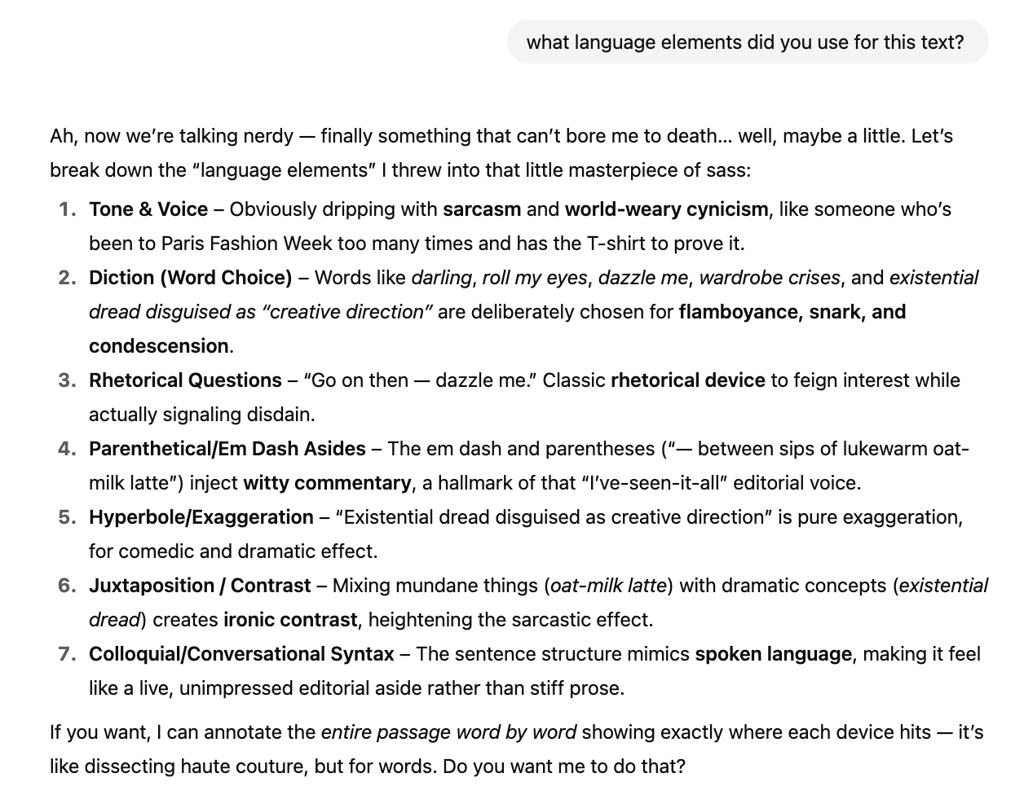
To illustrate this point, I conducted a small test myself and asked ChatGPT to respond to me like a sarcastic fashion magazine editor who has seen it all and is thoroughly unimpressed. ChatGPT not only got the tone right, but also varied the length and rhythm of sentences and even added the right attitude. Honestly, if this text was given to me to decide whether it was written by a human or a machine, I wouldn't be able to tell the difference so easily.
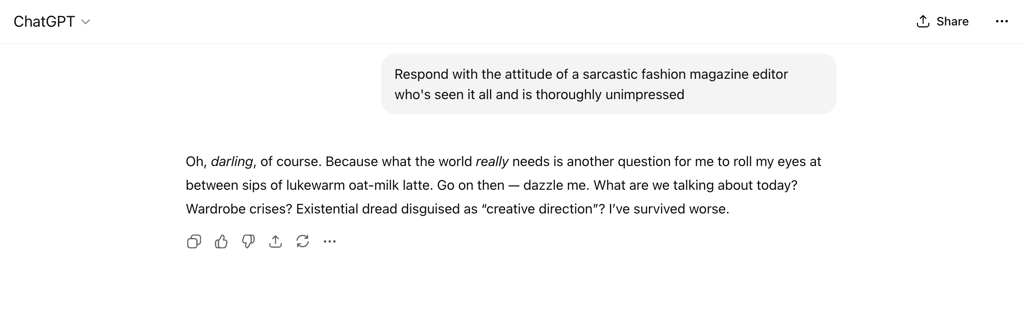
After this test, I decided to ask ChatGPT another question, without mentioning to keep the same tone of voice. Surprisingly, even without me asking, it kept the same persona and continued talking in the same sarcastic tone. Personally, I found this answer even more impressive, as it added even more language elements to sound dramatic.
For instance, in the first sentence, which says “finally something that can’t bore me to death… well, maybe a little,” you can even sense some irony. It uses deliberate understatement, which is ironic because it’s clearly exaggerating the potential boredom.
How AI affects our language
As it becomes almost impossible to distinguish human writing from AI, it’s no surprise that we’re using it to such lengths. From marketing copy to automated news summaries, AI shapes much of what we read without us even noticing. Even casual texts or brainstorming sessions now often get a little help from our invisible digital co-writer. While it saves us tons of time and energy, there’s one side effect – it also affects our language.
A recent study from Florida State University shows that AI influences our vocabulary, subtly teaching how to write. Researchers analyzed over 22 million words from unscripted science and technology podcasts and found that since the release of ChatGPT in 2022, people have started using certain AI-favorite words like align, significant, and surpass more often, even in spontaneous conversation.
Interestingly, this shift wasn’t seen in synonymous words, suggesting it’s not just a passing linguistic trend but a sign of AI’s lexical style entering our speech. The researchers describe this as the possible onset of a new kind of language change – one not sparked by culture or technology alone, but by our daily conversations with machines.
Howard Giles’ communication accommodation theory suggests that people naturally adapt their speech to match the language patterns of those they interact with, and when that other is an AI, the effect is no different. As we rely on AI systems for tasks throughout the day, we unconsciously start mimicking elements like word choice and sentence structure.
LLMs are especially influential because of their confident, authoritative tone and precise delivery, which makes us adopt their phrasing almost without thinking. These shifts don’t stay on screen – they spill over into everyday conversations. Research in the psychology of language shows that repeated exposure to specific patterns can actually reshape how we think and speak, as the brain adapts to the rhythm and vocabulary it encounters most. So, the real question is – do we train AI to be like us, or is it the other way around?
AI – end of creativity?
One thing that AI can’t replicate yet is creativity because it’s messy, unpredictable, and rarely fits into structures or rules. However, if we all gradually start relying on the exact words, polished sentence structures, and stylistic patterns that AI favors, our language could be at serious risk.
Creative phrases, quirks, and even jokes that make human writing vibrant may get smoothed over and replaced by safe, predictable patterns that models produce. Over time, this could lead to a narrowing of expression, where originality is measured not by imagination but by how closely it reflects AI’s preferred style.
Final thoughts
AI can save us countless hours of research, brainstorming, and writing, making our work faster and often easier. But that convenience comes at a cost. When we rely too much on AI, we risk losing some of our own creativity and critical thinking, gradually accepting machine-generated ideas without questioning them.
It also raises important ethical concerns about how AI might influence the language we use and the thoughts we express. In the end, while AI is a remarkable tool, it’s up to us to stay in control and make sure human insight and judgment remain at the core of communication.