How AI is reshaping the future of healthcare

 Follow us
AI is no longer a thing of the distant future, seen only in sci-fi movies. The rise of large language models (LLMs) has pushed AI into everyday life and constant media headlines. Few industries have felt this shift as intensely as healthcare.
In just two years, AI has moved from an experimental support tool to something used daily by both doctors and patients. Some believe it could help cure cancer, accelerate drug discovery, and even extend life expectancy. Critics, however, argue that the technology is still too new and that its real-world adoption remains limited.
Healthcare is one of the most challenging industries to implement AI systems, as errors not only cost money – they can cost lives. Today’s medical AI is narrow, task-specific, and built for speed, pattern recognition, and automation rather than human-like reasoning.
- Governments and organizations worldwide are actively investing in AI, underscoring its pivotal role in healthcare transformation.
- With staff shortages and burnout at crisis levels, AI helps handle repetitive tasks and documentation.
- AI is already used in hospitals for early detection of sepsis, cancer, and stroke, often matching or exceeding human accuracy.
- AI will continue to improve drug discovery, diagnostics, precision medicine, and virtual healthcare access.
- Data quality and bias, reliability, privacy, sustainability, infrastructure, and regulation are key challenges that healthcare AI is facing.
- AI is driving the biohacking movement, optimizing sleep, recovery, mental health, and human performance.
Burnout and staff shortages push hospitals to implement AI






AI tools have several characteristics that could be applied in healthcare. It can analyze huge amounts of medical data in seconds, spot patterns humans might miss, and turn that into real, usable insight. At the same time, it can handle high-volume, repetitive work like patient questions, documentation, triage support, and routine monitoring. Doctors can spend up to half their day on admin instead of patient care, so AI can be a critical improvement in the system. And, unlike humans, AI doesn’t get tired, overwhelmed, or slowed down by volume.
With burnout and staff shortages hitting crisis levels worldwide, automation is no longer optional. It reduces pressure on healthcare workers, shortens wait times, and smooths the experience for both patients and staff. In some cases, models can even predict type 2 diabetes up to ten years in advance.
As healthcare costs continue to rise, AI is also seen as a powerful way to control spending. Once trained, a single system can be rolled out across thousands of hospitals, making large-scale use financially realistic.

AI now detects sepsis, cancer, and stroke in live hospital settings
AI has already seen some very useful implementations in healthcare. It’s deployed across hospitals, screening programs, and national health systems, delivering measurable improvements in diagnosis, efficiency, and patient outcomes.
Here are some more notable AI applications in healthcare as of right now:
- Early detection of sepsis. AI systems integrated into intensive care units can predict the onset of sepsis hours before visible clinical symptoms appear.
- AI-powered breast cancer detection. AI models can detect early-stage breast cancer with accuracy that often matches or exceeds that of human radiologists.
- Optimizing hospital operations and patient flow. AI-based scheduling and communication tools, such as Deep Medical, reduce no-shows and last-minute cancellations, allowing more patients to get help.
- AI in stroke and cancer diagnostics. AI is being used to analyze brain scans from stroke patients to support doctors in diagnosing and making treatment decisions in the UK.
- Brain scan interpretation. In some scenarios, AI systems have demonstrated up to twice the accuracy of human experts when interpreting specific types of brain scans, especially in time-critical neurological cases.
- Clinical chatbots and virtual health assistants. AI-powered chatbots are already used for symptom checking, mental health support, medication reminders, and patient follow-ups.
Governments now invest in AI as a core healthcare strategy
AI in healthcare isn’t only driven by startups and businesses. Governments and global health organizations are actively pushing it forward. Across the European Union, the AICare@EU initiative now supports the rollout of AI in hospitals and public health systems. In the UK, the NHS has become one of the world’s most active public healthcare adopters of AI, using it in areas like imaging, triage, and hospital operations.
In the US, the government is backing AI in healthcare through a coordinated national strategy that focuses on innovation, safety, and clear rules for medical AI tools. On a global scale, even the World Health Organization has made AI in healthcare a priority since 2018. That level of international involvement shows that AI is no longer an experimental technology – it’s becoming a core part of how healthcare systems transform.
Healthcare now: more informed than ever before
Most already use AI for their health, often without realizing it. Smartwatches, fitness rings, sleep trackers, smart glasses, biosensors, and even EEG headbands monitor heart rate, sleep, stress, and activity patterns, then give personalized insights and alerts in real time. Many also use ChatGPT to get health advice.
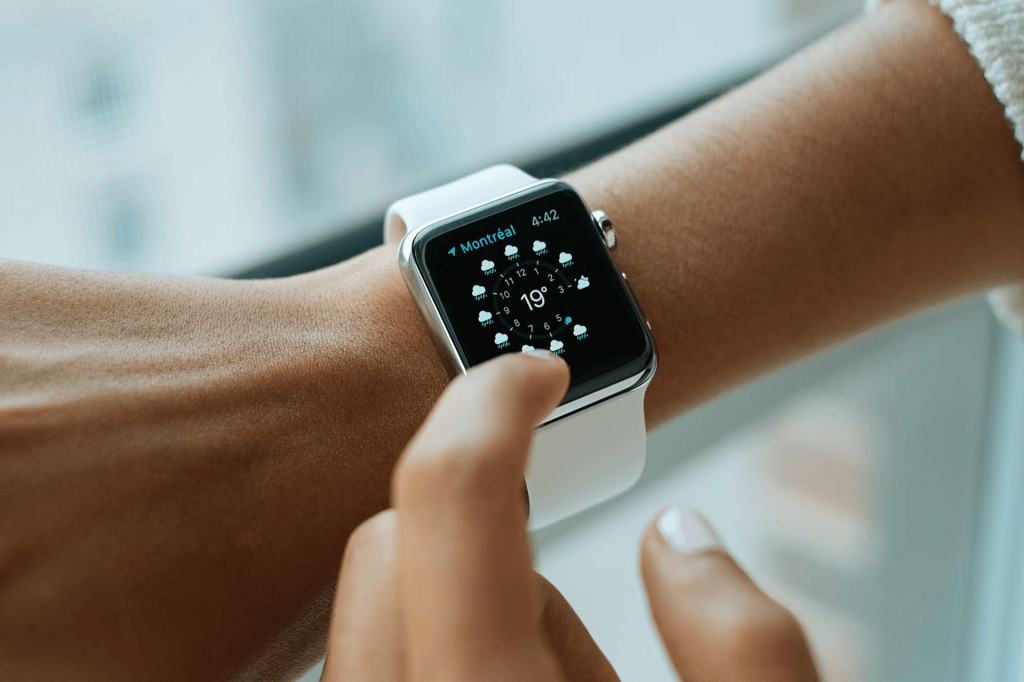
With wellness and longevity culture on the rise, millions now track their health daily, not just at doctor visits. Seeing real-time feedback helps people walk more, sleep better, manage stress, and make healthier lifestyle choices.
AI is also making mental health support more accessible. Apps like Woebot and Wysa offer CBT-based guidance, mood tracking, and exercises, lowering barriers for people who can’t access therapy or face stigma.
Wearables are shifting healthcare from reactive to preventative. Users can catch abnormal heart rhythms, poor sleep patterns, or stress early, while the data collected also helps improve research, diagnostics, and future AI-driven healthcare tools.
The future of medical AI: promising but unclear
Many people see the potential of using AI in healthcare, but it’s often viewed through two extremes. Some expect it to deliver instant cures and fully replace doctors, while others are very sceptical of its actual value beyond taking over routine tasks, let alone developing cures or medication. The reality lies somewhere in between. The next phase of AI in healthcare will focus on expanding proven applications rather than making sudden science-fiction level leaps.
In the near future, several developments are especially promising:
- Faster drug discovery. AI is already being used to predict molecular interactions, identify drug candidates, and simulate how compounds behave in the body.
- AI as the first point of medical contact. Symptom checkers, pre-screening tools, and automated follow-ups will help patients before they get to see a doctor.
- More accurate diagnosis and screening. AI can match or even exceed human accuracy in detecting early signs of cancer, heart disease, and neurological disorders.
- Robotics and precision medicine. AI-enhanced surgical robots can assist with minimally invasive procedures, improving precision and reducing recovery times. Robotics will also play a larger role in rehabilitation and elderly care.
However, for these advancements to scale safely and fairly, we need to address several key limitations of AI:
- Data quality and bias. AI systems can only be as good as the data they are trained on. If training data is incomplete or not representative, the results can be inaccurate or vary across age groups, ethnicities, and income levels.
- AI hallucinations and reliability. AI works by predicting answers based on patterns, which means it can sometimes produce incorrect information with confidence. In healthcare, even occasional errors can have serious consequences.
- Data privacy and security. Health data is among the most sensitive types of personal information. It’s hard to control how the data used for AI training and improvement is stored, shared, and reused.
- Sustainability. AI consumes a significant amount of computing power and electricity, both for training and in use. As healthcare AI continues to expand, its environmental footprint will become a serious concern.
- Technical infrastructure. Advanced medical AI relies on high-performance computing systems, secure data centers, and reliable digital networks. Many healthcare systems currently lack the infrastructure needed to support this at scale.
- Regulation and legal responsibility. AI in healthcare must be regulated to ensure safety without hindering innovation. Key legal questions remain unresolved, including who is responsible when AI makes an error and whether AI can legally contribute to diagnosis.
Most of these breakthroughs will happen over years, not months. Still, the long-term impact could be revolutionary. AI-driven drug discovery could save billions in development costs. AI-based diagnosing could become the main medical gateway in remote regions. As the world population increases and healthcare demand rises faster than the workforce, automation will play a crucial role in maintaining access to care.
Biohacking adopts AI to optimize sleep, recovery, and mental health
In recent years, biohacking has emerged as a new trend in the longevity and life-extension culture. This movement, focused on optimizing health and performance, has gained new momentum with the integration of AI. Some public figures have highlighted AI’s potential to not only improve healthcare but also extend human lifespan.
Biohacking is the practice of using science, technology, and lifestyle changes to improve your health. It can range from simple habits like optimizing sleep and diet to more advanced methods like using wearables, supplements, or data tracking to boost performance and health.
In mental health, chatbots like Woebot and Wysa make support affordable and easy to access, while more advanced AI models can offer personalized guidance alongside regular therapy. AI-driven sleep and recovery apps use wearable data to give tips that actually help people sleep better, recover faster, and feel healthier overall.
The culture of health tracking has become mainstream. Devices like smartwatches and Oura rings are now staples, allowing people to monitor sleep, recovery, and daily activity. This shift reflects a broader trend: health is no longer just about treating disease, but rather about enhancing human potential.
Some projects are really pushing the limits. Elon Musk’s Neuralink, for example, is developing brain-computer interfaces with the potential to decode neural signals, aid paralysis recovery, and ultimately expand the interaction between humans and machines. While this technology is exciting and powerful, it definitely makes you stop and think about the ethical side of things.
Not everything in biohacking is backed by solid science yet. Still, many ideas that start in this space often move into mainstream medicine, shaping the future of healthcare. AI is at the heart of this transformation, driving personalized, data-driven approaches that could redefine what it means to be healthy.
Final thoughts
Is AI truly the future of healthcare? Yes. Governments and global organizations are investing heavily in AI, and its proven ability to predict diseases, diagnose, and handle repetitive tasks makes it a tool with undeniable value. The potential return on investment, in both efficiency and patient outcomes, is unquestionable.
That said, AI isn’t a replacement for human care. It has limitations, requires oversight, and comes with real risks, including privacy concerns, environmental impact, and the possibility of errors like false negatives. The future of healthcare will likely be a mix of AI and human expertise – combining the speed and precision of machines with the judgment and empathy of healthcare professionals.