How costly is AI-fication?


 Follow us
AI has become widely used in our professional and everyday lives. We use it to accelerate our work and increase productivity. Also, we turn to AI to help us plan a vacation, brainstorm ideas, or even ask questions. There’s no doubt that AI-fication has brought many benefits to our lives. However, as in most cases, there’s a downside to this technology, too.
While AI seems intangible, the way it operates is very physical. It needs data centers to process information, which run on resources like electricity and drinking water. And, naturally, concerns over the real cost of AI-fication started becoming a central discussion.
TL;DR
- The companies that rushed to replace workers with AI are now paying extra to hire professionals to fix AI’s mistakes.
- People who live close to data centers have to share water resources and fear the future consequences of such trade.
- An increasing number of data centers in the US accelerates electricity consumption, which, in turn, raises the price for residential users.
- However, using AI brings many benefits to businesses and individuals. It helps them tackle everyday and routine tasks, in turn saving time and increasing productivity.
- There are ways to make data centers more sustainable and environmentally friendly. Experts suggest that such strategies as limiting how much power processors use and picking more energy-efficient equipment could reduce electricity demand from 10% to 20%.
The resource cost of AI: manageable for business, massive for the people






Businesses rushed to implement AI to streamline operations, enhance product development, and, of course, reduce costs. However, the real scale of AI-associated costs has only started to reveal itself now.
Organizations already have a good couple of years to track their return on investment (ROI) on AI initiatives. In the meantime, some people's lives have already been directly impacted by the resource costs of AI exploitation. This created an argument, whether AI’s pros outweighs its cons. Further, I explore both sides of the argument.
Business hires professionals to fix AI mistakes
While arguably, business got the most benefits from AI-fication, it has also experienced unwanted costs. Organizations that rushed to replace human work with AI, hoping to save money, now face new problems. Whether it’s a poorly written copy, faulty code, or fundamental miscalculations, many end up spending good money hiring professionals to fix AI’s mistakes.
This demand for damage control has even created a new industry of specialized professionals. Some writers report that, as of now, fixing AI-written copies makes up over 90% of their work.
Other industries have also been hit hard by AI’s shortcomings. In healthcare, IBM’s Watson Health initiative was expected to revolutionize cancer treatment with AI-powered diagnostics. Unfortunately, the platform often misdiagnosed conditions, forcing healthcare institutions to abandon it and leaving IBM with significant financial losses.
Some consequences, however, are more subtle. Apple and Goldman Sachs have paid for AI missteps with their reputation. Back in 2019, companies faced backlash over the Apple Card algorithm, which consistently offered lower credit limits to female applicants. Accusations of gender discrimination quickly followed, damaging public trust in both companies.
Water and energy consumption
While it may seem that AI usage is nearly effortless and doesn’t require many resources, that’s not true at all. Generative AI models, such as GPT-4 use data centers for the energy needed to train them and process data.
To illustrate the energy consumption, let’s take a measure of one unit of text that an AI model uses to process and generate outputs. In this case, processing a million units emits a similar amount of carbon as a gas-powered vehicle after driving 5 to 20 miles. To generate an image, generative AI uses an equivalent amount of energy required to charge a phone fully.
Also, AI data centers require vast amounts of energy and water, which is required for cooling. Vijay Gadepally, a senior scientist and principal investigator at MIT Lincoln Laboratory, says that data centers amount to 1%-2% of overall global energy, a similar number estimated for the airline industry. And this number is expected to grow, potentially reaching 21% by 2030, based on the rising AI demands.
AI data center energy consumption drives up cost of living
PJM, the company that operates the electric grid from the Mid-Atlantic region westward, estimates that data centers will make up more than 90% of the new power demand at the end of this decade. What does it mean to the regular user? Analysts and consumer advocates predict that over the next 5 years, due to energy needs of data centers intensifying, the prices can see an increase of up to 60%.
However, we can already see the shift in pricing. PJM Interconnection held the energy auction in July 2025, where the price of a megawatt soared to $329.00 on peak demand days. This is roughly a 1000% jump in price from two years ago. Such a price surge means that PJM’s customer power bills can increase between 30% to 60% by 2030.
Since the energy auctions generally have a year-over-year impact, PJM expects that the recent auction will have a 1.5% to 5% impact on utility bills starting June 2026.
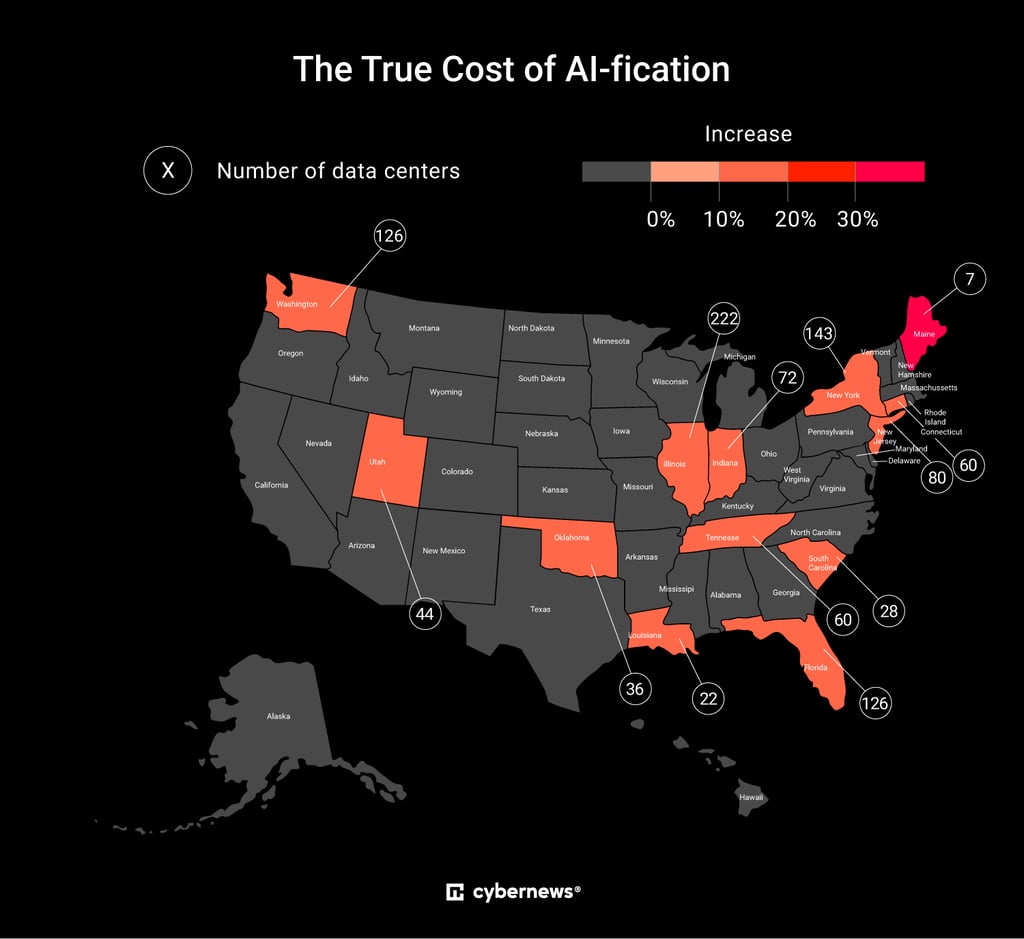
Note: Data was taken from U.S. Energy Information Administration and Data Center Map.
On the other hand, Ohio, the state with a rapidly increasing number of data centers, is already experiencing the impact. Statewide, electricity rates in Ohio increased by 3% from May 2024 to May 2025. This adds about $27.00 to an average electricity bill, contributing to the increasing cost of living.
AI data center water consumption causes problems for locals
Deep learning models, which are essential for generative AI, require a great amount of computational power. As a result, data centers that house these machines generate a lot of heat and require continuous cooling to prevent overheating and maintain optimal performance.
The problem lies behind the resources that many data centers use to cool down their systems, that is, drinkable water. A large data center can consume up to 5 million gallons of water per day – an equivalent of the water use of a town with a population of 10,000 to 50,000 people. Also, the water used in data centers is usually treated with chemicals that prevent bacterial growth and corrosion, making it unsuitable for human consumption and agricultural use. As a result, this water is not only consumed in large quantities but also completely removed from the local water cycle.
Another underlying issue with server farms is their location. They are less problematic when located in those parts of the world that don’t have water scarcity. Unfortunately, a big part of them is located in water-stressed regions.
The lack of humidity in water-stressed regions reduces the risk of corrosion and electrical issues in the data centers. Making such places as the southwest US an attractive location. However, these regions are considered the best places to locate data centers, and they pay the highest environmental cost in terms of water.
Beverly Morris and her husband Jeff, who live in Newton County, Georgia, have experienced the water issue associated with server farms first-hand. After Meta had built a data center close to their house, the couple said that the water had started to dry up. Morrises have already spent over $5000 trying to fix their water problems and have gotten nowhere. Ms Morris says that she’s afraid to drink the water due to excessive sediment build-up in the water. While Meta shakes off the accusations, new reports in the area suggest that similar faith is waiting for the entire county.
Benefits of AI for businesses and individuals
Despite intensive resource use, AI brings many benefits. It helps organizations to increase efficiency and productivity, support their employees with daily tasks, and speed up decision-making processes. Individual users also benefit from the use of AI in their everyday lives. It’s a great tool to plan a vacation or learn new skills. Let’s dive into the advantages that AI offers to both businesses and people.
Efficiency and productivity
Mindful usage of AI can help increase efficiency and productivity. By automating repetitive tasks, it can help save significant amounts of time and reduce human error. For example, AI can help with performing rule-based tasks, including invoice processing and data entry. It supports employees and frees them from routine tasks, giving more capacity to tackle complex and strategic work.
Another area that AI assistance is very prevalent in is customer support. Generative AI tools help companies to automate responses to most common questions. As a result, customers can receive answers to their queries immediately. Also, it can resolve some issues without needing to reach out to the human agents, reducing their workload.
More opportunities for small business and individuals
With open-source AI, small organizations and individuals have more chances to compete with the bigger players. It’s a powerful tool that is affordable and accessible to entrepreneurs and small businesses. A strategic adaptation of AI can assist with various ventures, like marketing strategies, to save money and time.
For small shops, AI can help to understand customers’ habits, optimize pricing, and predict what inventory might be needed next month. This way the owners can make decisions based on real data for a small investment. AI tools are great for reducing expenses and filling in workforce gaps.
Improved decision-making
AI has the ability to process large amounts of data and give insights momentarily. This is particularly useful to speed up the decision-making process based on real-time analytics and predictive insights. For example, some law firms use AI to speed up document reviews. It’s capable of analyzing thousands of legal documents in the matter of hours – a process that would take several weeks to complete by lawyers. It instantly connects relevant precedents and helps professionals make informed decisions.
Despite all the benefits that come with AI, experts warn not to be overly optimistic about the capabilities of AI tools. They are known to hallucinate, making human oversight crucial.
Day-to-day life tasks made simpler
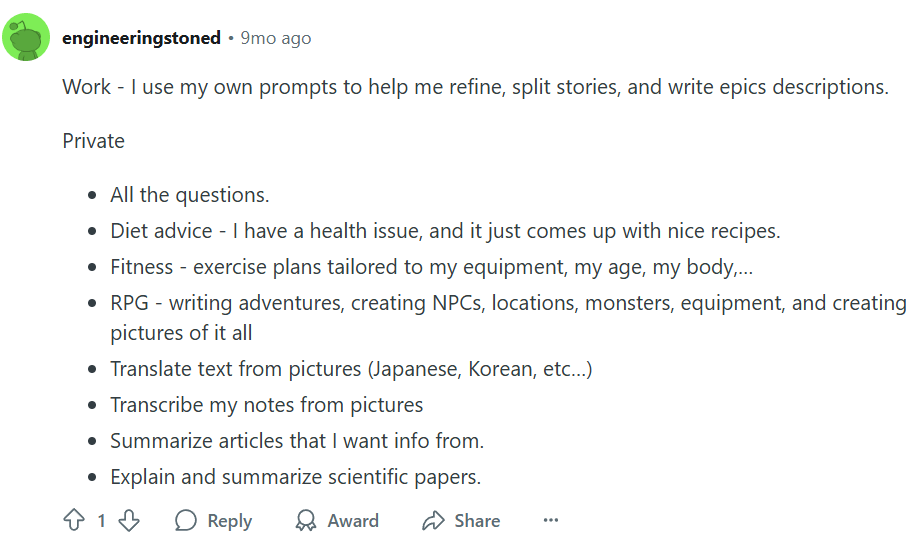
You don’t have to be a business owner to reap the benefits of AI tools. People apply AI in various aspects of their lives. For example, planning a vacation, answering questions, translations, and even turning to it for dietary advice. Others leverage it to simplify difficult-to-understand information and learn new skills.
Do the running costs of AI justify the gains?
Individual users can use some AI tools for free or an affordable subscription fee. A faster and more reliable ChatGPT Plus version’s cost varies based on usage, but you can get it for as little as $20. For this reason, it’s not only accessible but the return of using AI for an entrepreneur or a small business is likely to be positive.
However, the price of the AI implementation alone for larger businesses can cost up to $100 million. That’s due to the many processes and resources involved, like:
- Data costs
- Infrastructure expenses
- Talent acquisition
- Model development
- System integration
- Ongoing maintenance
The estimated cost also largely depends on the type of AI project. For example, small-scale AI automation, such as chatbots and rule-based automation, can cost between $10,000 and $50,000. At the same time, enterprise-grade AI solutions, like deep learning and autonomous systems, fall under the price range of $1M and $10M. These sums are not so small. Unfortunately, AI ROI is hard to quantify, since its impact is indirect and long-term. So, comparing the actual AI running cost and the profits it has brought today is not feasible.
Moving toward a more sustainable and ethical AI
AI delivers undeniable benefits like boosting efficiency and driving innovation. However, these advances carry environmental and ethical costs. Data centers that power AI consume enormous amounts of electricity and water. For this reason, it’s necessary to think about ways to preserve these resources.
Researchers suggest that companies can reduce energy emission without huge investments. In fact, applying some of these strategies can even help cut the operating expenses.
Simple changes like limiting how much power processors use, picking more energy-efficient equipment, and training AI models in smarter ways can cut global data center electricity use by 10% to 20%.
Actively employing these steps and combining them with training programs for workers can help with turning AI usage into both more sustainable and ethical.
Final thoughts
AI offers a handful of benefits to businesses and individuals. It helps increase productivity and efficiency, reduce labor costs, and simplify daily tasks. However, it also has a price. It drains our power and water resources with enormous intensity. Also, AI’s implementation can generally be costly.
With the AI demand foreseen to grow, the number of data centers will continue increasing all over the world. So, it’s essential that, amongst all the benefits of AI, we don’t lose sight of data center sustainability. Otherwise, the real cost of AI-fication might become too big a burden in the future.
