AI has begun to significantly affect entry-level employment, Stanford study says
The employment for young people has decreased since 2022, the year when ChatGPT was introduced to the public and soon became mainstream.

Image by Cybernews.

 Follow us
The employment for young people has decreased since 2022, the year when ChatGPT was introduced to the public and soon became mainstream.
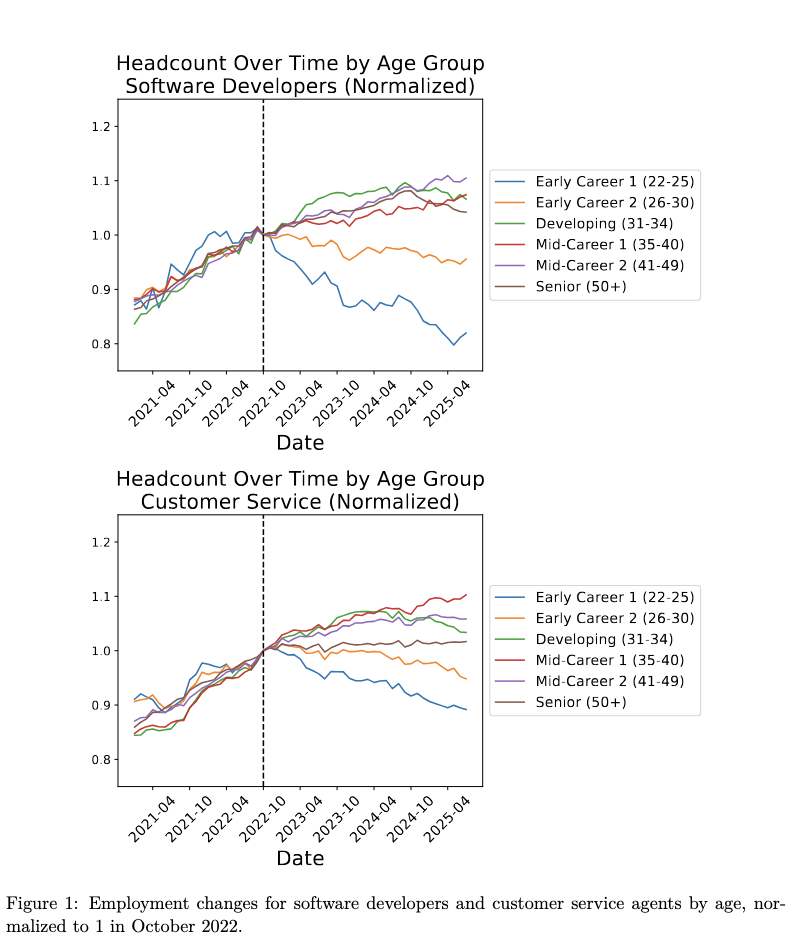
Early-career workers, ages 22 to 25, working in sectors most exposed to AI such as software engineering or customer service, experienced a 13% decline in employment.
That’s according to a 54-page long paper from Stanford, called Canaries in the Coal Mine? Six Facts about the Recent Employment Effects of Artificial Intelligence.
“Employment declines are concentrated in occupations where AI is more likely to automate, rather than augment, human labor,” the study reads.






In industries where AI augments human labor, employment is growing. It is also growing for older workers.
Stanford researchers explained what’s happening with the labor market since the wide adoption of AI:
- There are substantial declines in employment for young workers in sectors most exposed to AI.
- Economy-wide employment continues to grow.
- Employment is declining in occupations where AI can automate but not augment human work.
- Employment declines remain after conditioning on firm-time effects.
- Labor market adjustments are more visible in employment than in compensation.
- These patterns hold in occupations unaffected by remote work and across various alternative sample constructions.
“Historically, technologies have affected different tasks, occupations, and industries in different ways, replacing work in some, augmenting others, and transforming still others. These heterogeneous effects suggest that there may be “canaries in the coal mine” which are harbingers of more widespread effects of AI,” the study reads.
Could the “widespread effects of AI” mean economic crisis?
Since the beginning of the year, venture capitalists, investment bankers, and those with longer memory have been publicly discussing whether the AI boom is turning into an AI bubble, similar to the doc-com era.
Sam Altman has recently put more fuel to the fire by actually saying we are in the AI bubble. Moody markets didn’t like it. The same as they didn’t like the recent study by the MIT, saying that 95% of companies see no returns from generative AI.
However, this week, Nvidia announced revenue of $46.7 billion, up 6% from Q1 and up 56% from a year ago. While the stock still dropped as these jawdropping financial results were a little bit below expectations, the market remains positive.
And, despite putting AI stocks and investments under the spotlight, many experts don’t sound the alarm bells just yet. During the dot-com bubble, the online economy was pretty much open to everyone. This time, it’s big tech companies that dominate the market.
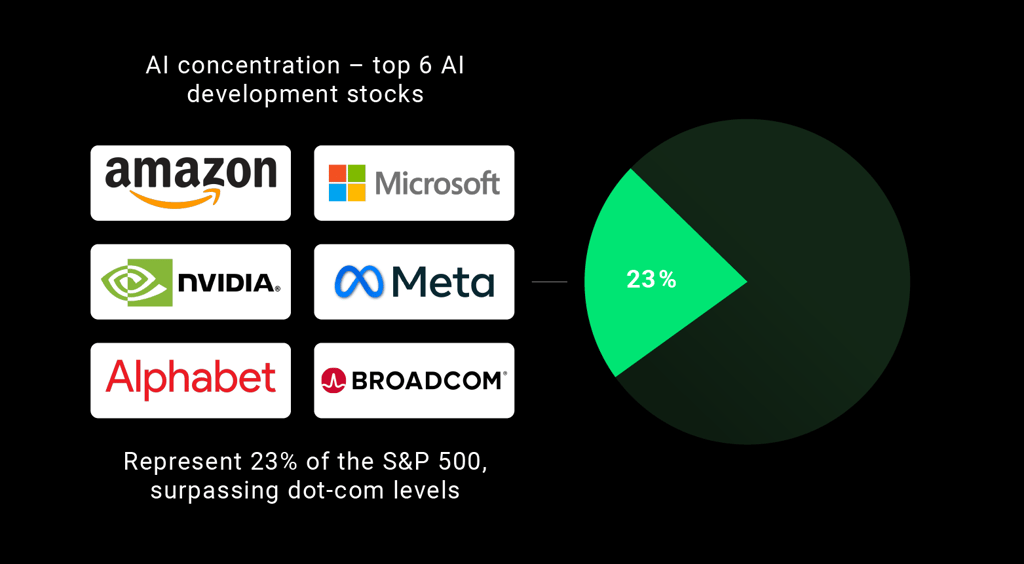
Nvidia, Microsoft, Amazon, Meta, Alphabet, and Broadcom are the top six AI stocks, representing 23% of the S&P 500 index.
Since they’ve been around for quite some time — all survived the doc-com bubble burst — we should expect they know how to play their cards right. But there’s also nearly 500 AI unicorns, and nearly 10,000 AI startups.
While the bankruptcy of some of them could have zero impact on the economy, it will greatly affect those working for those projects. And the projections are that the majority of those startups will burst sooner rather than later.
