AI is helping scammers target crypto users – cases jumped sixfold last year
Among the many signs of how criminals are increasingly using AI, blockchain analysts claim that AI-enabled scam activity increased sixfold in 2025.

By Cybernews.

 Follow us
Among the many signs of how criminals are increasingly using AI, blockchain analysts claim that AI-enabled scam activity increased sixfold in 2025.
The claim was made by TRM Labs in their 2026 Crypto Crime Report. However, the team hasn't elaborated on the more specific numbers behind the 500% rise.
"Large language models (LLMs) enable scams to cross language and cultural contexts with less friction, while AI-generated images, voice cloning, and deepfake videos reduce the cost of creating convincing personas," the analysts said, adding that these tools help with impersonation-style scams across messaging platforms, recruitment campaigns, and investment fraud.
As reported, another blockchain analysis company, Chainalysis, said recently that last year impersonation scams jumped by 1,400%, while the average amount of payments made to these criminals increased by over 600%. Also, according to them, AI tools are helping criminals make their operations more "profitable" and scale their “operations.”
Meanwhile, in the broader crypto scam landscape, according to TRM Labs' preliminary data, the total value received by scams has been seemingly dropping for a third year in a row, from $47 billion in 2023 to $35 billion in 2025.






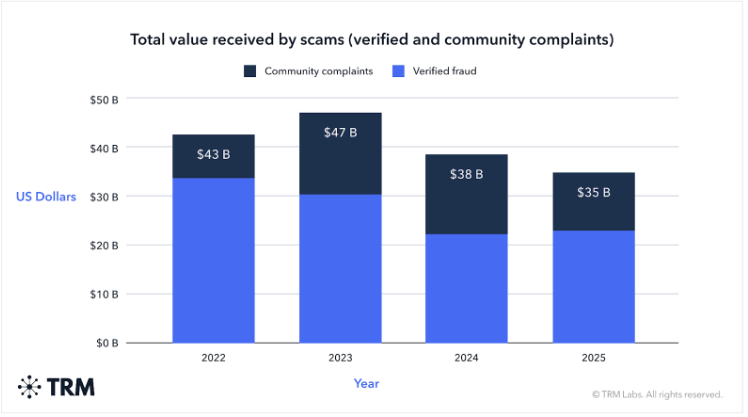
However, according to analysts, this should not be interpreted as a decline in real-world fraud activity, as fraud reporting is often delayed, and the 2025 figure might still increase. What's more, the vast majority of victims never report at all.
"In 2025, TRM observed $23 billion in verified fraud and an additional $12 billion tied to community complaints," the analysts said, emphasizing the importance of community complaints and shared reporting networks in preventing and fighting fraud.






Last year, investment-related scams, such as so-called "pig butchering" and pyramid schemes, brought in 62% of 2025 fraud inflows. Task/work-from-home scams have also emerged, tricking victims into fake platforms that offer paid micro-tasks such as writing reviews, clicking advertisements, or "optimizing" content.
TRM has also concurred with the findings of other analysts, noting that criminal networks now operate more like enterprises, with specialized teams and standard playbooks to scale their "operations."
"As adoption deepens, illicit activity now operates within a larger, more mature ecosystem. Illicit actors absorbed a smaller share of capital entering the crypto economy than in previous years, showing a downward trend in relative risk," the analysts have concluded, noting that despite the increase in absolute illicit volume, illicit volume as a proportion of overall crypto volume fell by 0.1 percentage point, to 1.2% in 2025.
Unlock more exclusive Cybernews content on YouTube.