AI Influence on crime: cybercrime losses soar as searches for “free Voice AI” surge by 147%


 Follow us
AI is more likely to intensify existing risks than create entirely new ones, although it can speed up and scale some threats. Cybernews did an analysis and found that last year's average investment scam cost more than a fully equipped Tesla Model S and was about 13% higher per complaint than the previous year. This indicates that cybercriminals target higher-value victims and that their threats are more difficult to recognize as fake.
According to Check Point’s State of Cybersecurity report 2025, criminals have begun using GenAI in their tools. Researchers suggest this may be one of the reasons behind the increasing cybercrime losses. Based on the annual Internet Crime Complaint Center (IC3) reports, while reports of phishing, tech support fraud, and data breaches are decreasing, the amount of losses continues to rise. In 2024, losses increased by around $4 billion compared to the year before.
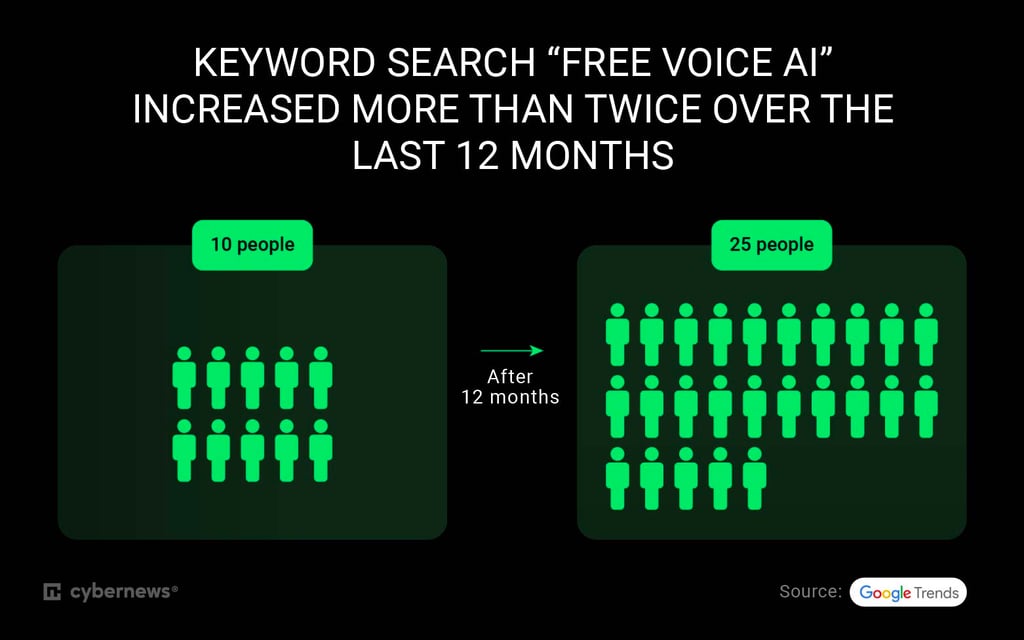
Keyword search “free voice AI” more than doubled in 2025
Search engines are now using AI to better handle harmful content and improve query processing and ranking, and potentially impact the results for various search terms. The word “deepfake” is often linked to scams or crime, so the results might be less valuable. Google says machine learning can find patterns that show potential scams. Large language models can quickly spot new trends and determine what is safe or harmful.
According to Google Trends, researchers at Cybernews found that:






- Search for “deepfake AI tool” hit its highest point (100) in July 2025;
- Search for “free voice AI,” a more natural-sounding term, had a 147% increase (from 36 to 89 points) since August 2024;
The growth was calculated considering scores go from 0 to 100, with each point already representing 1% of the maximum popularity.
In addition to Cybernews' findings, a new report has found that AI impersonation scams are up by 148%. The improvement of AI is visible with such videos circulating on the internet; people cannot distinguish between AI and real life. This AI-generated video of bunnies on a trampoline has hundreds of millions of views on TikTok and is causing a crisis among young people, who believed that AI can only fool their parents.
Voice and video AI platforms are growing rapidly. Major players like ElevenLabs, a voice generation platform, and Runway are seeing their user bases and revenues soar. As of October 2023, ElevenLabs surpassed 1 million users, and its valuation rose to over $5 billion in 2025. Similar patterns are happening with video generation AI, such as Runway, which reached $90M in revenue as of June 2025.
“As AI revolutionizes every industry, it’s no wonder that it could become a powerful weapon in the wrong hands. Instead of spending hours manually scrolling social media, criminals now use AI to instantly scan countless Facebook and LinkedIn profiles, automatically identifying the most profitable targets. When people openly list their phone numbers, emails, and favorite hobbies, this information could be used to tailor the scam to the individual. From romance scams to fake identities, known as Frankenstein IDs, with AI tools available online and personal information, it is a playground for criminals,” says Cybernews information security researcher Mantas Sabeckis.
Phishing scam losses grow as complaints dip
There was a noticeable decline in reported phishing scams in recent years in the US: Data from the annual IC3 reports show a 40% drop in reported phishing complaints since 2021, with complaints decreasing from approximately 342,000 to around 193,000.
At first glance, fewer complaints suggest lower losses. But the numbers show a different pattern. According to Deepstrike, AI-generated emails now lack the grammatical errors and awkward phrasing like before. They now achieve a 54% click-through rate, compared to just 12% for human-crafted phishing emails.
For instance, a finance professional was duped into paying out $25 million to scammers who used deepfake technology to impersonate the company’s CFO during a video conference call. The scam wasn't discovered until the employee later verified with headquarters.
While complaints decrease, losses increase:
- In 2023: $18 million and ~300,000 complaints → avg loss $60;
- In 2024: $70 million, ~200,000 complaints → avg loss $350, or 6 times higher;
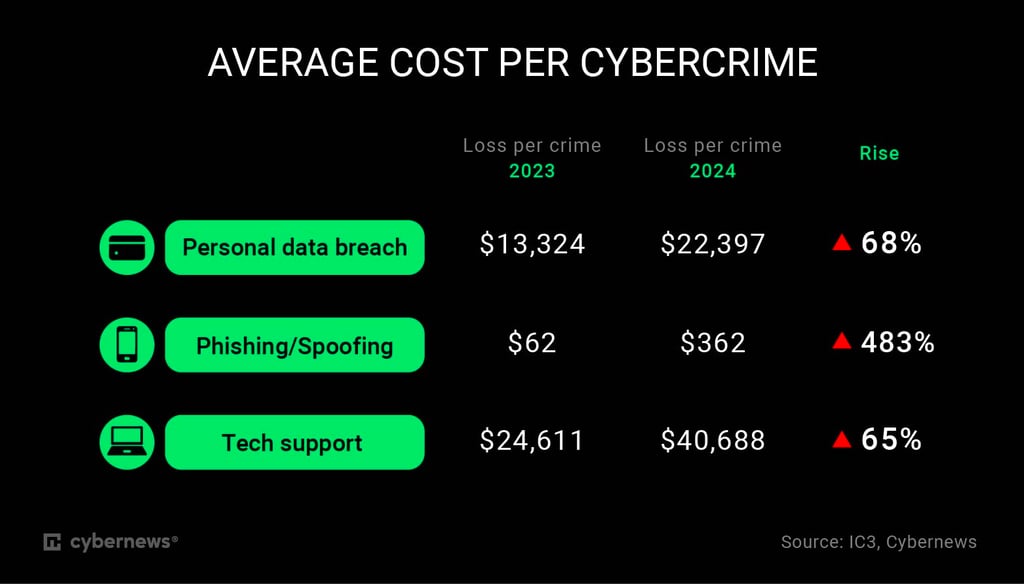
Cybernews found that the pattern shows up in other types of cybercrime. Although personal data breach complaints rose only 16%, losses jumped 95%, from about $744 million to almost $1.5 billion.
Tech support scams are another common trick. They push people to pay for fake services to fix problems that do not exist. Cost per tech support scam rose around 65%, from $24,611 in 2023 to $40,688 in 2024.
These scams usually start with scary pop-up warnings meant to cause panic and prompt hasty decisions. If you run into these alerts, the best bet is to close them right away. If you're really worried, reach out to the company directly using info from their official site. To stay safe, use strong, unique passwords for each account and regularly check if your login credentials have been leaked in data breaches.
Could investment crime this year exceed $11 billion?
For the past several years, losses from investment cybercrime have also been rapidly growing. In 2024, they reached $6.5 billion, which is 364% more than in 2021. According to Cybernews, losses will only grow further, potentially reaching $11 billion this year and over $18 billion in 2026.
Even American billionaire Elon Musk featured in fake videos that used AI to promote a financial scam. The videos, posted on Facebook, used real footage of Musk with an artificially generated voice, making it seem like he was inviting people to invest in a stock trading platform called Quantum AI.
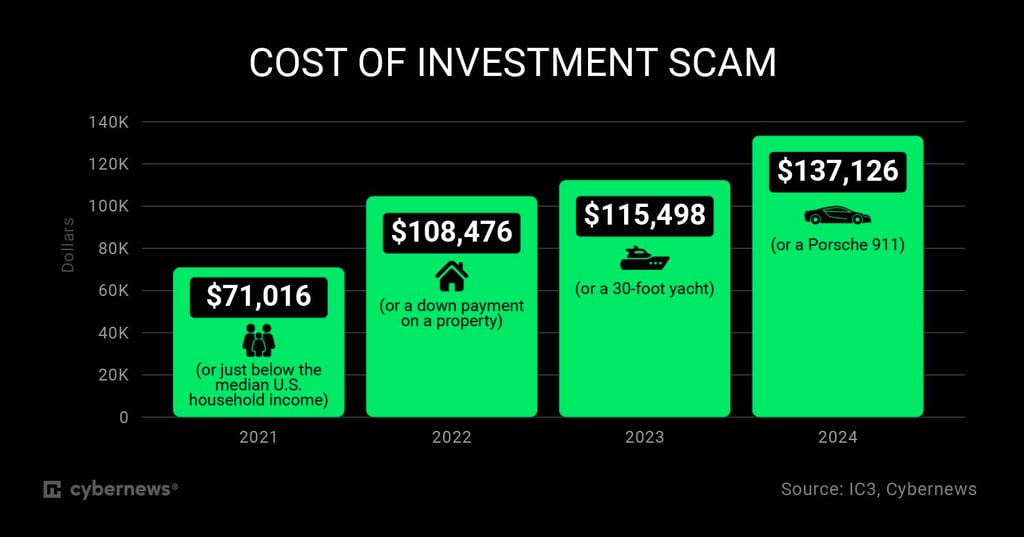
The average cost of investment scams is also rising, showing a shift to higher-value targets.
- In 2021, the average loss per investment complaint was $71,000;
- In 2022, the average loss per investment complaint was $108,000;
- In 2023, the average loss per investment complaint was $115,500;
- In 2024, the average loss per investment complaint was $137,000 (~cost of a Porsche 911 or a 4-year state university degree);
Elderly cybercrime complaint costs skyrocket to almost $5 billion
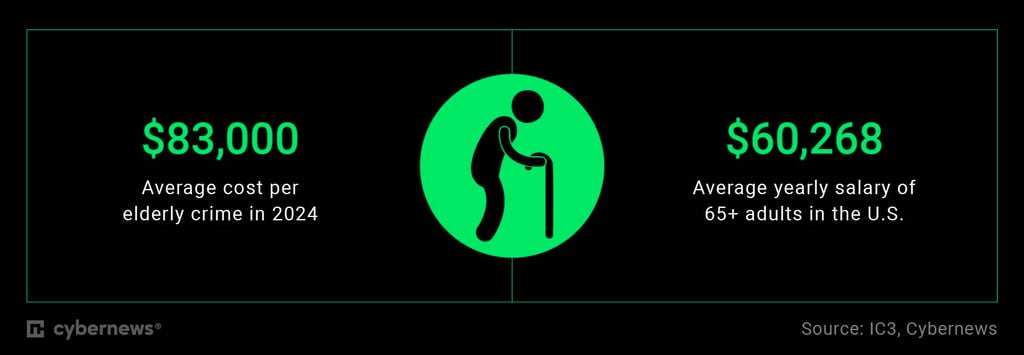
AI tools like live video or voice impersonation, fake documents, and voice generation can increase scams targeting seniors. In 2024, there was a 46% increase in complaints from elderly people and a 43% rise in financial losses compared to 2023. Seniors lost almost $4.9 billion to scams.
According to the Federal Trade Commission, the most common contact method for those 80+ is by phone (30%), making them the perfect target. Scammers use deepfake tech to impersonate grandchildren or children, often without the seniors' awareness. They only need a short audio clip of a family member's voice to sound like loved ones, asking for money for fake emergencies.
With this trajectory of crime growth, cybercrime could cost the world $1 trillion every month by 2031. The analysis shows that AI-driven attacks currently far outperform defenses in everyday life. According to ISACA’s study, 82% of respondents think keeping digital trust will be even more important in the next five years.
Methodology
This study analyzed data from the FBI's Internet Crime Complaint Center (IC3) reports from 2021 to 2024. Focusing on indicators like total victim count and financial losses, researchers at Cybernews calculated factors like the average loss per victim across different crime types, year-over-year percentage changes in victim numbers and monetary losses, and annual growth rates for some metrics. Researchers made calculated assumptions about the impact of AI on the previously named crimes. The study analyzed recent data from Google Trends by checking search phrases to better understand the possible implications of AI on cybercrime.
