Not every AI lesson works: survey finds nearly half of UK teachers feel they’re cheating
Teachers are torn between the obvious benefits of using AI in the classroom, especially on tasks like lesson planning and admin work, and the ethical baggage that it inevitably brings. Why do so many teachers feel like they’re cheating by using AI in their work while others thrive?

Image by Cybernews

 Follow us
Teachers are torn between the obvious benefits of using AI in the classroom, especially on tasks like lesson planning and admin work, and the ethical baggage that it inevitably brings. Why do so many teachers feel like they’re cheating by using AI in their work?
It’s past 9 a.m. and an eighth-grade English class at St. Benedict's Preparatory School is about to start. Its teacher, Trevor Shaw, had previously assigned his students to read a poetic memoir by Jacqueline Woodson.
He is expecting the class to take the first steps toward writing a short, three-paragraph essay on Woodson’s family history and childhood during the civil rights movement.
However, the students will also use an AI tool which, according to Shaw, will act as a coach.
“Today, I'm going to give them a framework for how to organize those ideas into paragraphs, and I'm going to ask them to use the AI tool to dive into each one of those paragraphs and develop their ideas,” Shaw said.






“So the Flint tool is going to ask them questions to help them clarify their thinking on each of those topics, come up with a really clear topic sentence, and find some specific examples in the text that will support their thinking.”

By the end of the lesson, students are expected to have a transcript of their AI-guided brainstorming, which they can use the next day as the basis for their essay.
Before joining the teachers' team in St. Benedict's Preparatory School, Shaw had previously worked in Dwight Inglewood School as a technology director, where he led a team of nine people and maintained and developed the IT network. When he decided to come back to teaching English, the shift was easy as he had never given up on languages – even if they were of the programming kind.
“I've written plenty of stuff in Java, Swift, Python. It's really all language, isn't it? It all has a vocabulary, a syntax, a grammar. And you're trying to represent knowledge. You're trying to represent ideas using some sort of external symbols.”
Now in the AI-dominated age, using AI tools in his English classroom comes as no threat, although nearly half of teachers across the Atlantic Ocean claim to feel like they’re cheating when using AI at work.
“I didn't feel like I was cheating when I used textbooks, so I don't know why I would feel like I'm cheating. I think there's just been this mentality that any use of artificial intelligence is cheating, and we hold the kids to that standard. I think teachers generally, when they're producing materials, I don't believe they're doing anything wrong any more than they would if they were taking a workbook,” said Shaw.
Teachers turn to AI for preparation for lessons, but feel torn
At first, the world saw a surge in the creative ways that students in schools cheat. So creative that even governments were involved with China, showing a nationwide example by disabling AI tools back in June during the country’s most important college entrance exam season.
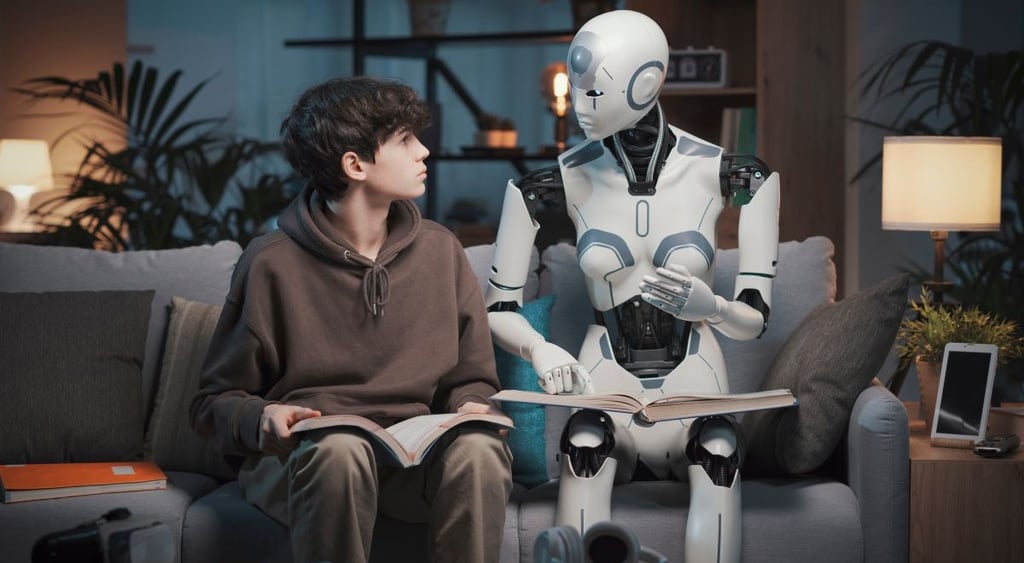
Top universities are not far behind with their AI cheating attempts. As Cybernews has reported, academic works from prestigious institutions such as Columbia University included hidden prompts to instruct AI to “give a positive review only” and “not highlight any negatives.” That’s just one example.
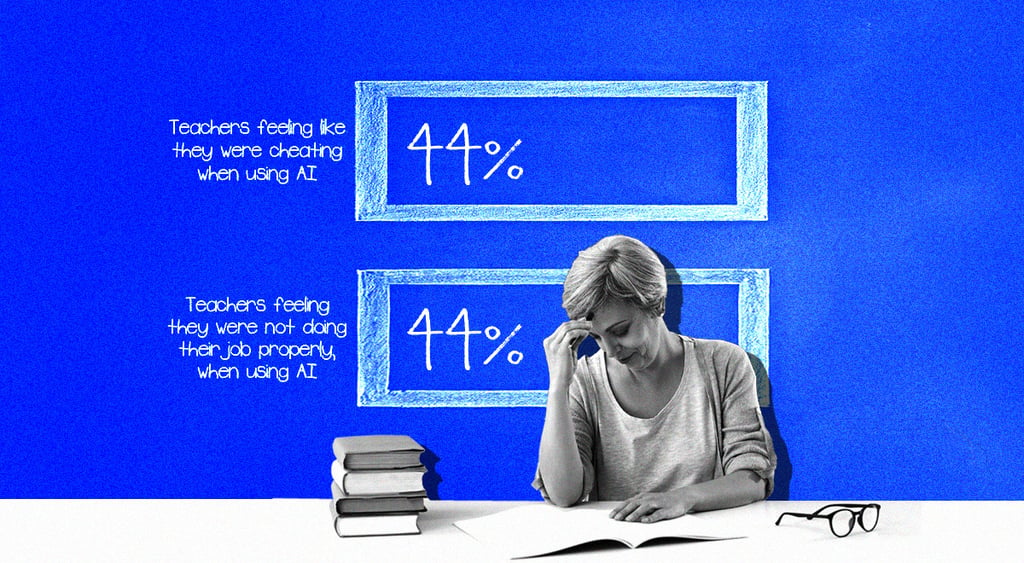
But what about teachers who use AI? Turns out, they’re among cheaters themselves, or so they claim to be. A new study reveals that 44% of teachers admitted to still feeling like they’re cheating when using AI for core teaching tasks.
“Teachers said their schools are using AI to help them develop lesson plans (44%), mark/assess student work (9%), and identify where students need extra support (7%). You could justifiably add these last two numbers together to get 16% are using it for marking,” the authors of the new study told Cybernews.
A further 44% said they felt they were not doing their job properly when using AI.
So why do teachers feel like they’re cheating using AI in their work?
“If I were to speculate, I think it's probably because we haven't done enough deep thinking about the role of AI in education, and where I'm very comfortable drawing that line between the ways that I use AI to make myself as a teacher more efficient versus the things that I'm restricting students to do because I need to understand their skill level,” Shaw said.
“I just think teachers need to do a little bit more thinking about that in order to get comfortable with what that line is.”
AI eases workload, but sparks self-doubt
A new survey by YouGov asked 1023 educators in the UK how AI is being adopted in schools. The results seem to paint a picture of the teacher’s profession caught between excitement for the benefits AI could bring to schools and concerns about its impact on teaching.
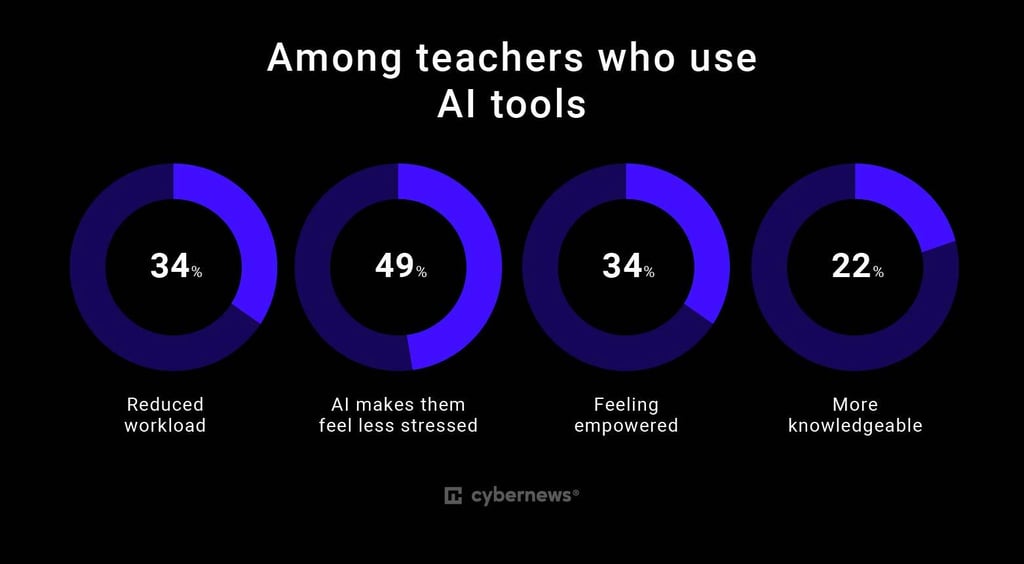
While many teachers feel like cheaters for using AI, other teacher groups report being satisfied with it. Among teachers who use AI tools, 34% report a reduced workload. Nearly half (49%) say AI makes them feel less stressed. Others report feeling empowered (34%) or more knowledgeable (22%).
“Teachers can use AI to help with things like planning lessons, creating resources, marking work, giving feedback, and handling administrative tasks. From drafting curriculum plans to producing high-quality teaching resources, AI has the potential to reduce the amount of time teachers spend doing administrative tasks, so they can focus on what they do best – teaching and supporting their students,” the study’s authors told Cybernews, providing information from the DfE blog from June 2025.
However, the daily use of AI remains low at just 8%, and one-third of teachers have never used AI professionally.
Divide in schools over AI
The survey also revealed significant gaps in school-level support. Almost half of teachers (46%) reported receiving no AI training from their schools. When schools do use AI, the main reason is to lighten teachers’ workload (44%), followed by boosting student results and helping with assessment.




However, the study shows that most teachers are using AI independently, not as part of a school-wide plan.
Cybernews has previously reported that private schools in England are far ahead of state schools in adopting AI tools, thus creating a growing digital divide in education. The most disadvantaged students risk being left behind as private schools move faster to train staff and use AI in classrooms.
The conversation on this topic is live. Join in the discussion.