Shadow AI soaring: 59% of employees hide AI use from their bosses
Nearly six in ten US employees are using AI tools at work that their employers haven’t approved, and many are feeding models with sensitive data, a new Cybernews survey has revealed.

Image by Cybernews

 Follow us
Nearly six in ten US employees are using AI tools at work that their employers haven’t approved, and many are feeding models with sensitive data, a new Cybernews survey has revealed.
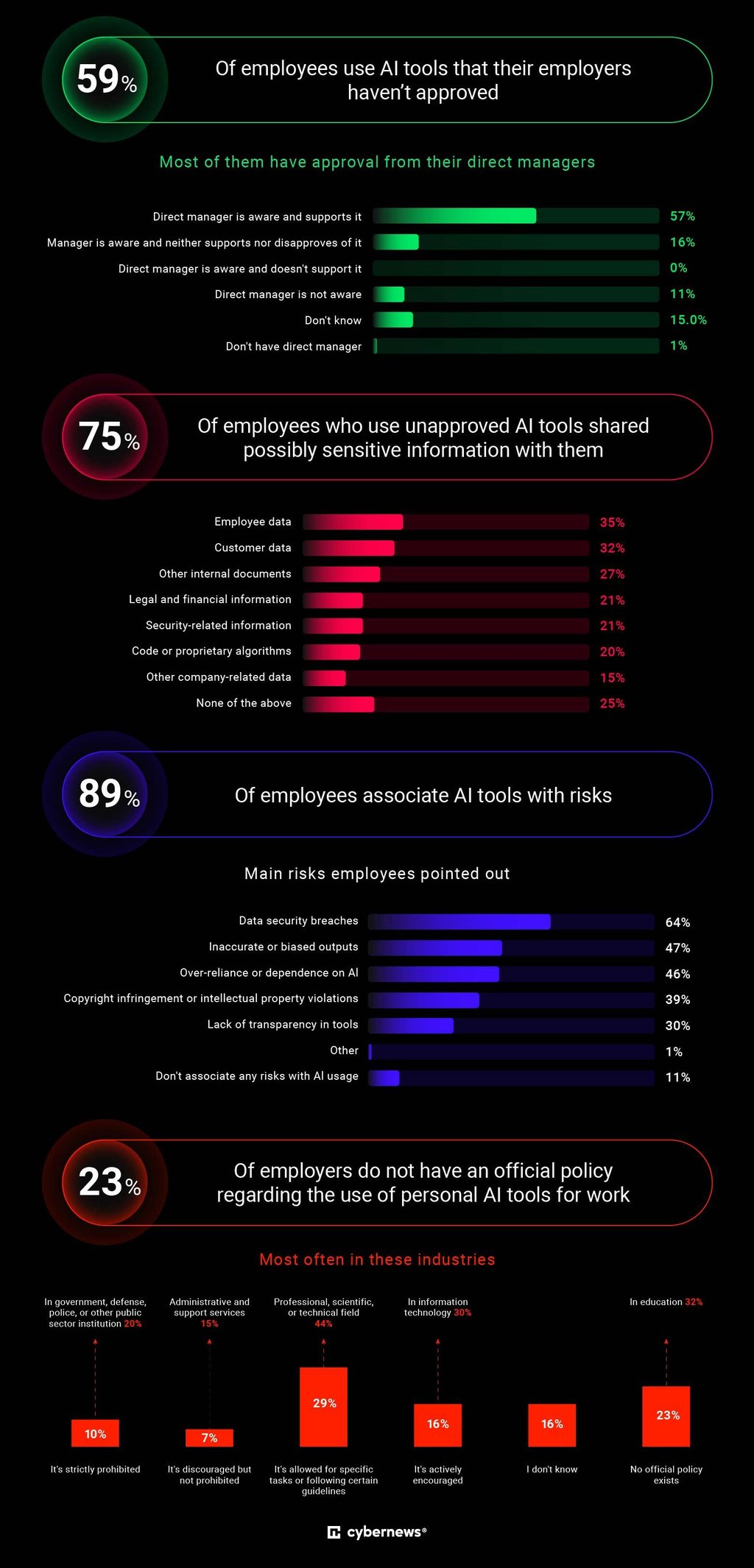
The use of AI at work is accelerating, but much of it is happening in the shadows. A Cybernews survey of more than 1,000 employees across the US showed that 59% admit to using unapproved AI tools to help with work tasks. Many use AI a few times per week, if not daily.
Shadow AI, or the unmonitored use of generative AI tools, occurs when employees feed corporate and sensitive data into systems outside IT’s control. This phenomenon is a pain point for multiple companies, as it introduces various risks to data safety.
However, despite recognizing risks like data breaches or AI giving wrong answers, workers continue to bypass company rules, often because the approved tools don’t meet their needs.





Companies set rules, employees do not follow
Seventy-seven percent of companies have an official policy on whether workers can use personal AI tools in the workplace, and 52% of employers provide approved AI tools. However, only a third of employees say those tools fully meet their work requirements.
This mismatch is fueling shadow use. Eighty-five percent of employees who have approved AI tools also admitted to using unapproved ones in the past year. In contrast, 69% of those without company-approved tools said they hadn’t used outside AI at all.

How do employees use AI?
Generative AI dominates workplace use. Employees most often turn to AI for writing, editing, research, brainstorming, and data analysis. The most commonly used tools are generative AI tools like ChatGPT or Claude. AI writing assistants, such as Grammarly and Jasper, and AI research assistants, such as Perplexity AI or Consensus, are also widely used.
The survey also highlights inequalities in who gets access to employer-approved tools. Executives, managers, and supervisors are more likely to be equipped with AI, while frontline employees are left to find their own solutions.
Men and millennials also report higher access rates, as do employees in IT, professional, scientific, and technical industries. These same groups are also the most likely to rely on unapproved AI.

Sensitive data is fed to AI tools
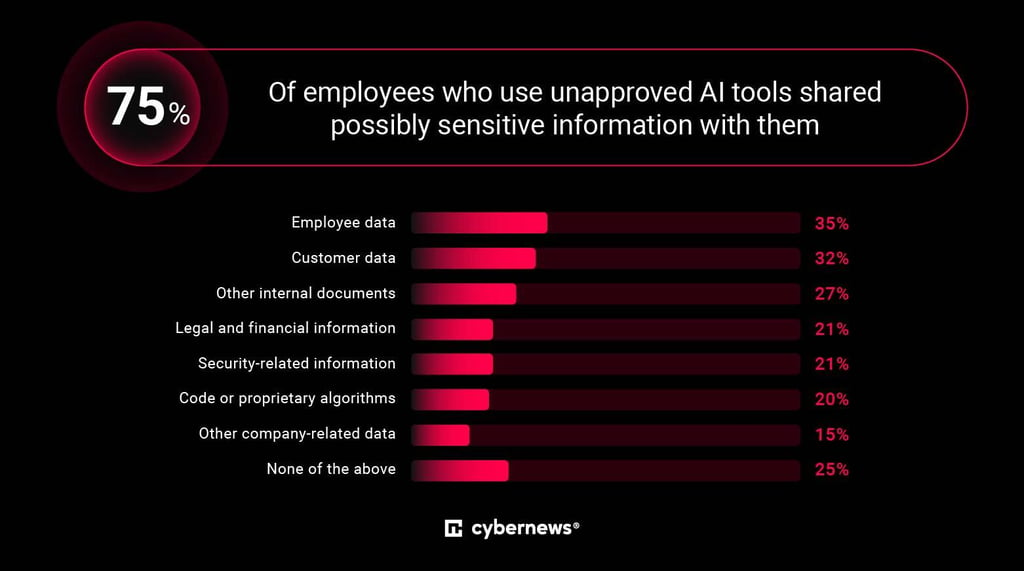
Many workers enter potentially sensitive data into personal AI systems. Three in four employees who use unapproved AI tools have shared work-related information, including customer details such as contact data or purchase history.
These workers were also likely to share internal documents, legal and financial information, code, and proprietary algorithms.
Ironically, most respondents said they would stop using AI tools if they knew company data was being revealed. AI tools giving wrong answers and the boss’s disapproval were also legitimate reasons to stop using personal AI tools.
Popular AI tools are not safe
Another major issue with AI is cybersecurity, as widely used AI platforms and tools show uneven and often poor cybersecurity performance. According to Cybernews Business Digital Index, nearly 90% of analyzed AI tools have been exposed to data breaches, putting businesses at severe risk.
In previous research, Cybernews analyzed 52 of the most popular AI web tools in February 2025, ranked by total monthly website visits based on Semrush traffic data.
Researchers found major gaps despite an average cybersecurity score of 85 out of 100. While 33% of platforms earned an A rating, 41% received a D or even an F, revealing a deep divide between the best and worst performers.

AI use at work is exploding, and so are the risks
In just two years, Gallup found that the number of US employees using AI in their roles has nearly doubled, with daily use skyrocketing from 4% to 8% in the past year alone. Research by van der Meulen and Barbara Wixom predicts that by 2027, nearly three-quarters of employees at large organizations will be using AI.
Google’s 2024 survey of knowledge workers showed 93% of Gen Z employees already juggle two or more AI tools at work, while 79% of millennials report similar habits.
The Cybernews community is talking about this. Be a part of the conversation.
Elon University’s 2025 survey backs this up, finding that 58% of AI users regularly switch between multiple models to complete their tasks. From writing emails to taking meeting notes, AI is quietly becoming the default assistant in modern offices.
Worryingly, a huge chunk of this activity is happening outside corporate guardrails. Harmonic’s research shows 45.4% of sensitive data prompts are entered through personal accounts, completely bypassing company monitoring systems.






A 2025 Metomic survey of security leaders in the US and UK found that while 90% of organizations claimed confidence in their defenses, many malware attacks, phishing schemes, or breaches were tied to sloppy AI use. Sixty-eight percent admitted to actual data leaks caused by staff feeding sensitive information into AI tools, yet just 23% had rolled out serious policies to stop it.
No wonder some companies are nervous. Samsung, Verizon, and J.P. Morgan Chase are among the big names that have outright banned ChatGPT and similar tools over compliance and security fears.
Still, this might not be a solution without providing alternatives, as a simple ban might potentially fuel the shadow use of personal AI tools.
Unlock more exclusive Cybernews content on YouTube.