Bring Your Own AI and the rise of shadow AI in the workplace
BYOD, also known as "Bring Your Own Devices," was a trend that IT infamously failed to prevent as leadership teams and workers united in their demands to bring their personal iPads and smartphones into the office.

Image by Cybernews.

 Follow us
BYOD, also known as "Bring Your Own Devices," was a trend that IT infamously failed to prevent as leadership teams and workers united in their demands to bring their personal iPads and smartphones into the office.
The rise of SaaS and Cloud Computing would then grab the baton as Shadow IT became the next big challenge for the guardians of the corporate networks. Suddenly, teams could easily bypass IT restrictions by using tools like Slack, Dropbox, and Google Apps.
While IT teams attempt to rebrand themselves as business enablers rather than blockers, many workers are once again regaining control. This phenomenon is being dubbed "Bring Your Own AI," or BYOAI, and it's spreading through offices worldwide.
Welcome to the new shadow workforce of AI-powered employees hiding in plain sight. Behind every minimized window is a user hiding AI tools to get ahead, while company policies struggle to catch up.
Users who have their own AI accounts and use it at work, eclipse the number of companies providing AI to employees. While @mit calls this the undefinedShadow AI Economy,undefined I call it BYOAI. Just like in the early days of iPads and iPhones, IT adapted to support BYOD (Bring Your Own… pic.twitter.com/3E55MWhJgh
undefined Brian Solis (@briansolis) August 23, 2025





BYOAI in the workplace
OpenAI's ChatGPT, Google Bard, Anthropic's Claude, or other cloud AI apps that aren't officially provided or sanctioned by their employer are being used to complete tasks.
The popular AI tools are used to draft emails, summarize reports, generate code, or brainstorm ideas, often without the IT department's knowledge.
Just like the shadow IT phenomenon, people are using their own tech solutions because the company hasn't provided a convenient alternative. BYOAI, often called "shadow AI," means a lot of AI activity is happening off the official radar.
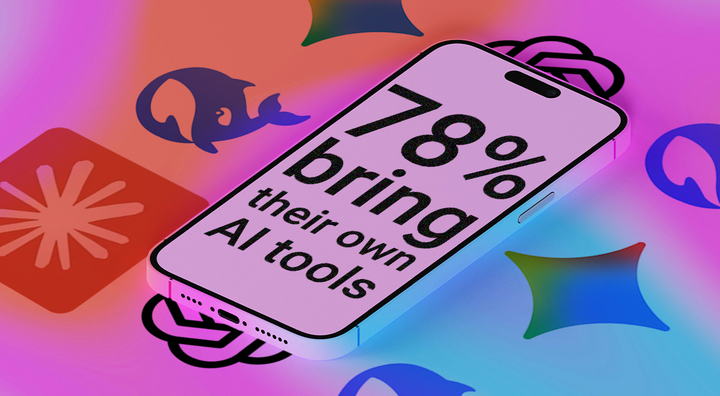
The Word Trend Index report from Microsoft and LinkedIn found that 75% of knowledge workers have tried or use AI at work, and 78% of those AI users are bringing their own AI tools to the office.
Office workers aren't waiting for an official memo permitting them to use AI or training courses; they're just doing it. And if that means signing up for a $20/month ChatGPT Plus subscription or a premium image generator on their own, many are willing to do so.
Exploding Topics recently revealed in a survey that 29% of employees personally pay for AI tools they use at work. What's the ROI (Return on Investment)? 80% said AI tools have increased their productivity, and over 90% rated their overall work experience with AI as positive.
The latest Microsoft Work Trend Index report about AI and work claims 75% of workers already BYOAI to work. I true, where is the promised productivity boom? Outside of data protection, why the need to invest in strategic AI when workers BYOAI? pic.twitter.com/izgIPZy7YE
undefined Marc Watkins (@Marc__Watkins) June 6, 2024
The hidden risks of "Shadow AI"
When staff start pasting company information into a chatbot or relying on an AI's output to make decisions, new risks emerge. Data security and privacy are the most obvious concerns.
When Samsung Electronics discovered that some of its engineers had uploaded internal source code to ChatGPT, it banned employees from using ChatGPT and other AI tools at work. Major banks like JPMorgan and Goldman Sachs also restricted employees from using public AI bots. But they cannot police devices at home.
When everyone is doing their own AI thing, the organization loses visibility and control. The company's tech leaders might not even know that the customer support team has started using an unofficial AI chatbot to answer customer emails, or that engineers are feeding proprietary product plans into a coding assistant online.
Shadow AI usage means security and compliance teams can't assess what tools are in use, nor ensure that those tools meet the company's standards.
Over the past few weeks, I’ve seen troubling stats on “shadow AI” and spoken with leaders losing sleep over it. A recent @hrdive article reported that 45% of employees have used AI tools their companies banned and 58% have pasted sensitive data into them. The Fortune piece that…
undefined Arvind Jain (@jainarvind) August 25, 2025
Employees vs. Employers
Ironically, while employees are sprinting ahead with AI, many companies have barely left the starting blocks when it comes to guidance and training. This gap is becoming increasingly obvious. Studies indicate that only about 39% of AI-using employees have received any AI-related training from their employer.
In other words, a substantial majority are self-taught or learning as they go. And it's not because workers wouldn't welcome the help, it's simply that most employers aren't offering much in the way of AI education yet.
The same Microsoft/LinkedIn survey found that only 25% of companies even plan to provide AI training in the near future. This isn't due to a lack of employee interest; in many cases, the training isn't available.
The result is a wild west environment where employees are left to figure out AI on their own. For better and worse, this experimentation is happening under no one's supervision.




If every employee is doing their own thing with AI, there's no shared base of best practices, no efficiency of scale, and likely a lot of reinventing the wheel. By not actively training people, companies leave potential productivity gains on the table.
On the flip side, organizations that do invest in upskilling their workforce stand to benefit enormously. Professionals themselves recognize this, and they're already seeking out AI knowledge independently. They're hungry to learn. And businesses that satisfy that hunger can turn a chaotic shadow AI situation into a powerful, well-leveraged toolset.
#ShadowAI usage surged 50% in 90 days according to @Netskope's latest report. While companies debated acceptable use policies, employees quietly funneled 8.2 GB of data per month into #GenAI tools. Shadow AI isn’t coming. It’s already eating your data.https://t.co/UYq2RjNg00 pic.twitter.com/cqcdcLFGiY
undefined Kiteworks (@Kiteworks) August 21, 2025
Provide secure AI tools
A very straightforward way to curb risky shadow AI usage is to offer official AI tools that employees can use safely. Many tech providers now have enterprise-grade AI solutions that prioritize privacy and security.
For instance, OpenAI launched a ChatGPT Enterprise edition that promises encrypted conversations and no usage of company data to train the model. Microsoft is integrating its Copilot AI assistant into Office 365 with admin controls for businesses. By signing up for these kinds of services (or building their own in-house AI tools), companies give employees a sanctioned outlet for AI experimentation.
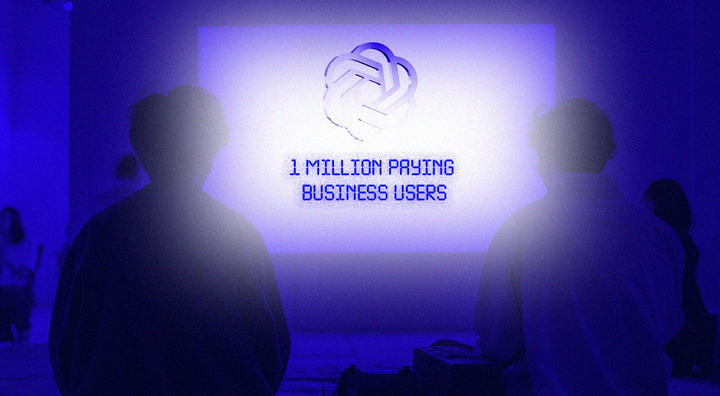
There's evidence this is starting: OpenAI reported it had over 1 million paying business users for its ChatGPT business products by late 2024, including at many Fortune 500 companies.
With an approved tool, an employee doesn't have to go rogue with a random app; they can use the company-provided AI, which comes with proper security, compliance checks, and support. It's the same logic as providing approved software to prevent shadow IT.
Sure, not every AI need can be met in-house, but covering the common cases like a company-wide AI assistant for writing, research, and coding can dramatically reduce the incentive for employees to use unvetted tools.
The era of BYOAI is officially here. Companies that acknowledge it and adapt will be the winners of tomorrow.