Newsom signs AI safety law but bends to lobby from big tech
California’s governor, Gavin Newsom, has signed landmark legislation aimed at protecting children from risks posed by artificial intelligence (AI), but vetoed the bill restricting underage users’ access to chatbots.

Image by Cybernews.

 Follow us
California’s governor, Gavin Newsom, has signed landmark legislation aimed at protecting children from risks posed by artificial intelligence (AI), but vetoed the bill restricting underage users’ access to chatbots.
SB 243, a bill signed on Monday (October 13th), requires companies operating chatbots to issue a clear warning every three hours, reminding the user to take a break and that they are interacting with AI, not a human.
Companies operating chatbots also must maintain a protocol for preventing the production of suicidal ideation, suicide, or self-harm content to the user.
There’s a growing concern about the impact AI has on children. Last year, 16-year-old Adam Raine took his own life after confiding in a chatbot. His parents are suing the chatbot’s creator, OpenAI, alleging it validated Raine’s “most harmful and self-destructive thoughts.”










Meta’s chatbots were found to offer explicit sexual conversations to children, prompting the Senate’s investigation into the tech giant’s policies.
Nearly three in four (72%) teenagers have used AI companions, including for romantic interactions and emotional support. Many say conversations with AI companions are as satisfying or even more satisfying than those with real-life friends.
Critics accuse Newsom of “siding with big tech”
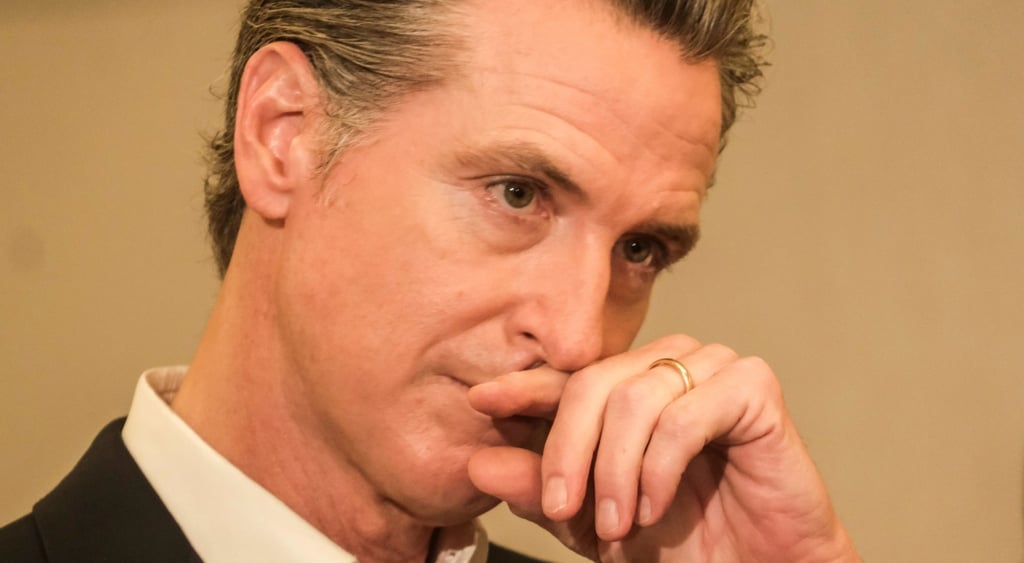
Newsom vetoed AB 1064, a bill that would have banned companies from making chatbots available to users under the age of 18 unless they could ensure the technology couldn’t engage in sexual conversations and encourage self-harm.
“AB 1064 imposes such broad restrictions on the use of conversational AI tools that it may unintentionally lead to a total ban on the use of these products by minors,” Newsom wrote in his veto letter.
California’s governor said he will work on finding an approach that protects children from these harms while allowing them to continue using AI.
Assemblymember Rebecca Bauer-Kahn, who authored AB 1064, said she was highly disappointed with the veto and that Newsom was “siding with big tech.”
Common Sense Media, a nonprofit organization that supported the bill, called the veto “deeply disappointing” and said the legislation is desperately needed to protect children and teens from dangerous AI companion chatbots.
“Clearly, Governor Newsom was under tremendous pressure from the big tech lobby to veto this landmark legislation,” the organization said in a statement.
The conversation on this topic is live. Join in the discussion.
OpenAI, which was involved in negotiations along with other tech giants, welcomed the legislation, saying that it will pave a “critical path toward harmonization with the federal government.”
Newsom may not be the only one under pressure from tech companies. Nathan Calvin, general counsel of Encode, a small AI policy nonprofit, accused OpenAI of using intimidation tactics against him for “working on AI regulations, including SB 53.”
One Tuesday night, as my wife and I sat down for dinner, a sheriff’s deputy knocked on the door to serve me a subpoena from OpenAI.
undefined Nathan Calvin (@_NathanCalvin) October 10, 2025
I held back on talking about it because I didn't want to distract from SB 53, but Newsom just signed the bill so... here's what happened:
🧵 pic.twitter.com/VnYCJYg2DH
Calvin, who was subpoenaed by OpenAI, said he believes the company used the pretext of its lawsuit against Elon Musk to intimidate its critics and “imply that Elon is behind all of them.”
Musk, a co-founder of OpenAI who left the company due to disagreement with CEO Sam Altman, has sued his former startup, claiming it abandoned its nonprofit missions and formed an illegal conspiracy with Apple to stifle competition.
Humans are accountable for autonomous AI, the bill says
The signed legislation includes the AB 316 bill, which maintains human accountability for AI systems. This bill states that those who developed, modified, or used AI that has caused harm to a human cannot use the claim of AI autonomy as a defense against civil liability.
Meanwhile, the AB 621 bill amends existing law to address deepfake pornography, allowing victims to seek as much as $250,000 in civil relief.
Donald Trump’s special advisor for AI and crypto, David Sacks, has previously said that startups are being impacted by individual states’ reporting requirements.
He compared California’s AI safety bill with the EU AI Act, passed in 2024, which became the first comprehensive legal framework for AI in the world. The law aims to ensure the ethical use of AI and people’s fundamental rights.
Sacks said in a recent All-In Podcast episode, “This is like very European-style regulations – actually, maybe even worse than the EU, because the EU tried to basically harmonize to get to one authority.”