Meta rolls out Muse Spark, its new personal AI model
Meta is rolling out Muse Spark, its first AI model from Superintelligence Labs, to power a more personal Meta AI across Facebook, Instagram, WhatsApp, Messenger, and smart glasses.

By Getty Images

 Follow us
Meta Platforms officially entered the AI race on Wednesday, rolling out its first artificial intelligence model, Muse Spark, created by the company’s new Superintelligence Labs unit.
- Meta has rolled out Muse Spark, its first AI model from Superintelligence Labs, and it is already powering Meta AI.
- The company is bringing the model to Facebook, Instagram, WhatsApp, Messenger, and its AI glasses in the coming weeks.
- Meta is pitching Muse Spark as a faster, more personal assistant as Big Tech fights to dominate AI.
Key Takeaways by nexos.ai, reviewed by Cybernews staff.
Muse Spark is the first in a new family of models designed to move Meta closer to what it calls “personal superintelligence” – AI that can assist users with everyday tasks in a more tailored, responsive way.
Coined its “most powerful model” to date, Muse Spark is already live on the Meta AI app and website, and currently powering the Meta AI assistant, the company said in Wednesday’s announcement.
“Nine months ago, we rebuilt our AI stack from scratch. new infrastructure, new architecture, new data pipelines. Muse Spark is the result of that work, and now it powers Meta AI,” Alex Wang, Meta’s chief AI officer, posted on X.





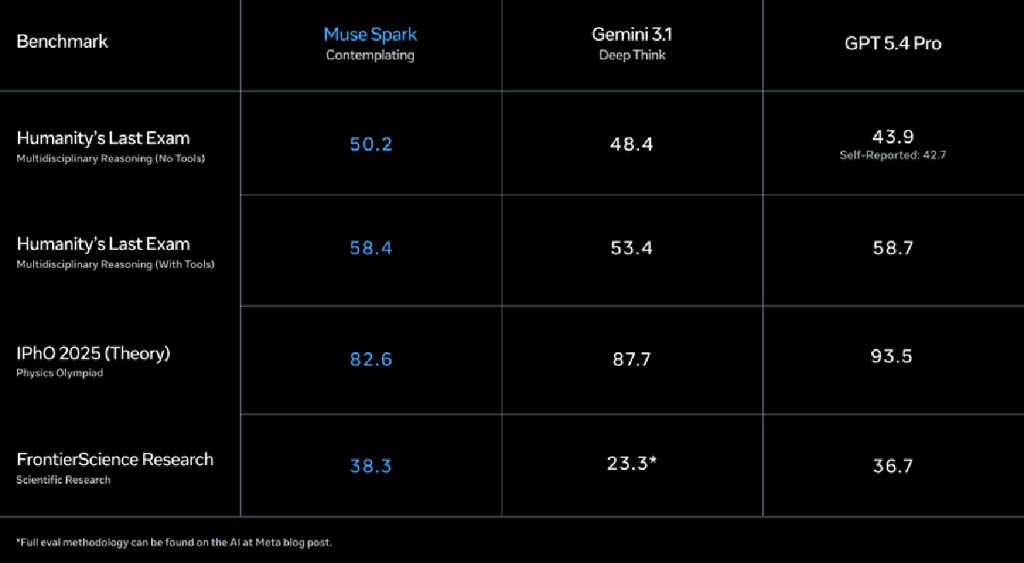
Wang also shared a benchmark table showing the model’s multimodal and reasoning skills against rival “extreme reasoning” models, including Anthropic’s Opus 4.6, Gemini Deep Think 3.1, GPT-5.4 Pro, and Grok 4.2.
The model's performance showed it catching up with top models in some areas, like language and visual understanding, but lagging in others, like coding and abstract reasoning.
Notably missing from the announcement was Muse Spark's exact size, a key measure typically used to compare an AI system's computing power with its competitors.
One X user also noted that "Muse Spark used 58M output tokens on the Intelligence Index, compared to 157M for Opus 4.6 and 120M for GPT-5.4" – suggesting the model may be producing some results more efficiently than rivals.
AI fintech builder @gabriel_horwitz commented on the millions of Meta users and the free training data the company now has access to.
"Meta has 3B users across Facebook, Instagram, WhatsApp, and if Muse Spark is now embedded in all of them and future versions can train off that data, the feedback loop they're about to build on real usage data is something OpenAI and anthropic literally cannot replicate," they said.
Built to be fast, multimodal, and more personal
The first of its new "Avocado" series of large language models by Meta Superintelligence Labs (MSL), already in development, Muse Spark is expected to roll out across all Zuckerberg-run platforms, including Instagram, Facebook, Messenger, WhatsApp, as well as its AI-enabled glasses, in the coming weeks.
The model itself is described as “small and fast by design,” but still capable of handling complex reasoning across areas such as science, math, and health.
Unlike earlier systems, Muse Spark is multimodal – meaning it can process both text and images.
This allows users to do things like snap a photo of food to estimate nutritional value, compare products visually, or get contextual recommendations based on what they’re looking at, Meta said.

It also introduces a more advanced approach to problem-solving where users can switch between faster responses and deeper “thinking” modes, with the AI deploying multiple sub-agents at once to tackle different parts of a question simultaneously.
Meta boasts that Muse Spark doesn’t just respond – but actively works through problems.
The company says the model excels at visual coding, allowing users to create custom websites and mini-games directly from a prompt.
“Ask Meta AI to build a dashboard for planning a big surprise party, spin up a retro arcade game to chase a high score, or launch a whimsical flight simulator — and share any of them with friends,” it says.
Meta bets on AI inside every app
Another key part of Muse Spark is its tight integration with Meta’s ecosystem, purpose-built to work across Meta products.
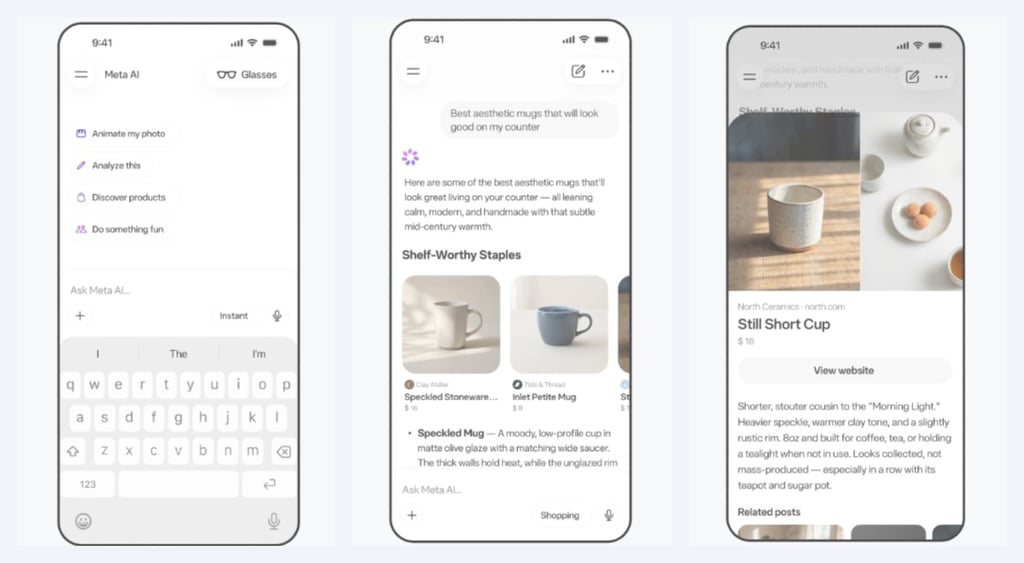
The system can surface recommendations, trends, and content pulled directly from platforms like Instagram and Facebook, giving users answers shaped by what people are actually sharing and discussing.






This includes shopping suggestions, travel ideas, and local insights – all embedded directly into the AI experience.
“It will power a smarter and faster Meta AI, and over time unlock new features that cite recommendations and content people share across Instagram, Facebook, and Threads,” it said.
Meta says future versions will go even further, integrating Reels, posts, and photos directly into responses while crediting original creators.
Safety checks and what comes next
As for guardrails, Wang said on X that his team conducted extensive safety evaluations “before deployment, both before and after applying mitigations across frontier risk categories, behavioral alignment, and adversarial robustness.”
“We found Muse Spark demonstrated strong refusal behavior across high-risk domains such as biological and chemical weapons,” he added.

Check if your data was exposed
Find out if your email and related personal information have appeared in known data breaches.
Wang, former AI CEO at Scale, was hired last year as part of a $14.3 billion deal to revamp Meta’s AI department and staff a new superintelligence team after dismal feedback on its earlier Llama 4 models.
The new MSL head acknowledged in another X post that "there are certainly rough edges we will polish over time in model behavior."
Meta also said it will be offering the model in private preview via API to select partners, although it said it "hopes to open-source future versions of the model."
Unlock more exclusive Cybernews content on YouTube.