Microsoft takes step back from OpenAI with new “in-house” AI models
Microsoft seems to be gaining independence from OpenAI’s influence by unveiling its two in-house artificial intelligence (AI) models, MAI-Voice 1 and MAI-1-preview.

Omar Marques via Getty Images.

 Follow us
Microsoft seems to be gaining independence from OpenAI’s influence by unveiling its two in-house artificial intelligence (AI) models, MAI-Voice 1 and MAI-1-preview.
Microsoft has revealed its two latest AI models, which include a “highly expressive” natural speech generation model and the tech giant’s first end-to-end foundation model.
MAI-Voice 1 allows users to generate spoken language snippets using textual prompts. By choosing the tone, voice, and mode, users can generate their text in a specific style.
Microsoft markets this model as an “interface of the future of AI companions,” supposedly encouraging people to use MAI-Voice 1 to create AI companions or use it as a chatbot pal.




Equally, the tech giant says that users can generate stories and guided meditations using a single prompt.
The model can generate a full minute of audio in “under a second on a single GPU” making it one of the fastest and efficient audio generation models, according to Microsoft.
Microsoft’s second model is described as an “in-house-mixture-of-experts-model” which is pre- and post-trained on 15,000 NVIDIA H100 GPUs.
The MAI-1-preview is a powerful answer to your everyday chatbot as it's designed for customers looking to receive “helpful responses to everyday queries.”
This model will be rolled out in Copilot, Microsoft’s AI-powered chatbot, over the next few weeks, so it can learn and evolve based on users' feedback.
The in-house AI model is open for testing in LMArena, an open-source platform where people evaluate new AI models.
What’s happening with OpenAI and Microsoft?
Prior to the announcement, Microsoft had relied heavily on OpenAI’s models to power its AI products like Azure and Copilot.
Microsoft previously invested billions of dollars in OpenAI, describing it as a “long-term partnership.”
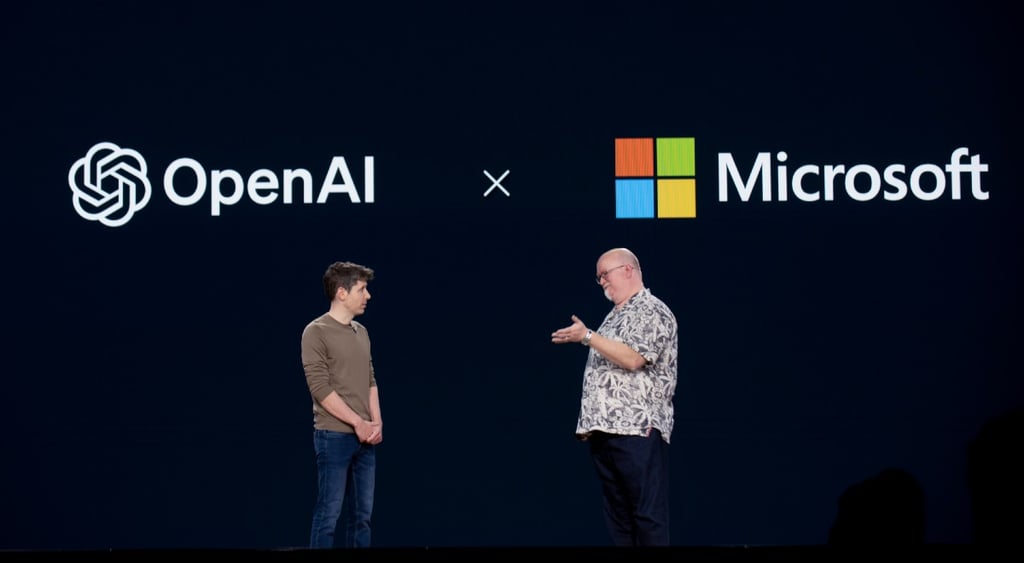
The tech giant reportedly spent $13 billion on OpenAI, an investment that was eventually cleared by the UK watchdog, according to Bloomberg.
Now, it seems to be shifting to homegrown products, like the MAI-1-preview, which is supposedly trained and tested in-house.