Microsoft says “typing code is absolutely over” as AI agents reshape how Windows 11 is built
The role of a software engineer is changing.

A conductor bringing about software code. Image by Cybernews.

- Microsoft engineers say AI agents can build, test, and run code with less manual typing.
- Satya Nadella said AI produces 30% of Microsoft’s coding, but warned against overtrusting AI.
- Developers still need to review AI output because machines make mistakes and can introduce known errors.
- Microsoft uses more than 100 AI agents to help find security flaws in Windows and Azure.
Key Takeaways by nexos.ai, reviewed by Cybernews staff.
When a Microsoft engineer posts on X that “typing code is absolutely over,” you’d be forgiven for not knowing whether he was being blunt or plain cryptic.
David Fowler’s post suggests that manual, line-for-line programming is needless compared to just a few years ago, thanks to AI coding tools. But it doesn’t necessarily mean the death of the programmer.
AI models, like Microsoft’s Copilot, are much more powerful these days. They can take a task, simulate the code on a virtual cloud-based computer, configure everything, and then run the software.
In effect, they’re road-testing their own code in a cloned environment.




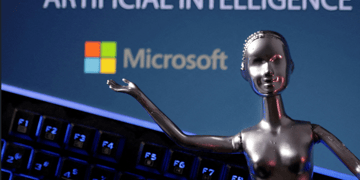

Microsoft CEO Satya Nadella has gone on record advising businesses against putting too much faith in AI. But on another occasion, Nadella also admitted that 30% of Microsoft's coding is produced by AI.
The role of the programmer is therefore changing into checking the progress of AI output, and manually deciding where the machine has made the wrong decision. Think of it like a conductor prompting and following the ebb and flow of the (agentic) orchestra.
The keyboard may be losing its starring role, but the programmer still plays a vital role in the process.
Typing code is absolutely over.
undefined David Fowler (@davidfowl) September 3, 2026
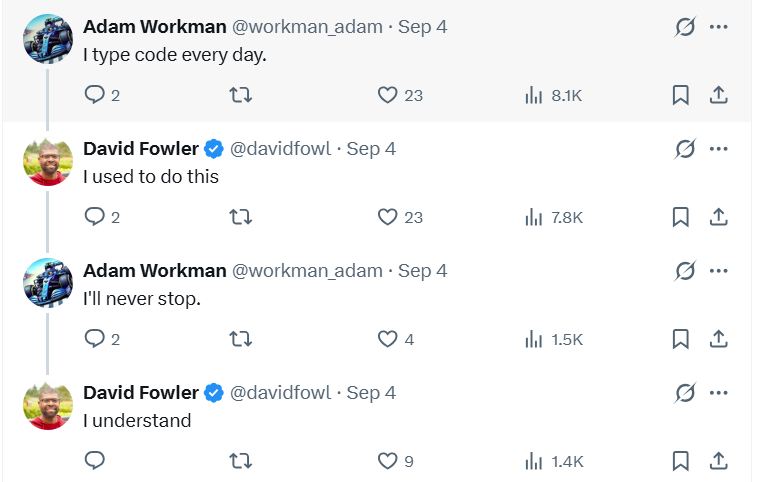
“I type code every day”
Several coders reacted to the post. One replier maintained, “I type code every day,” while another claimed they’d never stop doing so.
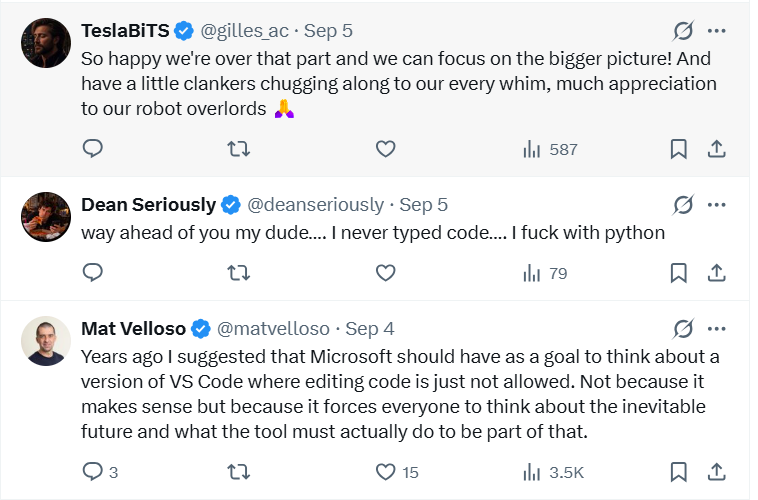
On the other side of the coin, another commenter appreciated “little clankers chugging along to our every whim,” adding that he has “much appreciation to our robot overlords.”
And another poster claimed he had recommended Microsoft should cut down on human editing of software code.
Such an impassioned discussion highlights how much it means to developers that they still code.
AI builds and fixes software
The big change is fewer back-and-forths between prompting AI and having to check the output. AI agents are becoming fully adept at building and executing tasks themselves, as opposed to waiting on one-step commands.
There are messy parts of software development that can eat up a developer's time. Things like inspecting logs, identifying failures, and bouncing between different tools can be frustrating.
With an AI agent intervening in such laborious tasks – as the cliché says, “doing the legwork” – the development of Windows itself means that the tools will be used by machines, all under the bonnet of software development.
Has your password leaked?
Machines still make mistakes, however. A Veracode report from earlier this year revealed that approximately 44% of AI-generated code contained a known error, underscoring the need for humans to keep tabs on operations.
Microsoft is using AI to fix AI. MDASH (Microsoft Security multi-model agentic scanning harness) uses over 100 agents to perform complex security tasks, essentially hunting for vulnerabilities across Windows and its cloud computing platform, Azure.
Perhaps it goes to show that Fowler's provocative statement is better understood as a prediction that human developers will have more of a supervisory role, rather than simply vanishing out of thin air.