SpaceX and Blue Origin data centers could be catastrophic for Earth, scientists warn
It’s all just dangerous, irresponsible nonsense.
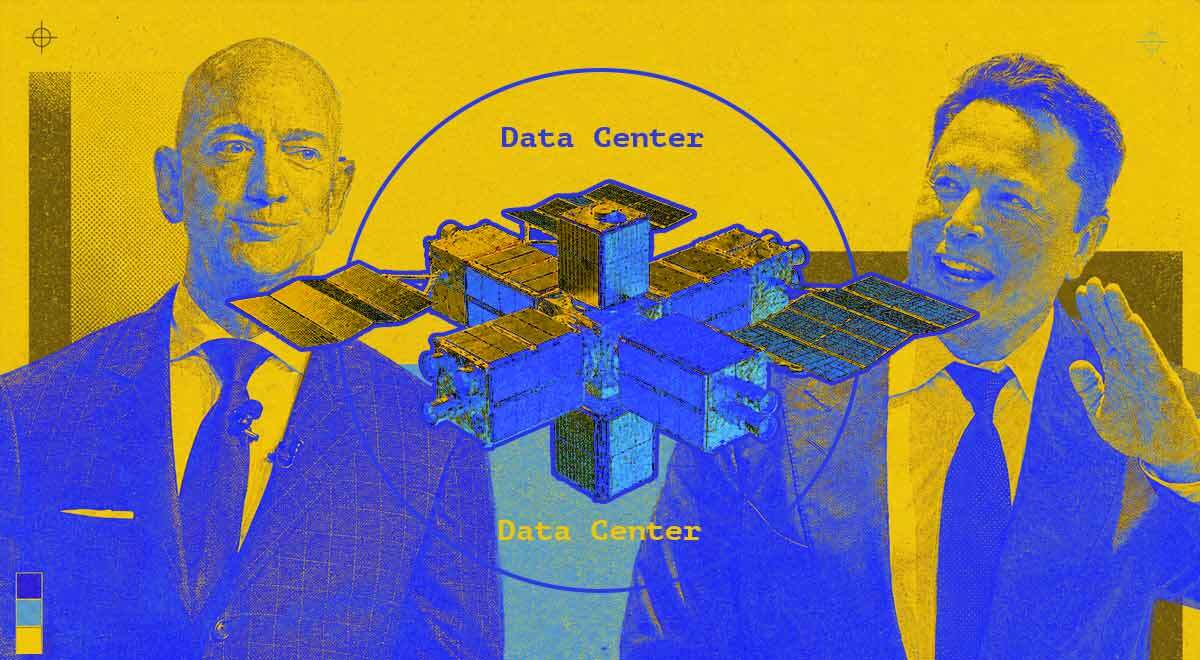
Image by Cybernews.

 Follow us
- Musk's SpaceX and Bezos's Blue Origin plan orbital data center mega-constellations to dodge Earth-based opposition
- Scientists warn over a million satellites could trigger catastrophic atmospheric pollution and stratospheric damage
- Petition organizers call claims of consequence-free AI expansion in space absurd and dangerously vague
Key Takeaways by nexos.ai, reviewed by Cybernews staff.
Since it’s pretty clear that people don’t like AI data centers, tech billionaires like Elon Musk and Jeff Bezos want to launch them in space. In a new petition, scientists say the idea is ridiculous and could cause an unprecedented environmental disaster.
On the surface, the idea seems quite reasonable. Communities are rising up against data centers on Earth, so moving them to our planet’s orbit would, in theory, solve this particular problem.
Plus, the tech bros say, the sun-synchronous orbits of these satellites would allow for the exploitation of “near-constant solar power.” That way, we could easily sate AI’s enormous appetite for energy.
The first proposal of this kind came in January when SpaceX, owned by the world’s richest individual, Elon Musk, sought permission to deploy a mega-constellation “of a million satellites that operate as orbital data centers.”






Has your password leaked?
A startup called Starcloud soon followed, and in March, Blue Origin, a space tech firm owned by Amazon founder Jeff Bezos, proposed “Project Sunrise,” another mega-constellation of data center satellites.
All these proposals are framed with grandiose rhetoric, which is not unusual, of course, when Musk is involved. His SpaceX, for example, claims that the data centers will “ensure humanity’s multiplanetary future amongst the stars.”
The problem is that all this is simply dangerous nonsense, a group of scientists says in a new petition organized by EarthJustice, Public Employees for Environmental Responsibility, and DarkSky International, all non-profits.
More than a million data center satellites would cause an ecological catastrophe of previously unseen proportions, they add.

According to the co-signees of the petition, claims that orbital data centers would facilitate the rapid expansion of AI computing without the social, economic, or environmental problems posed by terrestrial data centers are plainly ridiculous.
“The proponents of these proposals describe their plans in grandiose, civilization-changing terms,” reads the petition.
“But these same proponents have refused to embrace any inquiry into the impacts of their self-claimed epochal technology on the environment, science, economy, or other values,” the scientists add, claiming that the tech giants are all “conspicuously vague on the subject.”
The stratosphere is already experiencing an unprecedented rise in heavy metals, noxious gases, and carbon particles due to record numbers of satellite launches.
For instance, megaconstellations are creating significant light pollution, which is harming wildlife, academic and amateur astronomy, and indigenous cultural practices.
Even more importantly, “the operation of more than a million data center satellites threatens potentially catastrophic forms and quantities of atmospheric pollution, risking damage to the climate, to the ozone layer, to human health, and to the chemistry of the stratosphere itself,” the petition claims.
Indeed, the stratosphere is already experiencing an unprecedented rise in heavy metals, noxious gases, and carbon particles due to record numbers of satellite launches. Of the approximately 15,000 satellites in orbit as of 2026, roughly 50% were launched in just the last 5 years.




Stay updated with our latest stories and follow us on social media
Be the first to discover new stories, ideas, and updates from our team.
Spacecraft that bring those satellites up and down are extremely pollutive as well. Their launches emit black carbon, nitrogen oxides, carbon monoxide, aluminum oxide, chlorine gases, and, once in orbit, mercury.
The Cybernews community is talking about this. Be a part of the conversation.
A 2023 study sponsored by the National Oceanic and Atmospheric Administration found that sulfuric acid aerosols, which make up much of the stratosphere, now contain metals.
That’s bad news since those aerosols are thought to play a crucial role in regulating the Earth’s temperature and may function as a planetary “sunscreen” by creating high-level clouds that reflect solar radiation.