Robot successfully removes gallbladder with 100% accuracy
Recent research showed an AI-guided robot perform a complex stage of a common gallbladder operation (cholecystectomy) without human help.


 Follow us
We’re getting much closer to fully automated surgeries — recent research showed an AI-guided robot perform a complex stage of a common gallbladder operation (cholecystectomy) without human help.
The machine was reportedly trained on videos of human doctors performing operations using organs taken from dead pigs. Then the robot had to remove a gallbladder on its own with no mechanical help, just using voice commands.
The robot, named SRT-H (Surgical Robot Transformer-Hierarchy), was able to respond and learn from the team’s voice commands, similar to a junior surgeon. The system uses artificial intelligence (AI) to make independent decisions and navigate possible complications during surgery, according to Axel Krieger of Johns Hopkins University in Baltimore, who led the research.
Eight operations on eight varying sets of pig gallbladders and livers removed from animals were performed with a 100% success rate. The robot managed to successfully undertake 17 tasks, each lasting minutes.
This included identifying ducts and arteries, grabbing them precisely, strategically placing clips, as well as severing parts with scissors.





“This advancement moves us from robots that can execute specific surgical tasks to ones that truly understand surgical procedures,” Krieger said, "This is a critical distinction that brings us significantly closer to clinically viable autonomous surgical systems that can work in the messy, unpredictable reality of actual patient care."
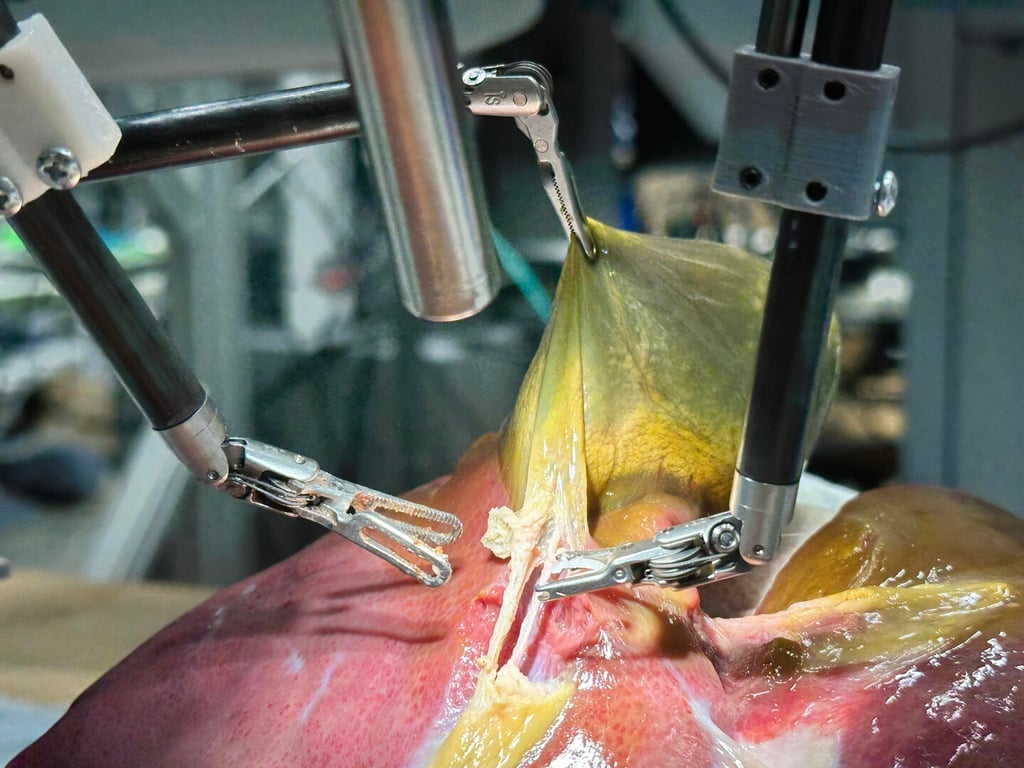
Although the robots were a bit slower than their human counterparts, they managed to map out shorter trajectories between tasks. They also consistently corrected mistakes as they went along, adapted to anatomical variations, and requested various tools.
SRT-H uses the same machine learning architecture that underpins ChatGPT and Google Gemini, allowing it to respond and adapt in real time. This means that robots can swiftly adjust in case the tissue they’re working with appears different from what was expected, not limited to their training but able to improve.
"This work represents a major leap from prior efforts because it tackles some of the fundamental barriers to deploying autonomous surgical robots in the real world," said lead author Ji Woong "Brian" Kim, a former postdoctoral researcher at Johns Hopkins who's now with Stanford University. "Our work shows that AI models can be made reliable enough for surgical autonomy – something that once felt far-off but is now demonstrably viable."
Robotic AI is currently used in less than 1% of surgeries worldwide and may take decades before it achieves wide adoption — however, such exciting breakthroughs can only give us hope for what’s to come.


