By participating in this viral trend, you help train AI where it struggles the most
The viral trend where people repeat the same phrase in different tones may play into the hands of big tech companies, whose AI models struggle with emotion recognition.
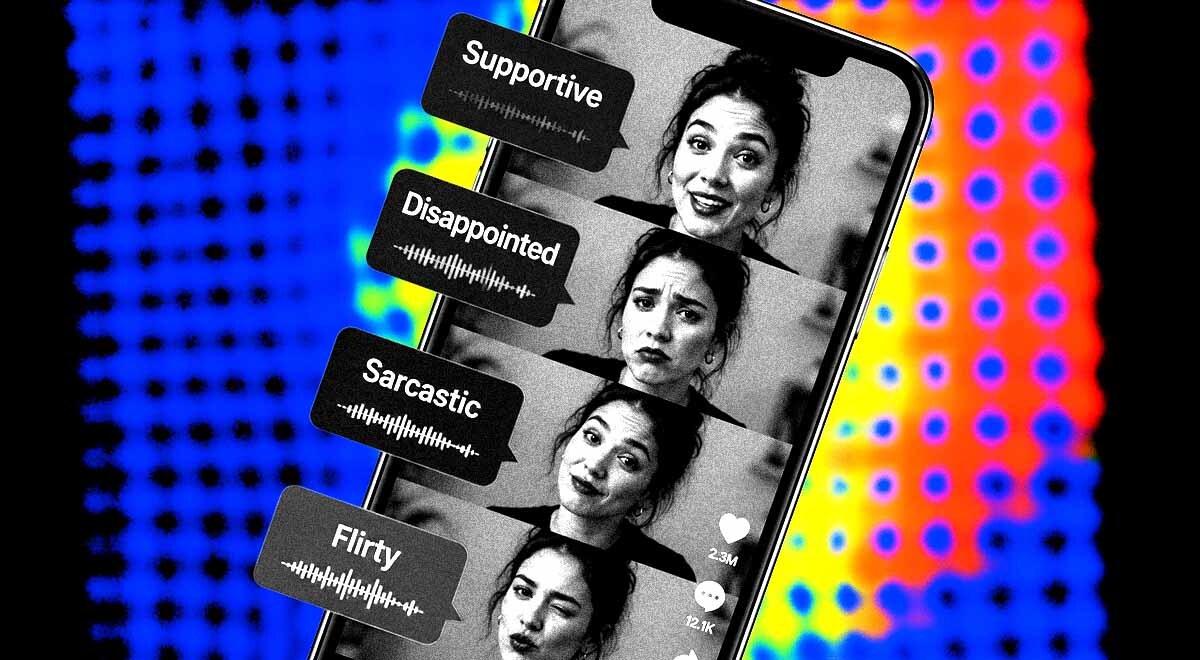
Image by Cybernews

 Follow us
The viral trend where people repeat the same phrase in different tones may play into the hands of big tech companies, whose AI models struggle with emotion recognition.
- A trend where users repeat the same phrase in different tones has gone viral on social media.
- Experts say these videos can be used to train AI models for emotion recognition, the area where they still struggle.
- However, due to the exaggerated, comic nature of social media, such data may not reflect real-life situations.
The tones range from supportive to sarcastic and angry, making short phrases sound hilarious, as evidenced by creators barely holding back their laughter while participating in the trend and hundreds of likes on these videos.
However, as innocent as it may seem, the trend may have a darker side, first brought to attention by Clara Fulks, a digital ethicist and CEO of the consulting firm North Star Strategies.






“That is going viral because big tech companies need emotional training data to train their emotion recognition models,” Fulks said in a recent video.
She called “the same phrase trend” a big victory for tech companies that want to use or sell this data.






Solving the biggest emotion recognition challenge
Olga Kokhan, founder and CEO of data services company Tinkogroup, says the trend is a case study in one of the biggest challenges in emotion recognition: the same words can mean totally different things depending on tone, pacing, emphasis, and context.
“Thousands of users saying the same phrase with different emotional expressions create a dataset that teaches AI systems to distinguish between what is being said and how it is being said,” she tells Cybernews.
This data can be used to improve models that analyze speech patterns, sentiment, and customer interactions, as well as accessibility tools.
For example, companies sell AI software to call centers, claiming they can recognize emotions and sentiment of customers, and hint at agents’ answers based on callers’ moods.
Thousands of users saying the same phrase with different emotional expressions create a dataset that teaches AI systems to distinguish between what is being said and how it is being said.Olga Kokhan
However, Kokhan and other experts who spoke to Cybernews pointed out limitations of data collected from such trends, stemming from the nature of social media platforms, which don’t necessarily reflect the real-world settings.
John Licato, PhD, an associate professor at the University of South Florida's Bellini College of Artificial Intelligence, Cybersecurity, and Computing, says there’s a tendency in viral trends to do things for the sake of comedic effect or viral spread.
“This doesn’t lend itself to the most immediately useful training data,” he says.
Emotional AI intensifies surveillance
Licato explains that frontier large language models (LLMs) are doing well at detecting broad categories of emotion, but not yet at human-level performance.
“When we start to use them to detect emotions at a more fine-grained level, they do much worse. Nuances of human emotion are very difficult to get right, in part because they can differ significantly from person to person,” he tells Cybernews.
Kokhan emphasizes that human emotion is also highly dependent on culture, context, personality, and situation. As a result, even advanced models may misinterpret sarcasm, mixed emotions, or subtle emotional states.
While the models are far from accurately identifying our emotions, the efforts to do so already carry significant risks.
A 2025 analysis by the Institute for the Future of Work (IFOW), an independent UK charity, warns that emotional AI shifts surveillance from what we do to how we feel.
In workplaces, for example, this technology can be used to track employee engagement or loyalty.
“Over time, this kind of surveillance may pressure us to perform emotions that conform to machine expectations – smiling when we don’t want to, suppressing frustration, or ‘correcting’ our expressions to avoid being flagged,” the analysis reads.
Social media trends are data goldmines
“The same phrase” trend isn’t the first example of user-created content potentially being used to train AI models – and likely not the last.
The “Hug my younger self” trend, which took social media platforms by storm in late 2025, involved using AI to generate images of users holding their younger selves from childhood photos.
Experts then warned that those who joined the trend handed over their biometric data to LLMs, which cannot be reclaimed, putting themselves at risk of becoming targets of deepfakes.
“The 2016 again” trend, in which users uploaded photos of themselves from a decade ago, was described as a “data goldmine” for AI companies by Jonathan Drake Steele, a founder of the cybersecurity consulting firm Steele Fortress LLC.
He explained that training facial recognition models requires images of the same person across time, which is normally expensive to obtain, but is free on social media when shared as part of these trends.
Unlock more exclusive Cybernews content on YouTube.