German-Japanese geeks develop electricity-free tech that could cool AI data centers
The idea flips a basic assumption in electronics cooling.
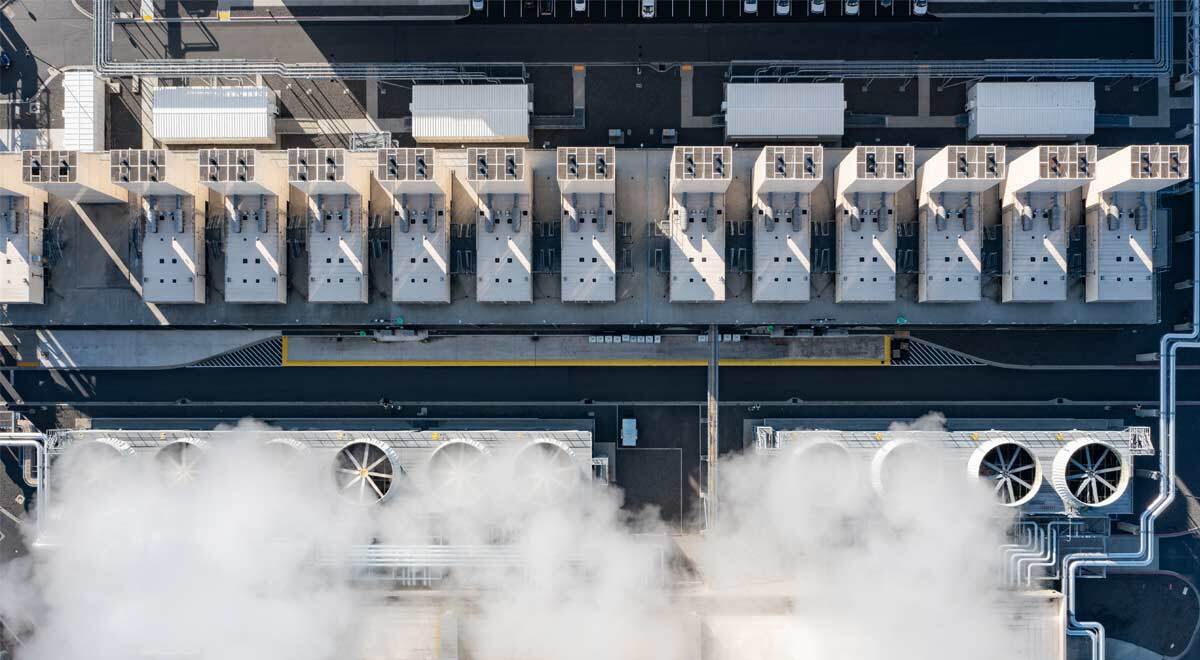
Data center cooling requires vast amounts of energy. By Shutterstock / Cybernews.

 Follow us
- Scientists built a proof-of-concept cooling system that uses heat, not electricity, to create cooling.
- The prototype uses ultra-thin metal films that turn heat into motion and motion into cooling.
- So far, the system produces far too little cooling for today’s AI servers, CPUs, or GPUs.
- Researchers hope scaled-up versions could reduce reliance on power-hungry compressors and harmful refrigerants.
Key Takeaways by nexos.ai, reviewed by Cybernews staff.
It’s a little shocking that the AI giants haven’t discovered this themselves, but a new experiment suggests that it could soon be possible to cool data centers without vast amounts of electricity and environmentally harmful refrigerants.
The data center boom, driven by increasing use of digital services and the promise of AI’s revolutionary potential, is causing major environmental concerns globally due to heavy water consumption, greenhouse gas emissions, and water pollution.
Since cooling them requires massive amounts of energy, data centers have been shown to raise electricity prices for nearby residents.
Unsurprisingly, Americans are protesting – and even resorting to violence. But data center cooling could actually be a lot cheaper and sustainable – that’s because no electricity would be required.






As detailed in Nature Energy, scientists from the Karlsruhe Institute of Technology (KIT) in Germany and the University of Tsukuba in Japan have developed a solid-state cooling system that uses heat to generate the mechanical work required for refrigeration.

This could potentially open a route to processors and data centers that recycle some of their own waste heat for cooling.
If the system works, computers will one day be able to cool themselves using their own heat. Instead of relying on a motor, compressor, or conventional refrigerant loop, the prototype uses ultra-thin shape-memory metal films that turn heat into motion, and that motion into cooling.
How does it work?
One metal film shrinks when heated. That movement stretches a second film designed to cool when the stress is released.
By cycling the process, the system creates a cooling effect without the usual moving parts found in traditional refrigeration systems.
Has your password leaked?
This matters because modern cooling systems – from air conditioners to server-room chillers – usually depend on electrically powered compressors and refrigerants that carry significant environmental costs.
Indeed, right now, refrigeration and air conditioning systems mostly rely on vapor-compression cooling and are extremely energy-inefficient.
Vapor compression cooling dominates the market, but its reliance on high global warming potential refrigerants accounts for more than 40% of global energy-related CO2 emissions, and its bulky components, such as compressors, make it incompatible with miniaturized systems,The researchers point out.
Of course, even if their concept of electricity-free miniaturized cooling is now proven, it’s still just that – a proof of concept rather than a product.
Besides, in lab tests, the system produced only a very small amount of cooling power, far below what today’s CPUs, GPUs, or AI servers require.
The conversation on this topic is live. Join in the discussion.
Still, the idea is interesting as it flips a basic assumption in electronics cooling. If this works, heat – currently the problem – will become part of the solution.
“We believe that this is only the beginning. By scaling up this technology, we want to develop compact cooling systems that leverage abundantly available heat sources for sustainable cooling,” said Jingyuan Xu, head of KIT’s ZEco Thermal Lab.
