How to build an app with AI 2026
Being behind major reports like The Mother of All Breaches and RockYou2024, our in-house cybersecurity experts and journalists provide unbiased, real-world testing and in-depth analysis.
We maintain complete transparency by openly sharing our testing methodologies with our audience.
Learn more

AI has reshaped numerous industries, but changes in software development are revolutionary. AI-powered app builders can achieve in hours or even minutes what took months to realize. Simultaneously, no-code AI builders, also called Vibe coding, allow people without extensive programming knowledge to bring their ideas to life.
That doesn't mean AI builders will replace coders. As of now, they struggle to create complex and highly customizable apps. Also, creating challenging back-end solutions, like user data repositories or managing authentication, is still done best by experienced human developers.
AI is particularly efficient at creating front-end code. Also, you can quickly generate Minimum Viable Product (MVP) models to see how your ideas look in action.
Like many, I am relying increasingly on AI solutions both professionally and personally. In this guide, I will share my research and experience using AI builders to create apps, taking the full-stack Base44 builder as an example.
Why use AI app builders for your app development
AI builders transform software development from heavy coding into a natural language-led process. The process is now significantly easier, cheaper, and available to a wide range of people. Here are its core benefits.
- Speed. Coding an interactive button in JavaScript can take an hour or even more, depending on its function complexity. In comparison, it takes up to a minute to write accurate instructions for an AI builder to achieve the same results.
- Cost savings. Software development is typically a collaborative process, involving front-end and back-end developers and quality assurance, making it pricey. AI builders empower a single person to take care of the whole development cycle, at least for MVPs, as long as they have a sufficient understanding of it.
- Accessibility. Learning programming languages is challenging, and becoming proficient often takes up to a year of daily commitment. AI builders allow people without coding skills to develop apps, adding more complexity as they master the tool.
- Automation. AI efficiently handles repetitive tasks, taking care of boilerplate code like standardizing CSS visualizations throughout the whole website. It frees up human resources to concentrate on more creative tasks.
What are the cons of building apps with AI
AI builders are not perfect, and I believe they will not be able to replace human creativity in the foreseeable future, if ever. At the current state, here are the most visible shortcomings you should be aware of.
- Limited customization. AI builders use templates, so different applications will feel at least somewhat similar. They are much more restrictive than human-coded apps.
- Migration issues. Your application code will be tied to a specific AI builder you chose. If you want to switch builders or export code to a more customizable platform, you may face issues that require rewriting at least parts of your app.
- Scalability challenges. The back-end is where AI struggles most because it involves numerous pieces, like authentication, information security, server maintenance, and much more. Once your app user base grows, you will likely notice that the AI builder may not offer sufficient quality code that is applicable to your particular situation.
- Learning curve. AI makes things easier, but you will not get far without mastering a chosen tool. Writing accurate instructions is a skill you must develop. Also, you must have at least some understanding of how the selected programming language works to ensure your instructions encompass all app development aspects.
Apps that are commonly built with AI
You will get the best results by using AI builders according to their strengths and weaknesses. To give you a better idea, I have outlined several examples that AI builders are fully capable of taking care of.
Small businesses
Small businesses benefit from AI builders a lot because they don't have to spend on otherwise expensive software developers. For example, they can use AI-crafted support chatbots that answer customer queries, also reducing customer support costs.
Another example would be inventory tracking. Because such apps are typically straightforward and rely on simple, but repetitive maths, AI is more than capable of producing them. The same logic applies to many other applications that simply require a visual representation, instead of extensive user interaction.
Startups
A successful startup is a lot about offering an idea that is viable and will attract users. Instead of relying on intuition or limited surveys, you can use AI builders to craft MVPs. This way, you can introduce a model of your future application and collect feedback.
Following market trends is also paramount, as you don't want to release an app into an already saturated market. You can instruct an AI builder to craft you an app that uses Retrieval-Augmented Generation (RAG), which is a highly accurate method of fetching and updating information from external databases on a chosen subject.
Personal projects
This is where your creativity aligns with AI builder capabilities, as personal projects rarely involve enterprise-grade complexity. For example, you can ask for a travel app that would take destination, price, and duration as input, and provide a suitable voyage within these parameters.
Alternatively, you can ask for a personalized fitness app that produces a workout flow according to your needs and daily schedule. Keep in mind that such apps use APIs to fetch relevant information from external databases, so they save hours you'd otherwise spend searching manually.
Enterprise solutions
Enterprises deal with tons of documents, like PDF files. Instead of going over them manually, they can instruct AI to build an application that would scan uploaded PDFs to extract specific information.
However, this should involve expert oversight, instead of just relying on AI solutions. Enterprise documents typically involve client or other sensitive data. It should be stored according to data security rules, which involve encryption and controlled access permissions. A viable solution would be asking for the AI builder to craft a code base and then add more complex elements later on.
How to choose the right AI app builder
Different AI builders are optimized for different tasks. Some are designed for fast MVP crafting, while others are for enterprise-grade apps and scaling. But there are universal features that each one should include, which I list below.
- Features. At each AI builder core is natural language processing to understand written commands. A full-stack AI builder that can take care of both front-end and back-end is highly beneficial, and an easy connection to external APIs ensures efficient data sharing and compatibility with third-party tools.
- Ease of use. AI builders are designed to make development easier, but there is a learning curve to master them. A drag-and-drop interface, pre-built templates, and a visual workflow editor will make things even easier.
- Pricing. Most AI builders have a subscription price and also monetize credits. These credits are used for AI actions. Estimating how many credits you will potentially need is crucial, as complex apps can become costly.
- Scalability. Once your app starts growing, the AI builder must support an increasing number of users. That typically includes spending more credit, but also verifying the capacity of cloud servers and how many simultaneous users they can sustain.
How to create an app with AI: step-by-step guide
I'll use Base44 full-stack AI builder as an example, which is very easy to get started with and use. It's also a freemium builder, so you can follow this step-by-step guide together.
-
Create a Base44 account or choose to log in with Google.
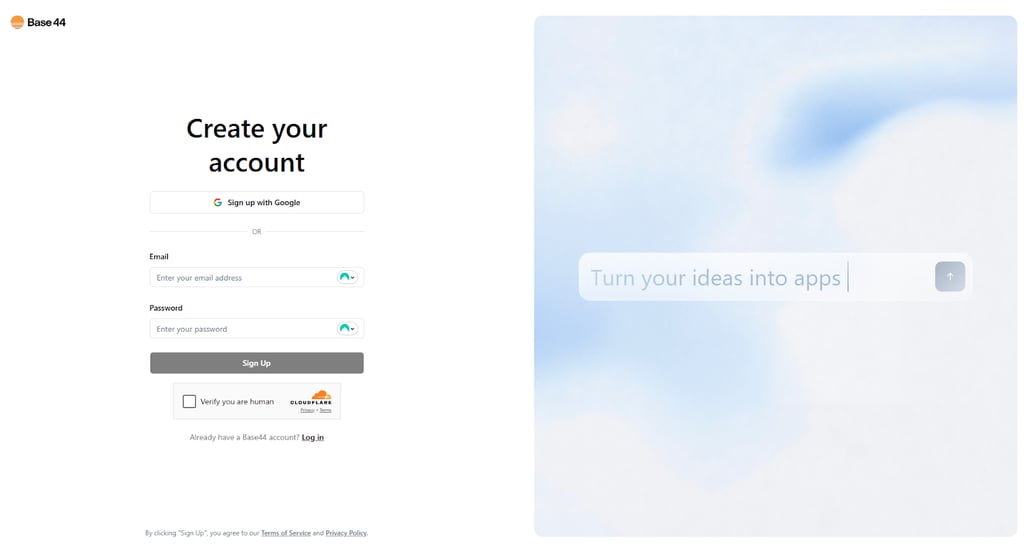
- Base 44 immediately lands you on the app creation screen. You get 100 credits on its freemium version.
-
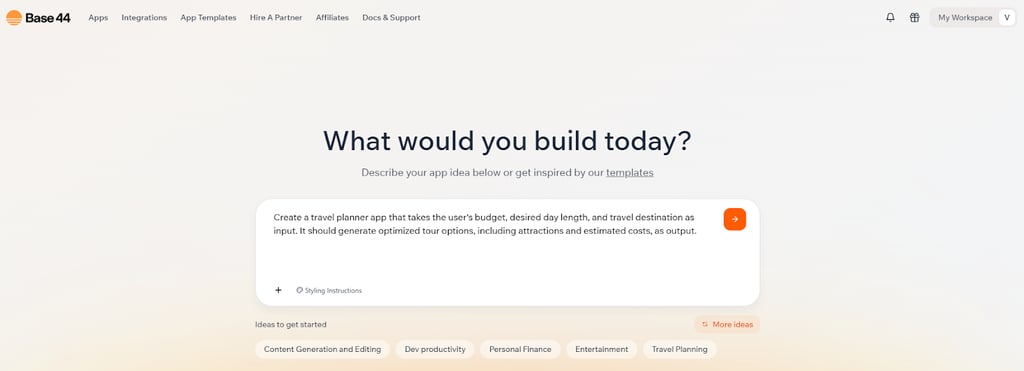
Describe your app, and take a look at the picture below for my simple travel app description.
-
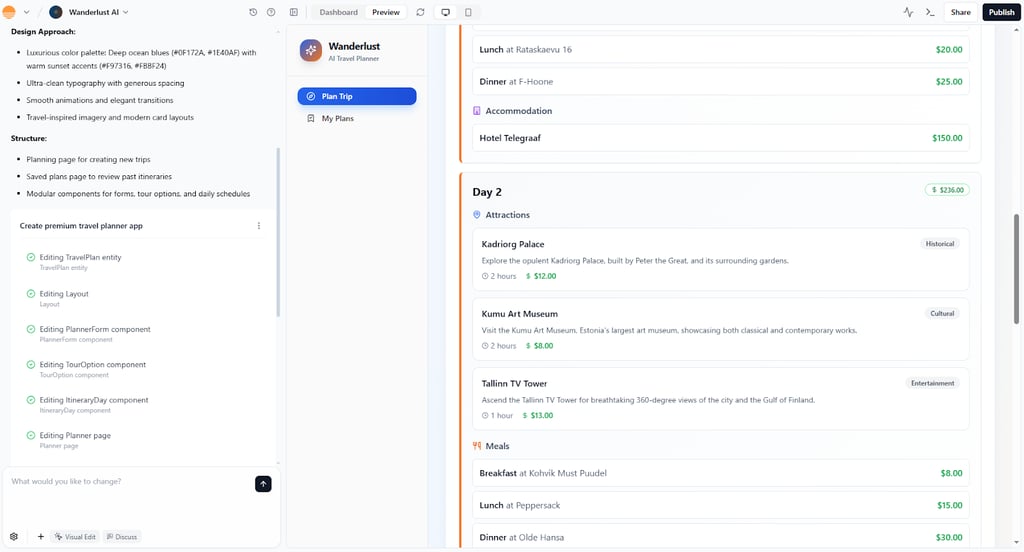
In a few minutes, Base44 will alert you that the app is ready. Now you can try it out and instruct to add more features.
-
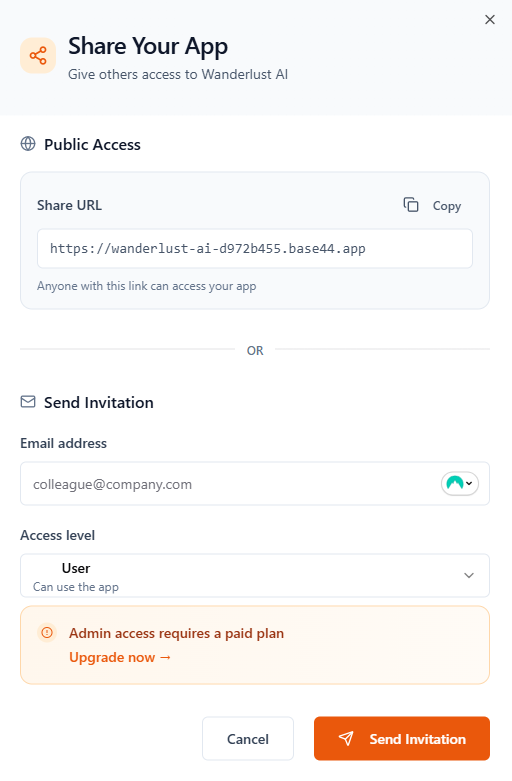
In the top right, you can immediately share the app with other users.
-
In the top left, click on Wanderluxe and Users for detailed statistics, and feel free to explore a wide range of Base44 features.
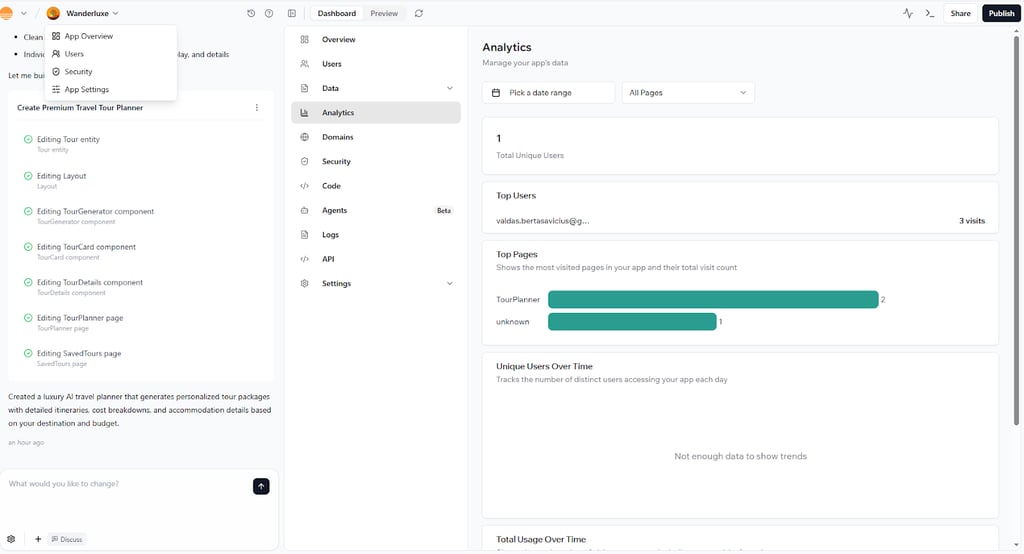
Base44 takes care of the back-end and hosting, so the process is easy and fully taken care of. Similar steps also apply to other AI builders.
Ai app builders vs traditional development
This was a breeze, but it's worth noting that you will run into limitations for more complex tasks. Making a highly complex app can cost quite a lot of credits, and an experienced programmer will still outperform it in terms of customization.
Conclusion
AI builders were just recently released, but they are already reshaping many industries. Although there is a learning curve, and programming knowledge is advantageous, app development is now widely accessible to non-technical users.
Base44 lets you try it out for yourself, as it runs on a freemium model. It also takes care of hosting, allowing you to share the app with other users immediately.
Base44 and similar builders fall behind in terms of customization for more complex tasks, which are best reserved for experienced programmers. However, it is also fully capable of creating enterprise-grade applications.
FAQ
Do I need any coding experience to use an AI app builder?
No, AI app builders are designed for beginners, but having a basic understanding of app design and structure can help you get better results.
How long does it take to build an app using AI?
For AI builders like Base44, creating a simple app takes a few minutes and hours for the starting prototype. Creating a fully functional Minimum Viable Product can take days and weeks.
How secure are apps built with AI app builders?
Security depends on the platform’s built-in features. Look for SSL encryption, regular updates, built-in authentication, server security management, and GDPR or HIPAA compliance if handling sensitive data.
Can I add custom features not included in the AI builder?
Some AI app builders allow integrations with third-party APIs or plugins, but complex custom features often require traditional development.