ZeroGPT vs GPTZero comparison in 2026
Being behind major reports like The Mother of All Breaches and RockYou2024, our in-house cybersecurity experts and journalists provide unbiased, real-world testing and in-depth analysis.
We maintain complete transparency by openly sharing our testing methodologies with our audience.
Learn more

Ever since generative AI tools like ChatGPT and Gemini transformed content creation, the web has been flooded with machine-written text. From school essays and blog posts to marketing copy and everyday emails, AI is now doing a lot of the heavy lifting in writing tasks. However, with this surge came another trend: AI detection tools.
In this article, I compare two of the most talked-about names – GPTZero vs ZeroGPT. Both promise to check whether a piece of text was crafted by a human or an algorithm. In this article, I analyzed their key differences – focus, performance, features, integration, and pricing. Let’s see which one does a better job at detecting AI.
Are GPTZero And ZeroGPT not the same?
I’m sure you’ve noticed that ZeroGPT is simply GPTZero with the name inverted. That’s not a coincidence. These two platforms have been locked in a strange sort of internet beef ever since AI detection first went mainstream.
At first glance, they sound like the same product, but they’re not. GPTZero came first, launching on January 1, 2023, straight out of Princeton research and quickly becoming a valuable tool for educators and professionals. Then, just weeks later, ZeroGPT appeared, riding on the brand confusion.
ZeroGPT launched with bold but misleading claims, even advertising millions of users on day one without a working detector. Media outlets mixed up the names, adding fuel to the fire. While GPTZero focused on academic benchmarking and responsible AI use, ZeroGPT leaned on ads and SEO tactics. I’ll get into the details of this rivalry, but one thing is clear: these are two very different tools.
Key differences between GPTZero and ZeroGPT
While GPTZero and ZeroGPT share a similar name, they’re actually quite different. As I tested both services, I was able to identify their main differences, starting from their initial focus to language, input, and platform features and integration. Let’s see how they compare after I’ve put them side by side.
Focus
GPTZero and ZeroGPT are AI tools that started with the same ultimate goal – to detect an AI-generated text. Over time, GPTZero has stayed true to its roots, specializing in AI detection and scaling its technology for individuals. ZeroGPT, on the other hand, shifted its focus to a broader approach by bundling multiple writing tools under the same brand.
- GPTZero: 100% focused on AI detection solutions
- ZeroGPT: expands into grammar checks, plagiarism detection, translation, and paraphrasing
Language and input features
Looking at language support and input options, GPTZero and ZeroGPT take very different approaches. GPTZero focuses primarily on English, breaking text down by sentence and paragraph to highlight sections likely generated by AI. Meanwhile, ZeroGPT casts a wider net, supporting over 20 languages, analyzing content in real-time, and accepting multiple file types like PDFs and URLs. It even gives percentage-based AI scores and highlights AI-like sentences.
- GPTZero: mainly English, breaks content into sentences and paragraphs, highlights suspected AI sections
- ZeroGPT: supports 20+ languages, real-time analysis, accepts PDFs, URLs, and other formats, provides percentage-based AI detection and highlights AI-like text
Platform features and integration
To put it boldly, GPTZero focuses on the quality, while ZeroGPT – more on the quantity of tools. GPTZero’s robust suite of professional tools include Chrome extension, a user-friendly dashboard, an API, Microsoft add-ons, and detailed report visualisations that break down AI detection results. In contrast, ZeroGPT leans on a multi-tool strategy, bundling paraphrasing, plagiarism checking, grammar correction, and humanizing tools into a single suite.
- GPTZero: Chrome extension, dashboard, API, Microsoft add-ons, detailed report visualizations
- ZeroGPT: paraphrasing, plagiarism checking, grammar correction, humanizing tools – all in one suite
Business and recognition
The gap between GPTZero’s credibility and ZeroGPT’s approach is also hard to ignore. GPTZero went viral in early 2023, raised millions in seed funding, and by mid-2024 closed a $10 million Series A. Its technology is now trusted in schools, hiring processes, and major publications, showing that it’s credible beyond hype. ZeroGPT, on the other hand, takes a free-for-all approach, offering unlimited use and broad language support. While that sounds appealing, it positions the platform more as an all-around toolkit than a serious AI detector, raising questions about focus and reliability.
- GPTZero: viral growth; millions in seed funding; $10 million Series A by 2024; trusted in schools, hiring, and publications
- ZeroGPT: unlimited free use; global language support; markets itself as an all-around toolkit rather than a dedicated detector
GPTZero vs ZeroGPT: AI detection test results
To see how these tools actually work, I conducted 3 in-house tests with different types of writing: a school-style essay, a marketing copy sample, and a creative blog post. The idea was simple – put GPTZero and ZeroGPT side by side and determine which one handles real-world text more reliably. One of these texts was generated by ChatGPT, while the other was written by me (a human).
Testing GPTZero
GPTZero performed flawlessly in all three tests, separating human and AI writing every time. Whether it was a school essay, marketing copy, or a blog post, the detector showed 100% accuracy with no false positives or misses. Here’s how GPTZero handled each task.
School paper
I started testing GPTZero’s capabilities with two essays: one written by AI and one written by me. It identified both correctly without hesitation, labeling them with 100% certainty and leaving no room for doubt.

Copywriting
Another task I gave it was to recognize a piece of marketing copy. There were two texts: one written by AI and the other by me. Once again, GPTZero separated them perfectly – my sample was flagged correctly, and the AI copy was instantly detected.
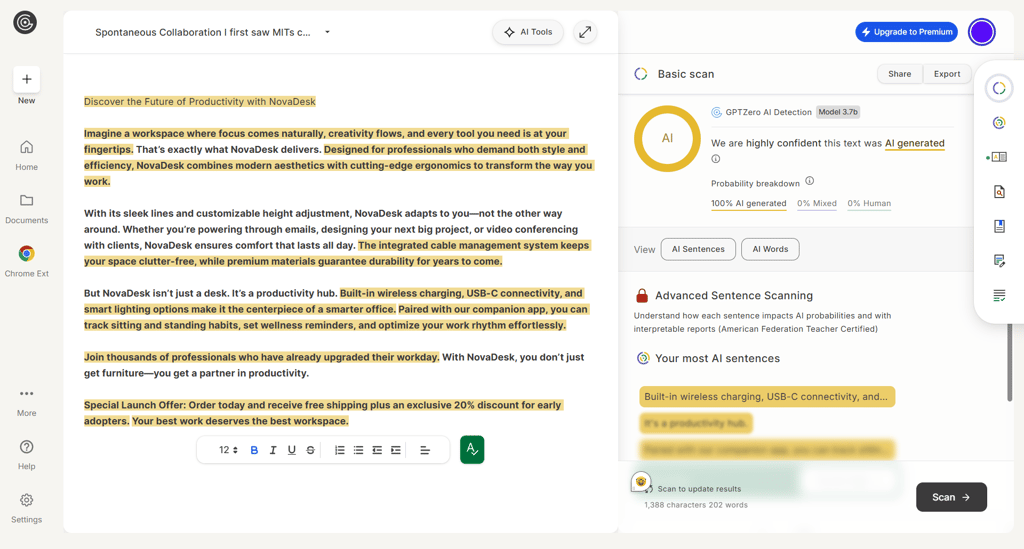
Creative blog post
Lastly, I tested its AI recognition capabilities by giving a creative blog post. Again, in one scenario it was written by AI, in another – by me. Even with more free-flowing, creative writing, GPTZero stayed sharp. It tagged the AI-generated post while leaving the human draft untouched.

Testing ZeroGPT
ZeroGPT performed reasonably well across the tests, but its accuracy wasn’t flawless. While it cleanly separated human and AI in the school paper, it slipped slightly on the copywriting sample, marking AI text as only 95% machine-generated. The creative blog post showed another small hiccup, flagging 2% AI in a fully human draft. Here’s how it compares to GPTZero.
School paper
As with GPTZero’s testing, I gave ZeroGPT two essays: one written by AI and the other by me. In both cases, it correctly distinguished between the machine-generated and human-written texts with 100% accuracy. ZeroGPT performed this task the same way GPTZero did.

Copywriting
On the copywriting task, ZeroGPT came close but wasn’t 100% correct. It labeled my human-written draft as 100% human, but the AI-generated sample was only flagged at 95% AI. Still accurate, but not as sharp as GPTZero’s flawless call.

Creative blog post
With the creative blog post, ZeroGPT showed a slight hiccup. It tagged my human-written piece as 98% human but slipped in a 2% AI label. The AI-generated post, however, was flagged correctly at 100% AI. Again, on a more advanced task, GPTZero performed better than ZeroGPT.
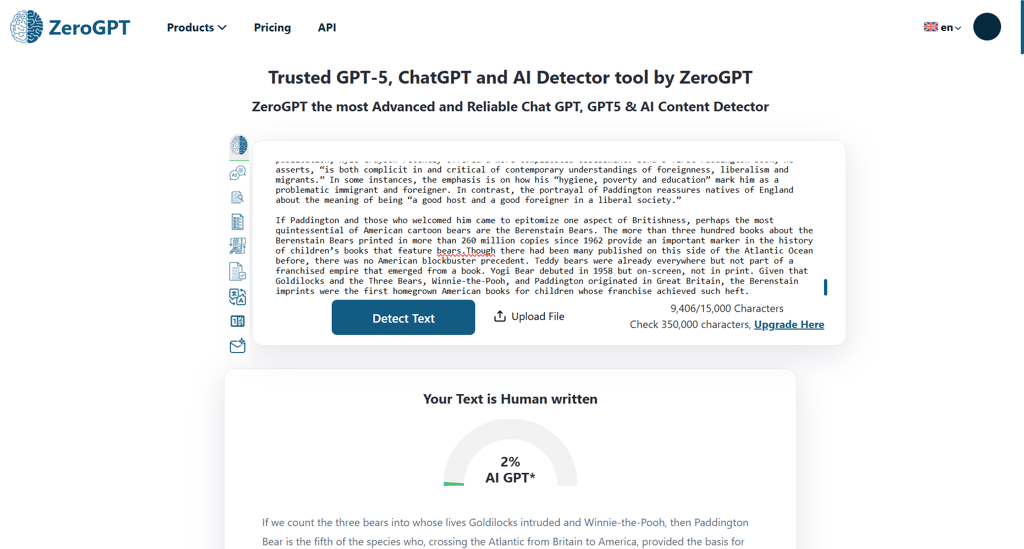
All in all, GPTZero outperformed ZeroGPT in AI detection across different types of texts. That said, ZeroGPT still managed to distinguish AI-generated from human-written content, so it shouldn’t be dismissed entirely.
Pricing and plans comparison
Affordable pricing and plan options often play a significant role in the final decision. Let’s take a closer look at how GPTZero and ZeroGPT compare in this department and what each offers for different types of users.
GPTZero pricing
Overall, GPTZero offers 4 plans, available on a monthly or annual basis. Its cheapest plan starts at $8.33/month when billed annually, which is higher than ZeroGPT’s entry-level option. What I particularly appreciate is the free tier, which ZeroGPT doesn’t offer.
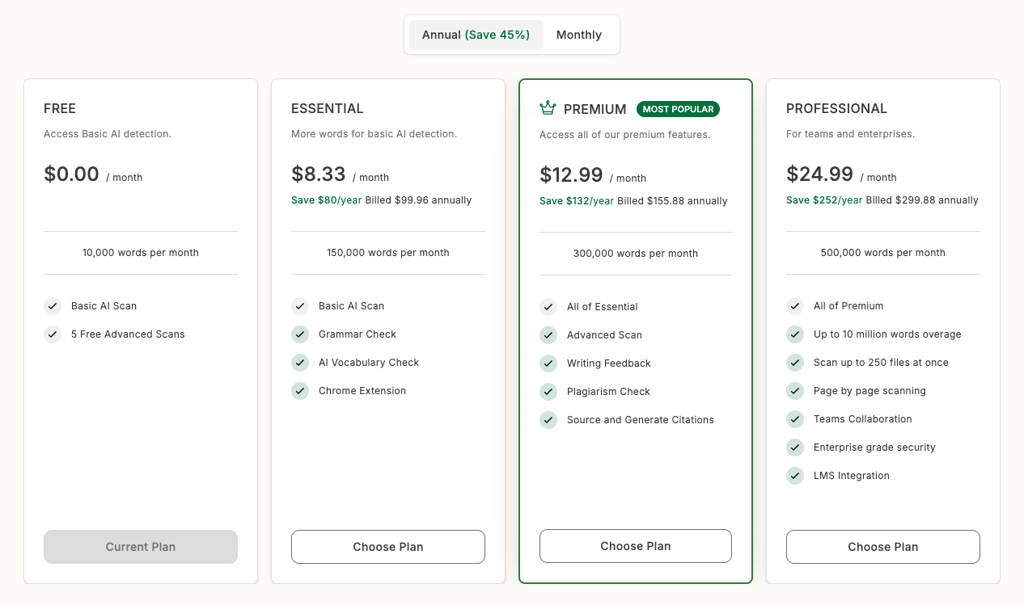
Now, let’s take a closer look at what each plan includes:
- Free plan. GPTZero’s free plan is quite generous. It allows up to 10,000 words per month, including basic AI detection features. You can easily scan and analyze text for AI-generated content without any cost.
- Essential plan. Starting from $8.33/month, the Essential plan offers up to 150,000 words per month. It includes advanced grammar feedback, plagiarism scanning, and access to the Chrome extension. It’s suitable for educators and writers seeking enhanced features.
- Premium plan. At $23.99/month, the Premium plan provides up to 300,000 words per month. It has all Essential features plus advanced AI deep scan capabilities, multilingual AI detection, and the ability to download AI reports. It’s best for professionals who need comprehensive tools.
- Professional plan. Designed for teams and enterprises, the Professional plan costs from $45.99/month and includes up to 500,000 words per month. It offers all premium features, batch scanning, team collaboration tools, and enterprise-grade security for organizational needs.
ZeroGPT pricing
ZeroGPT offers only 3 plans and doesn’t have a free tier. Its cheapest plan starts at $7.99/month, making it more affordable than GPTZero. Additionally, ZeroGPT includes more features, which could help you save further since you won’t need to pay for them separately.

Here’s what unique each plan has to offer:
- Pro plan. The cheapest ZeroGPT’s plan – Pro – starts at $7.99/month. It includes up to 100,000 characters per AI detection, 50 batch file checks, PDF reports, and access to grammar, paraphrasing, summarizing, and translation tools. It’s ideal for regular users or professionals who need reliable AI detection and basic extra tools.
- Plus plan. Priced at $13.99/month annually, the Plus plan builds on the Pro features with 100 batch file checks and higher limits on grammar, paraphrasing, summarizing, and translation tools. It’s designed for users who need more robust capabilities and heavier usage.
- Max plan. The Max plan costs $18.99/month when billed annually. It includes everything in the Plus plan and 150 batch file checks, unlimited access to all tools, advanced analytics, and a dedicated account manager. It’s perfect for teams or organizations that require full-scale AI detection and productivity features.
Final thoughts
If I had to compare GPTZero and ZeroGPT in simple analogies, I'd say that GPTZero is like a sharp school-yard detective – simple, focused, and reliable. As it highlights exactly which parts of a text might be AI-generated, it's beneficial primarily for teachers, students, or anyone checking a piece of writing. All in all, it's free, easy to use, and widely trusted.
ZeroGPT, on the other hand, is more like a Swiss-Army knife for writers and editors. It supports multiple languages, gives precise AI scores, and adds tools for grammar checking, paraphrasing, and even humanizing AI-written text. However, some tests reveal that it incorrectly flags human-written content, while others show that it correctly identifies casual writing. How well it works depends on your specific use case.
If you need a straightforward, user-friendly, and proven AI detector primarily for English text, GPTZero is the safer choice. If you want a full-featured writing toolbox with multilingual support, ZeroGPT could be a better fit – just double-check the results to avoid false flags.
FAQ
Are ZeroGPT and GPTZero the same?
No, GPTZero is the original AI detection tool, while ZeroGPT is its copycat. ZeroGPT was released shortly after GPTZero with a similar name and interface.
Which one is more accurate?
GPTZero tends to be more accurate with its detection rates. During in-house testing, GPTZero didn’t make a single mistake at recognizing AI-written or human-written texts, while ZeroGPT had some minor hiccups.
Can they detect all AI text?
No, although GPTZero is better than ZeroGPT at recognizing AI-generated content, it cannot detect all AI text – especially if it has been edited or comes from newer models. Sometimes, it even mistakes professional, polished human writing for AI-generated text.
Can I build mobile apps with Bubble?
Yes, Bubble apps run on mobile browsers, but additional tools or design steps are required to create native mobile apps.