Proton VPN vs CyberGhost comparison 2026
Our in-house cybersecurity experts and journalists, renowned for major reports like The Mother of All Breaches, conduct transparent, unbiased VPN testing and in-depth analysis.
With 750+ articles crafted based on real-world research, we empower readers to make informed purchasing decisions through first-hand expertise.
Learn more

Proton VPN and CyberGhost are both well-known VPN providers, but they focus on different things. Proton VPN has a privacy-first approach, with a robust security infrastructure and an excellent free version, while CyberGhost is better known for its lower prices and specialized servers.
To see which one actually performs better, I ran a series of hands-on tests comparing speed, server coverage, security, streaming and torrenting performance, features, and pricing. I’ve spent over a month testing and analysing both VPNs to deliver the most accurate Proton VPN vs CyberGhost comparison. We always keep an eye on what's going on, so that all of our reviews stay up-to-date.
Proton VPN vs CyberGhost: short overview
In hands-on testing, both Proton VPN and CyberGhost proved to be reliable options with good security and stable performance. Proton VPN came out ahead in most areas. It offers stronger privacy, a broader feature set, and a larger server network. Additionally, Proton VPN ranked higher than CyberGhost in our list of the best VPNs.
| Proton VPN | CyberGhost | |
| Rating: | ||
| Price: | From $2.99/month | From $2.19/month |
| Coupons: | Proton VPN coupon 70% OFF | CyberGhost VPN coupon 83% OFF |
| Servers: | 20,700+ servers in 149 countries | Undisclosed number of servers in 100 countries |
| Refund policy: | 30 days | 45 days |
| Platforms: | Windows, macOS, Linux, Android, iOS | Windows, macOS, Linux, Android, iOS |
| Simultaneous connections: | 10 | 7 |
| Support: | Knowledge base, FAQ, tickets, subreddit | Knowledge base, FAQ, email, 24/7 live chat |

Performance and streaming
When using any VPN, performance really matters. While looking for a VPN, most users prioritize speed because a slow VPN doesn’t just hinder your experience – it can make you stop using it altogether. Another important aspect for a VPN is its streaming capabilities, as well as torrenting for more specific target groups. That's why I started my evaluation by testing these factors.

Speed comparison
Both Proton VPN and CyberGhost support the WireGuard protocol, which is currently one of the fastest and most secure VPN protocols available. To keep things fair, I used WireGuard for both providers during testing.
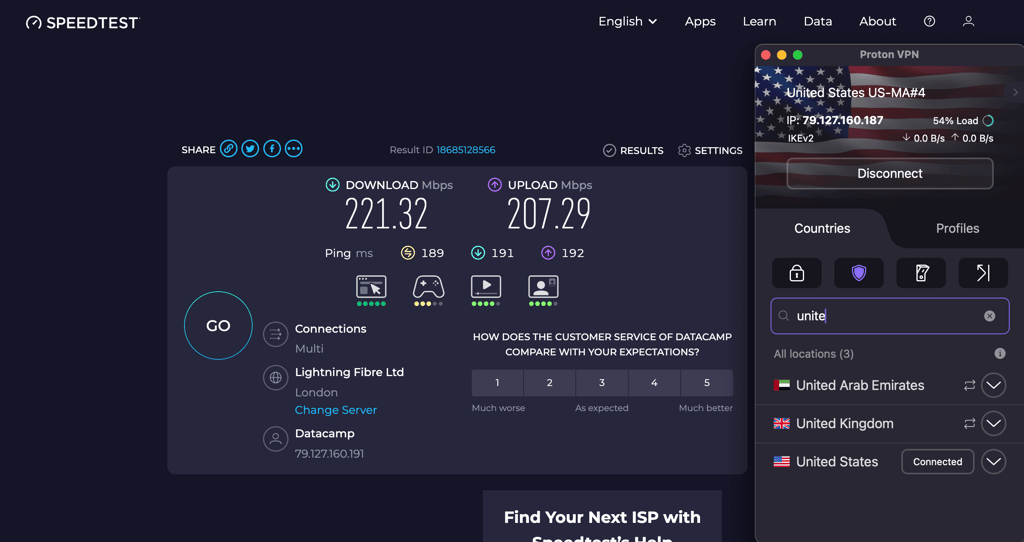
Below is a summary of Proton VPN’s speed results across multiple locations.
| Location | Download retention | Upload retention | Ping, ms |
| US | 83% | 90% | 110 |
| UK | 90% | 79% | 51 |
| Germany | 91% | 70% | 45 |
| Australia | 44% | 23% | 322 |
| Netherlands | 89% | 94% | 28 |
| Singapore | 73% | 64% | 170 |
| Japan | 53% | 28% | 303 |
And here’s a summary of the CyberGhost speed test results.
| Location | Download retention | Upload retention | Ping, ms |
| US | 79% | 20% | 112 |
| UK | 85% | 93% | 44 |
| Germany | 95% | 95% | 29 |
| Australia | 71% | 42% | 267 |
| Netherlands | 91% | 27% | 31 |
| Singapore | 75% | 63% | 170 |
| Japan | 54% | 36% | 236 |
Both VPNs delivered strong speeds, but CyberGhost was faster. That said, Proton VPN performed better on US servers (83% download retention compared to 79% and 90% upload retention compared to 20% with CyberGhost), which is worth highlighting. Since US servers are among the most commonly used, having strong performance there can make a real difference for many users.
Streaming and geo-unblocking
Both Proton VPN and CyberGhost performed well in my streaming tests. CyberGhost does have a slight edge here, as it offers dedicated streaming servers. These servers made the experience more straightforward and consistent, and I appreciated the more tailored approach.
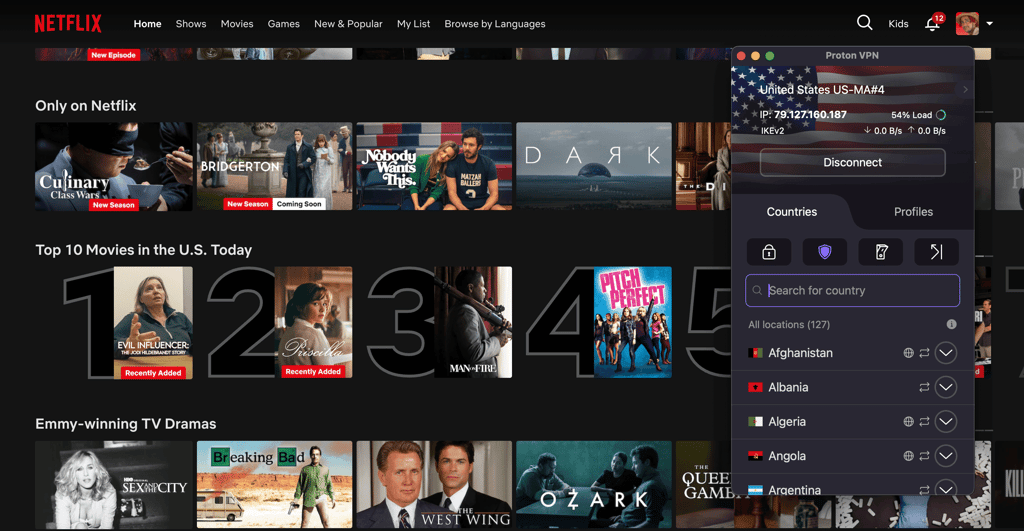
I tested both VPNs with US-based streaming platforms such as HBO Max, Hulu, Disney+ US, and Netflix US. Overall performance was smooth, with no noticeable slowdowns. The only exception was Proton VPN, which struggled to unblock Disney+ US during my tests.
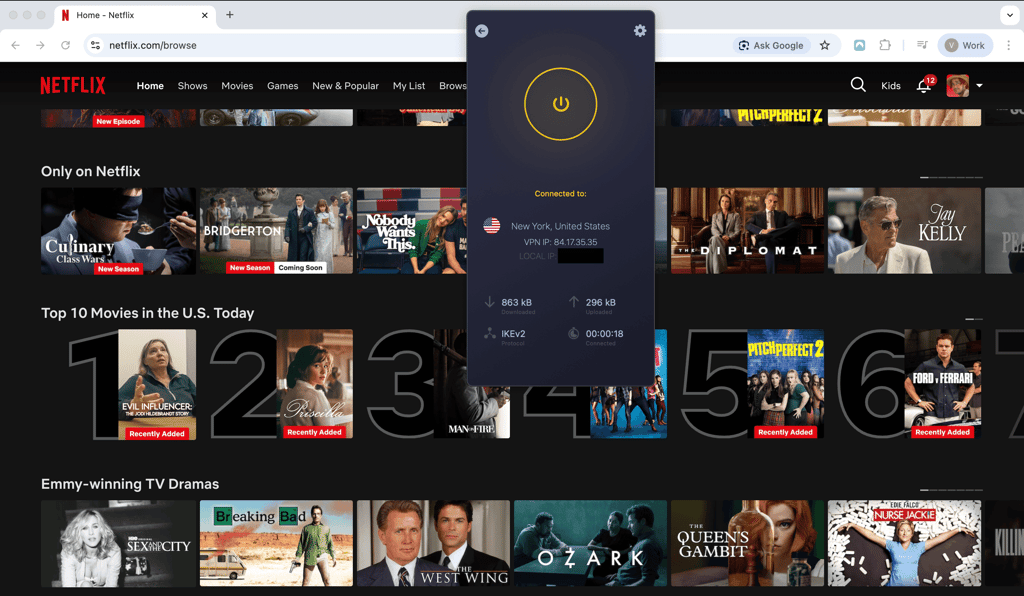
I also tried bypassing sports blackouts by streaming NBA and NFL games. Both VPNs handled this well, and their wide selection of US servers made it easy to find a working connection.
For international streaming, results were mixed. CyberGhost failed to unblock BBC iPlayer, while Proton VPN worked immediately. Netflix Japan worked with both VPNs. That said, speeds and streaming performance can vary when connecting to more distant locations, so it’s worth keeping that in mind.
Torrenting performance
Both providers support torrenting and allow P2P traffic, which is essential for this type of activity. CyberGhost offers dedicated torrenting servers, which guarantee secure torrenting, uninterrupted downloads, unlimited bandwidth, and fast speeds.
In contrast, instead of dedicated servers, Proton VPN supports port forwarding. This feature improved torrenting performance by boosting download speeds. So while the approach differs, both VPNs offer extras for torrenting enthusiasts.
Torrenting speeds matter a lot. Since using a VPN naturally slows your connection, having built-in optimizations makes a real difference. With the right setup, you can download files securely without giving up too much speed.
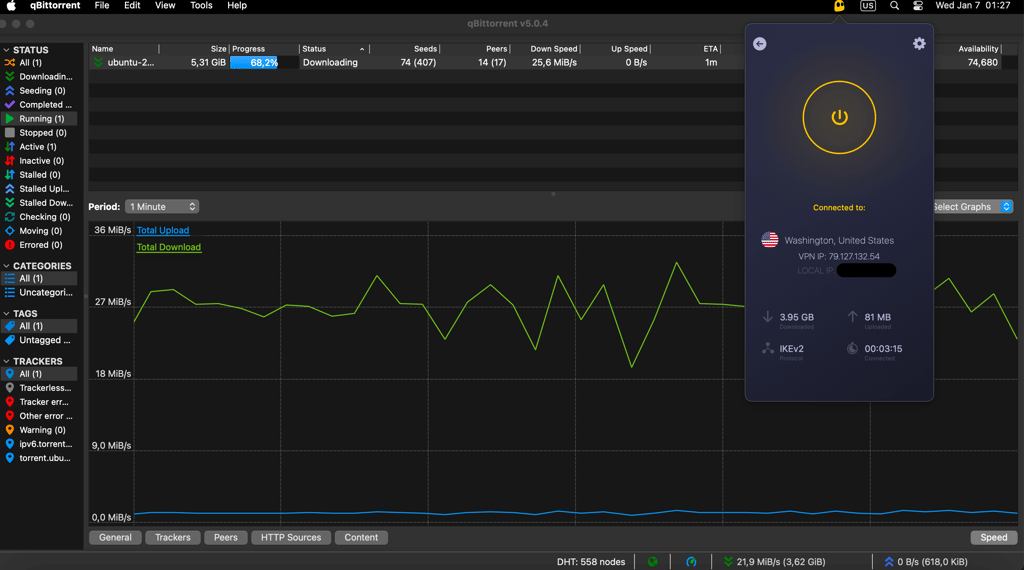
To test how these VPNs compare, I downloaded a 5.7GB Ubuntu ISO file. Here’s a summary of the results:
- Proton VPN downloaded the file in 4 minutes and 26 seconds, with an average speed of 23.3Mbps
- CyberGhost downloaded the file in 4 minutes and 33 seconds, with an average speed of 22.9Mbps
Proton VPN was slightly faster, but the difference was minimal. In practice, both are solid VPNs for torrenting.
Price and value
CyberGhost and Proton VPN offer one subscription tier and three plan lengths. Like most services, the longer you commit, the cheaper the monthly price is.
| Plan | Proton VPN | CyberGhost |
| 1-month | $9.99/month | $12.99/month |
| 6-month | - | $6.99/month |
| 1-year | $3.99/month | - |
| 2-year | $2.99/month | $2.19/month |
CyberGhost is the better deal if you are looking long term. Its multi-year plans are noticeably cheaper per month. In contrast, Proton VPN offers a better deal for the monthly plan, making it the better short-term option.
One big advantage of Proton VPN is its free plan. It’s surprisingly generous, giving you strong encryption and access to five servers, which is impressive for a free VPN. That said, the free plan doesn’t unlock all features, so it’s better to upgrade to a premium plan.
CyberGhost wins when it comes to refunds, offering a 45-day money-back guarantee compared to Proton VPN’s 30 days.
Proton VPN vs CyberGhost – server comparison
Proton VPN offers more than 20,700 servers across 149 countries, which makes it one of the largest VPN server networks available. CyberGhost doesn’t publicly disclose its exact server count, but it still offers solid coverage across 100 countries.
When it comes to specialized servers, CyberGhost stands out with dedicated servers for streaming, torrenting, and gaming. It also offers NoSpy servers, which are fully owned and operated by CyberGhost. Because these servers are managed in-house, they offer an extra layer of security and privacy, as noted in our CyberGhost review.
Proton VPN, on the other hand, offers Secure Core servers. This feature works like a double VPN, routing your traffic through an additional server in privacy-friendly countries such as Switzerland, Iceland, or Sweden before it exits the network. It’s designed to provide stronger protection against advanced attacks or those connecting from high-surveillance jurisdictions. We discuss this feature in more detail in our complete Proton VPN review.
Features
Both Proton VPN and CyberGhost go well beyond basic VPN protection. They include a solid set of extra features that make them feel more like full cybersecurity tools, designed to protect you from a wide range of online threats.
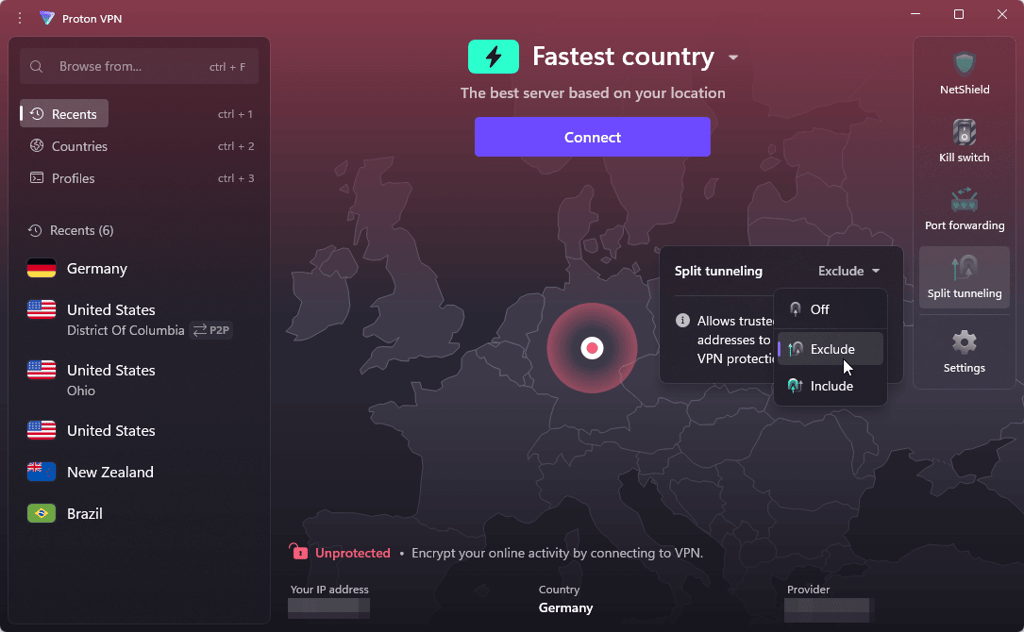
Both Proton VPN and CyberGhost offer split tunneling, but Proton VPN clearly has the edge here. Its version works on Windows, Linux, Android, browser extensions, Android TV, and even has an experimental version for macOS. CyberGhost only supports split tunneling (Smart rules) on Windows and Android. In my testing, both worked reliably, but Proton VPN’s wider platform support is a big advantage.
Both VPNs also include built-in ad blockers. These are DNS-based tools that block malicious ads, trackers, and pop-ups, making browsing smoother and safer. In testing with the AdBlock Tester tool, both CyberGhost’s ad blocker and Proton VPN’s NetShield scored 76/100. Solid, but not outstanding.
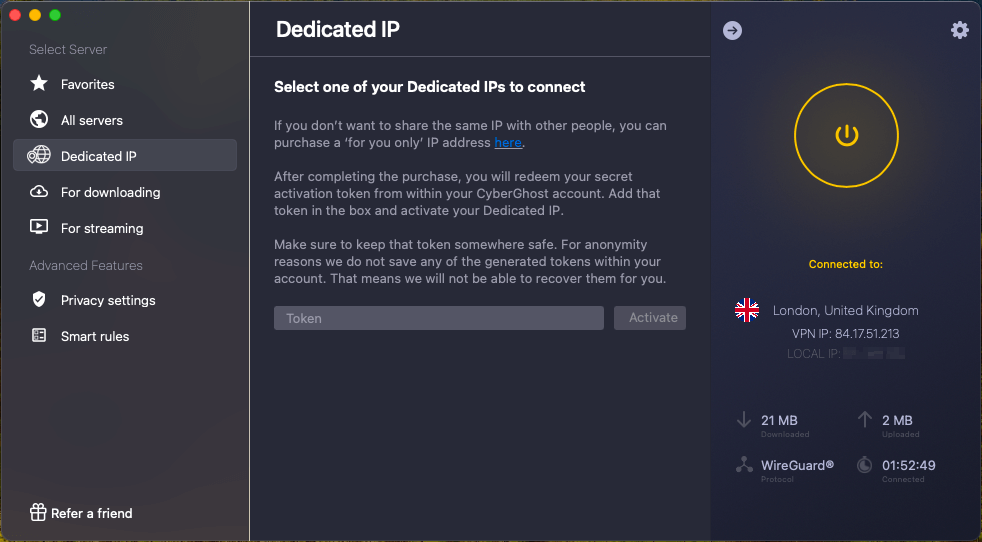
When it comes to unique features, CyberGhost offers a dedicated IP. Proton VPN only provides this for business users. A dedicated IP is useful for avoiding CAPTCHA and for remote work. It costs $2.50/month and is available in 13 countries. If a static IP is important to you, this is a big point in CyberGhost’s favour.
Proton VPN supports port forwarding, a rare feature that is especially useful for torrenting and gaming. It can help improve speeds while keeping your connection private. Proton VPN also includes forward secrecy, which creates a new encryption key for every session, keeping your data secure even if a key is ever compromised.
Privacy and security
Both providers are based outside the Five Eyes alliance, which is a solid start for privacy. Proton VPN is headquartered in Switzerland and benefits from some of the strongest privacy and security laws in the world. CyberGhost is based in Romania, which is also a privacy-friendly location with no mandatory data retention laws.
Both VPNs follow audited no-logs policies. This means they don’t store your browsing activity or connection data, and independent audits confirm they actually stick to those promises. CyberGhost’s no-logs policy has been audited twice by Deloitte. Proton VPN has gone through four independent audits, which show a strong and ongoing commitment to transparency.
Server infrastructure matters too. RAM-only servers don’t store data long term, which adds another layer of protection. CyberGhost already uses RAM-only servers, which is great for privacy. Proton VPN hasn’t fully switched to RAM-only servers yet. Instead, it relies on its audited no-logs policy to prove it doesn’t collect or store user data.
Where Proton VPN really stands out is transparency. All of its apps are fully open-source, so anyone can inspect the code on GitHub. This level of openness shows real confidence in its security practices and is something very few VPNs offer.
User experience
Both Proton VPN and CyberGhost support a wide range of devices, including Windows, macOS, Linux, Android, and iOS. To evaluate the user experience, I tested both providers app on macOS and Android.
Overall, apps were functional and easy to use. Proton VPN’s apps offer a strong balance between advanced features and intuitive navigation, while CyberGhost puts simplicity first, keeping its more advanced options neatly tucked away in dedicated menus.
Mobile
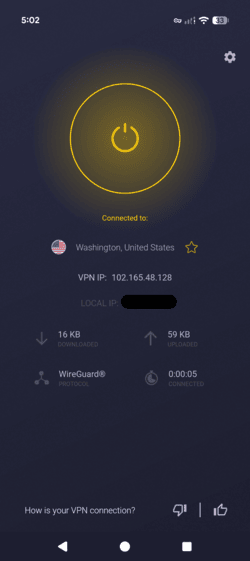
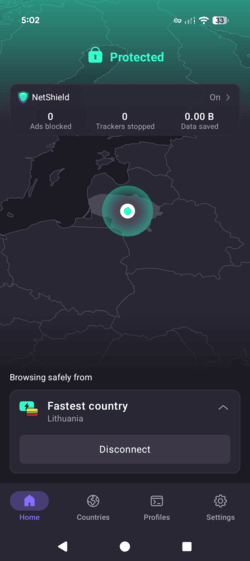
CyberGhost was very easy to use on mobile. I liked that I was able to mark my favorite server locations, which allowed me to connect quickly. The interface is very minimal but functional, and all features are just a few taps away.
Proton VPN was also easy to navigate. I especially liked the Profiles feature, which lets you create customised VPN connections for different use cases. Also, I found the map interface very convenient to use. It felt more modern than CyberGhost’s simple server list, although that may be a matter of personal preference.
Desktop
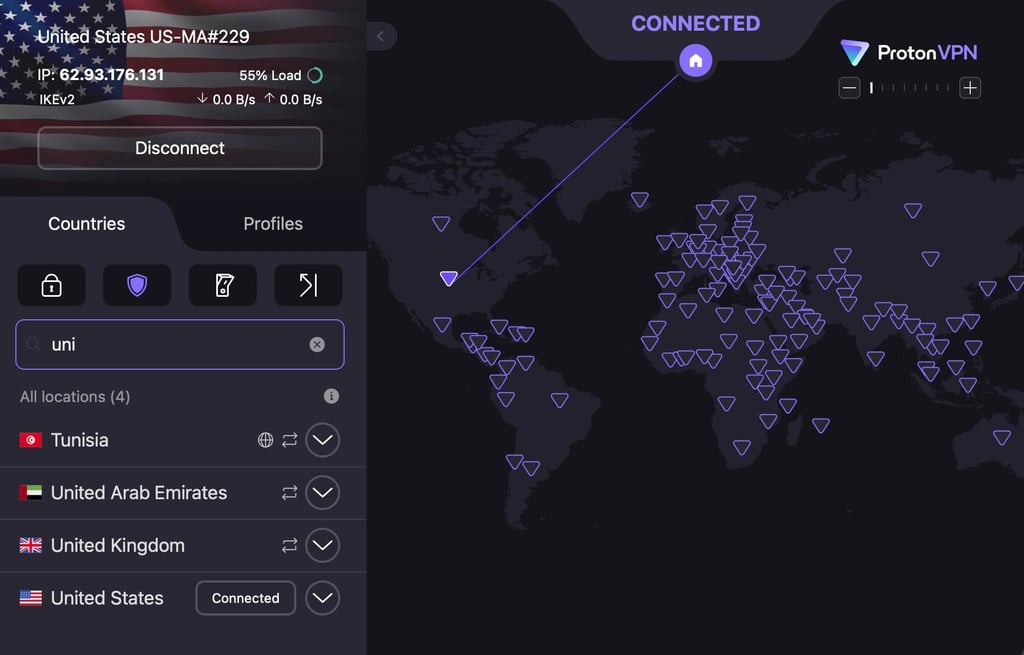
On desktop, I installed Proton VPN in under five minutes. The setup was smooth, with no unnecessary steps, so even beginners should feel comfortable. The interface closely matches the mobile app, with the same server map, server list, and key features easy to access. I really appreciated this consistency across platforms.
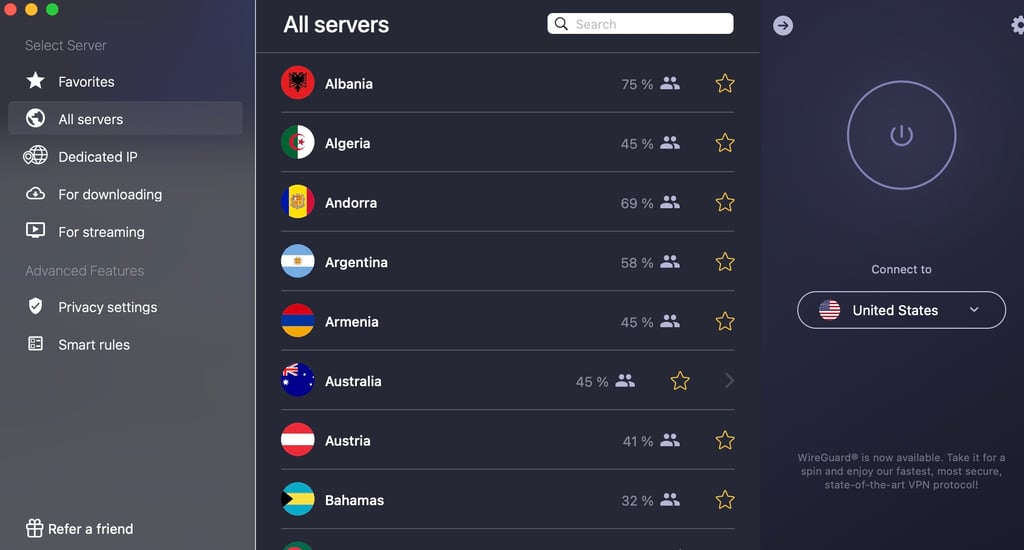
CyberGhost’s desktop app follows a similar approach. It has the same large quick connect button and familiar server list. While the desktop version includes more features than mobile, everything is clearly labelled and easy to find. Overall, CyberGhost feels especially beginner-friendly.
Service and reputation
Both Proton VPN and CyberGhost offer 24/7 live chat support, which is great if you need quick help with more complex issues. One thing to note, though, is that Proton VPN’s live chat is only available on paid plans, so free users miss out on that option.
I contacted both support teams to ask how to set up a VPN on a router, and overall, I was impressed with how clearly both providers' teams communicated. That said, response times were noticeably different. With CyberGhost, I waited around five minutes to connect to an agent, while Proton VPN got me through in about a minute.
Reputation-wise, their backgrounds are quite different. Proton VPN was created by scientists who met at CERN and set out to make the internet more private. CyberGhost, on the other hand, was acquired by Kape Technologies, a digital security company that owns several VPN brands.
Conclusion
Despite the strong challenge from CyberGhost, Proton VPN comes out on top. It delivered stronger results across most of my tests and stood out as the more well-rounded option.
| Category | Proton VPN | CyberGhost |
| Performance and streaming | ❌ | ✅ |
| Pricing and value | ❌ | ✅ |
| Servers | ✅ | ❌ |
| Features | ✅ | ❌ |
| Privacy and security | ✅ | ❌ |
| User experience | ✅ | ✅ |
| Service and reputation | ✅ | ✅ |
That said, CyberGhost still has its place. It’s a solid budget-friendly VPN, especially for beginners who want an affordable long-term solution. It works well for everyday use, including streaming and gaming, without much setup or hassle.
Proton VPN, on the other hand, is the better choice for privacy-focused users. It offers stronger privacy protections and several unique security features you won’t find with most competitors.
FAQ
Is CyberGhost VPN better than Proton VPN?
No, CyberGhost isn’t better than Proton VPN. Proton VPN offers a larger server network, performs better for torrenting, and includes more advanced and unique security features compared to CyberGhost.
Is there a better VPN than Proton VPN?
Yes, NordVPN is better than Proton VPN. It delivers faster speeds, offers more features, and is often cheaper, which makes it a better value for most users.
Is Proton VPN blocked by Netflix?
No, Proton VPN isn’t blocked by Netflix. If you run into issues, try switching servers, clearing your cache and cookies, or contacting Proton VPN’s support team.
Can CyberGhost VPN be trusted?
Yes, CyberGhost is a trustworthy VPN. It’s based in a privacy-friendly jurisdiction, follows an audited no-logs policy, and uses RAM-only servers, which helps keep your data secure.