IPVanish vs Surfshark: two excellent, affordable, and feature-rich VPNs
Our in-house cybersecurity experts and journalists, renowned for major reports like The Mother of All Breaches, conduct transparent, unbiased VPN testing and in-depth analysis.
With 750+ articles crafted based on real-world research, we empower readers to make informed purchasing decisions through first-hand expertise.
Learn more
In this Surfshark vs IPVanish comparison, both providers are widely recognized as fast, reliable VPNs with strong security and excellent features. During my testing, Surfshark stood out for its affordability and unlimited device connections, while IPVanish stood out for its consistent speeds and solid performance across distant servers.
For this comparison, I tested both VPNs using the same server locations and the WireGuard protocol to ensure accurate speed and performance results. I also evaluated their streaming capabilities, privacy features, and overall usability to see how each provider performs in real-world scenarios.
In this March 2026 comparison, Surfshark and IPVanish both excel, but each has unique strengths. Keep reading to see how they compare and which one may be the better fit for your needs.
Surfshark vs IPVanish
The table below summarizes the key differences between Surfshark and IPVanish. As you can see, Surfshark is ranked higher than IPVanish, although the difference is minimal. You’ll notice the two providers are similar regarding price, simultaneous connections, and the no-logs policy. Meanwhile, the most noticeable difference is that Surfshark has more servers than IPVanish, which is one of the reasons it’s ranked higher.
| Surfshark VPN | IPVanish | |
| ⭐ Rating: | ||
| 🥇 Overall rank: | #2 out of #41 | #8 out of #41 |
| 🖥️ Servers: | 4,500+ servers in 100 countries | 3,400+ servers in 112 countries |
| 📖 No logs policy: | No logs | No logs |
| 💵 Price: | From $2.49/month | From $2.39/month |
| 🔥 Coupons: | Surfshark coupon 87% OFF | IPVanish coupon 84% OFF |
| 🔒 VPN protocols: | OpenVPN, WireGuard, IKEv2, Dausos | OpenVPN, WireGuard, IKEv2, IPSec |
| 🍿 Streaming services: | Netflix, Disney+, Amazon Prime Video, Hulu, and more | Netflix, BBC iPlayer, YouTube, Disney+, Hulu, and more |
| 🖥️ Platforms: | Windows, macOS, Linux, Android, iOS | Windows, macOS, Linux, Android, iOS |
| 📥 Simultaneous connections: | Unlimited | Unlimited |
| 💁🏻 Support: | Knowledge base, email, 24/7 live chat | Knowledge base, email, 24/7 live chat |

Recent Updates
Key differences between IPVanish and Surfshark
If you’re short on time, here’s a quick breakdown of how Surfshark and IPVanish compare. Both VPNs are among the best VPNs in the market, they are affordable, fast, and feature-rich, but a few key differences can help you decide which one suits you best.
Choose Surfshark if:
- You want the best overall value. Surfshark is slightly cheaper, especially for long-term plans, while still offering a broader range of features across its subscription tiers.
- You need stronger privacy and security features. It uses RAM-only servers and includes advanced tools like MultiHop, Alternative ID, and antivirus (on higher-tier plans), making it a better choice for security-focused users.
- You prefer more server variety and flexibility. With over 4,500 servers and specialty options like Static IP and MultiHop, Surfshark gives you more control over your connection.
- You need high-speed performance. Surfshark consistently delivers fast download and upload speeds, ideal for streaming, gaming, and torrenting.
For a detailed overview, check our Surfshark review.
Choose IPVanish if:
- You prefer additional customer support options. IPVanish offers phone support (on higher-tier plans), which is rare among VPN providers.
- You want an essential VPN experience. It covers all essential VPN features without overwhelming you with extras, making it easy to use.
- You want slightly better raw performance consistency. IPVanish showed marginally higher download speeds in testing and very stable performance across regions.
- You need cloud storage and file-sharing tools. Its Advanced plan includes secure cloud backup and file sync features, making it useful for productivity and everyday use.
For a detailed overview, check our IPVanish review.




We spare no effort to test the products & their features. All information is gathered by our in-house research team & fact-checked by our team of experts. Discover the ins and outs of our testing procedures.
Speed, performance, and streaming
I compared Surfshark and IPVanish in terms of speed, streaming capabilities, overall performance. Here are the results of my testing.
Speed comparison
According to our tests, Surfshark and IPVanish are some of the fastest VPNs available. They’re not as fast as NordVPN, but being slightly behind the #1 provider is no small feat.
For this comparison, both VPNs were tested on the same server locations using the WireGuard protocol on a high-speed connection.
Surfshark speed test results:
| Server location | Download speed | Upload speed | Ping |
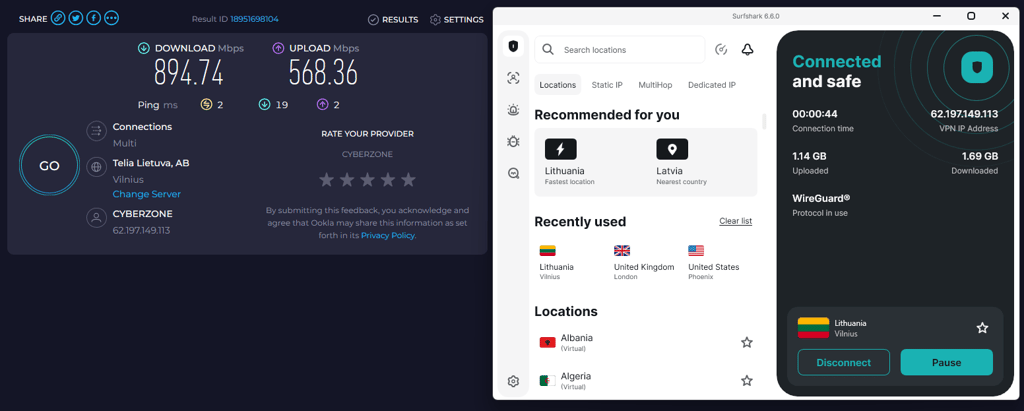
| Local | 894Mbps | 568Mbps | 2ms |
| London, UK | 847Mbps | 482Mbps | 41ms |
| New York, US | 780Mbps | 203Mbps | 99ms |
| Perth, Australia | 223Mbps | 70Mbps | 295ms |
| Tokyo, Japan | 574Mbps | 26Mbps | 270ms |
IPVanish speed test results:
| Server location | Download speed | Upload speed | Ping |
| Local | 459.24Mbps | 226.02Mbps | 71ms |
| London, UK | 846.57Mbps | 481.91Mbps | 39ms |
| New York, US | 801.41Mbps | 163.78Mbps | 98ms |
| Perth, Australia | 726.33Mbps | 91.51Mbps | 221ms |
| Tokyo, Japan | 653.68Mbps | 75.95Mbps | 269ms |
Note: Speed results can vary depending on server distance, your internet provider, and server load.
Surfshark came out ahead in the local test and was slightly better in London, with higher download and upload speeds than IPVanish. IPVanish, however, performed better in the US for download speed and clearly pulled ahead on the more distant Australia and Japan servers, where Surfshark slowed down much more sharply. Upload speeds were mixed in the US, but IPVanish again held the advantage in Australia and Japan
While these tests used the WireGuard protocol, both VPNs also support other tunneling protocols that may affect performance depending on the setup.
Streaming performance
According to our tests, Surfshark and IPVanish are practically on par regarding streaming. The research team tested the providers’ ability to stream high-definition video and bypass geographical restrictions on various popular streaming platforms. Overall, the results were great, and neither provider struggled in any area.
| Platform | Surfshark | IPVanish |
| Netflix US | ✅ Yes | ✅ Yes |
| Netflix other libraries | ✅ Yes | ✅ Yes |
| Amazon Prime Video | ✅ Yes | ✅ Yes |
| Hulu | ✅ Yes | ✅ Yes |
| Max | ✅ Yes | ✅ Yes |
| Disney+ | ✅ Yes | ✅ Yes |
| BBC iPlayer | ✅ Yes | ✅ Yes |
| YouTube TV | ✅ Yes | ✅ Yes |
Both Surfshark and IPVanish are superb options if you’re searching for the best VPN to unblock Netflix’s global content library. We focused our efforts on the US library since it’s the most desirable, but we didn’t skip other locations, such as Japan or Germany.
Neither provider offers specialized streaming servers like, for example, CyberGhost has, but that didn’t stop us from unblocking numerous streaming platforms. We had no trouble with Amazon Prime Video, Hulu, Max, Disney+, BBC iPlayer, and YouTube TV.
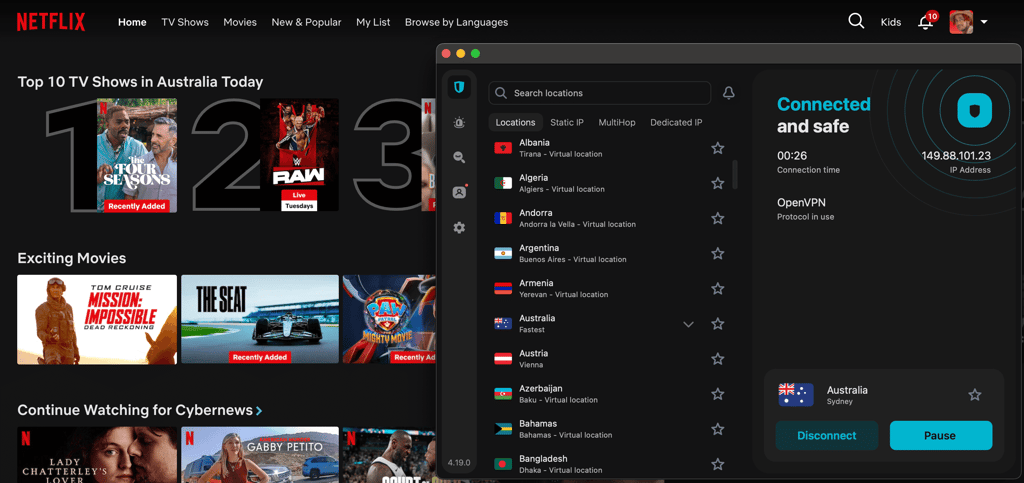
Since both providers fared well regarding speeds and geo-block removal, the ultimate deciding factor in this category is the inclusion of streaming-relevant features.
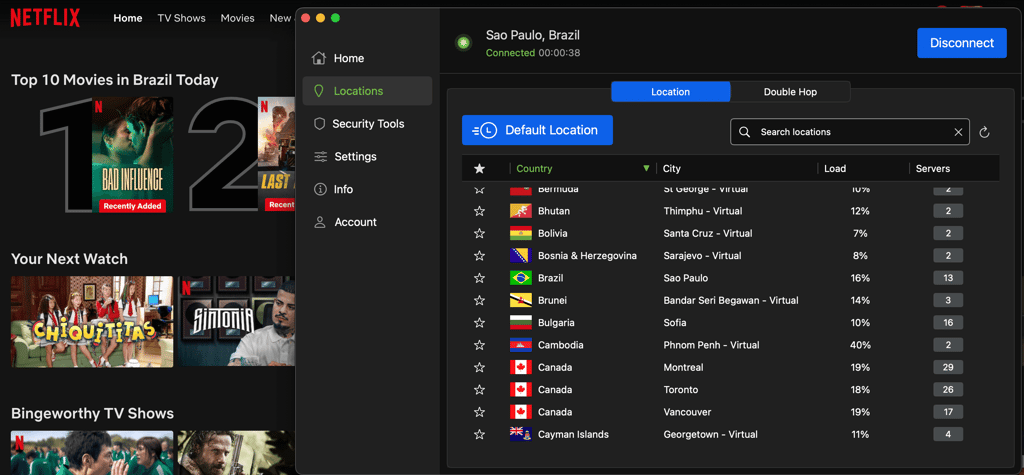
A huge bonus point for Surfshark is the Dedicated IP server category. While this is an optional extra, it can significantly improve your geo-unblocking results since you’ll have an exclusive and unchanging IP address in another country. It will make it easier to convince streaming platforms that you live in another country. This means you’ll be less likely to encounter IP blocking issues, which are common when using shared VPN IP addresses.
Torrenting performance
At first glance, both Surfshark and IPVanish appear well-suited for torrenting. All their servers support P2P traffic, they include kill switches, and they offer WireGuard for speedy connections. You can also enhance your security with split tunneling and obfuscation. As such, it was vital to test the two to check for any potential performance issues.
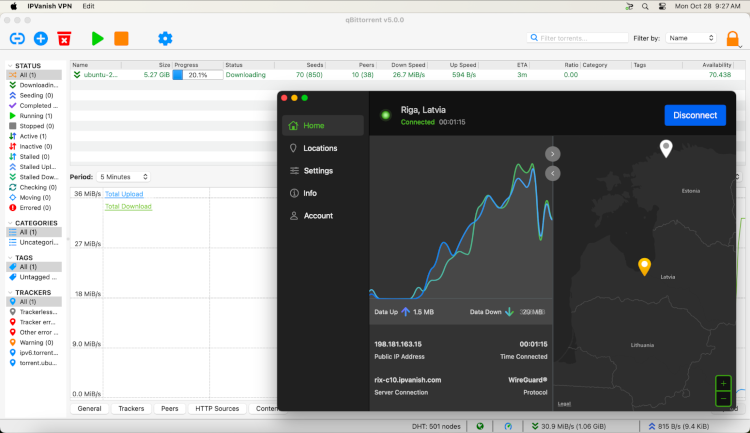
The research team tested both VPNs by downloading a 5.27GB Ubuntu client file on a Macbook laptop using the qBittorrent client. Naturally, we connected to nearby servers with the fastest speeds, which are selected automatically by the apps.
The results were pretty good with Surfshark. Unsurprisingly, the app connected us to servers in Lithuania. The download took only 3 minutes and 40 seconds, during which time the download speeds peaked at 38MB/s.
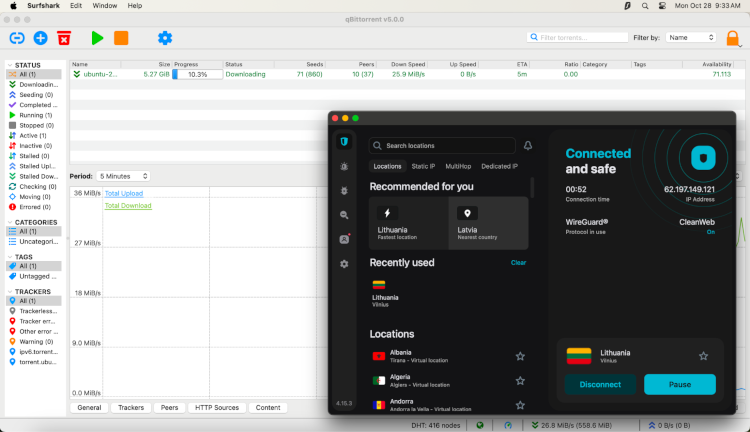
We experienced similar results with IPVanish. This time, the app connected us to servers in nearby Latvia since the service doesn’t have servers in Lithuania. Despite this supposed hindrance, the download took only 3 minutes, and download speeds reached a 36MB/s peak. So, since IPVanish downloaded the file faster, even with a smaller speed peak, it clearly had more consistent speeds with fewer slowdowns. The research team also noticed that IPVanish might be better for torrenting since its servers show overall traffic load, which could help you select the most optimal server for your needs.
Both providers offer reliable kill switches, obfuscation, and split tunneling, if you need extra security for whatever reason while torrenting. With Surfshark, simply enable WireGuard, NoBorders mode, and the kill switch, and you’re good to go. The same applies to IPVanish, but you’ll have to use OpenVPN if you require obfuscation.
IPVanish vs Surfshark price comparison
Surfshark and IPVanish are basically in the same pricing category, but the exact cost of each is slightly different. Surfshark’s cheapest subscription price is $2.49/month, while IPVanish costs only $2.39/month at its lowest. Additionally, the two providers have multiple subscription tiers, meaning the final cost will depend on your choice. Both providers offer a 30-day money-back guarantee, meaning you can test either without worry.
| Plan | Surfshark Starter | IPVanish Essential |
| 1-month plan | $16.45/month | $14.99/month |
| 1-year plan | $3.39/month | $3.89/month |
| 2-year plan | $2.49/month | $2.39/month |
| Current deal | Now up to 87% OFF Surfshark + 3 months FREE | Now up to 84% OFF IPVanish |
Surfshark and IPVanish are some of the most affordable high-quality VPNs on the market. They’re significantly cheaper than top-ranking providers like NordVPN, but you can find similarly priced options, too, such as CyberGhost VPN.
While Surfshark VPN is cheaper than IPVanish when comparing their starting prices, it’s crucial to note that both providers have multiple subscription tiers. That means either one can be more affordable or expensive, depending on your chosen plan.
Currently, IPVanish has two plans – Essential and Advanced. As the name suggests, Essential includes the VPN and its accompanying features like Threat Protection and unlimited device connections. It’s equivalent to Surfshark’s cheapest Starter plan and starts at $2.39/month.
Meanwhile, the Advanced subscription plan starts at $3.59/month and unlocks a few extra cybersecurity and convenience perks. With it, you gain a secure browser with built-in VPN capabilities, cloud backup storage, file sync & share, and phone support capabilities during business hours. Overall, I think it’s a worthwhile upgrade considering the affordable price.
On the flip side, Surfshark has three subscription tiers – Starter, One, and One+. Once again, the aptly named Starter plan is the most affordable option (starts at $2.49/month) and is meant for those needing just the VPN. This plan also includes the CleanWeb ad blocker and Alternative ID, meaning it has a fair share of extras.
Upgrading to the One plan adds Antivirus, Search, and Alert features into the mix. This plan starts at $2.49/month, making it cheaper than IPVanish’s Advanced tier. Finally, there’s the One+ option, which costs $4.49/month and unlocks Incogni. This is Surfshark’s most expensive tier and is pricier than everything that IPVanish offers.
The best part is that both providers offer 7-day free trials on mobile app stores (Apple App Store and Google Play) if you want to test their capabilities beforehand. There are some considerations, of course, such as the need to add payment details, but I think it’s better than nothing.
Servers and locations
Surfshark and IPVanish have respectable server networks, but Surfshark outshines IPVanish in terms of overall server number. However, many VPNs offer more servers than either provider. Examples include NordVPN, Proton VPN, CyberGhost, and PureVPN.
The table below breaks down the Surfshark and IPVanish details, such as numbers and available server categories.
| Provider | Surfshark | IPVanish |
| Servers | Over 4,500 | Over 3,400 |
| Countries | 100+ | 112+ |
| Virtual server locations | ✅ Yes | ✅ Yes |
| Port forwarding | ❌ No | ❌ No |
| Dedicated IP servers | ✅ Yes (additional cost) | ❌ No |
| Static IP servers | ✅ Yes | ❌ No |
| MultiHop servers | ✅ Yes | ❌ No |
Surfshark has over 4,500 servers across 100 countries, which is pretty impressive but still behind what NordVPN offers (8,000+ servers in 149 countries). The app includes physical and virtual servers, which are easily distinguishable by the label under the country’s name. You’ll also find a handful of specialized server categories at the top, such as Static IP, MultiHop, and Dedicated IP (even if you haven’t purchased one). I especially like that Surfshark’s MultiHop servers are customizable, which isn’t the case with NordVPN’s Double VPN servers.
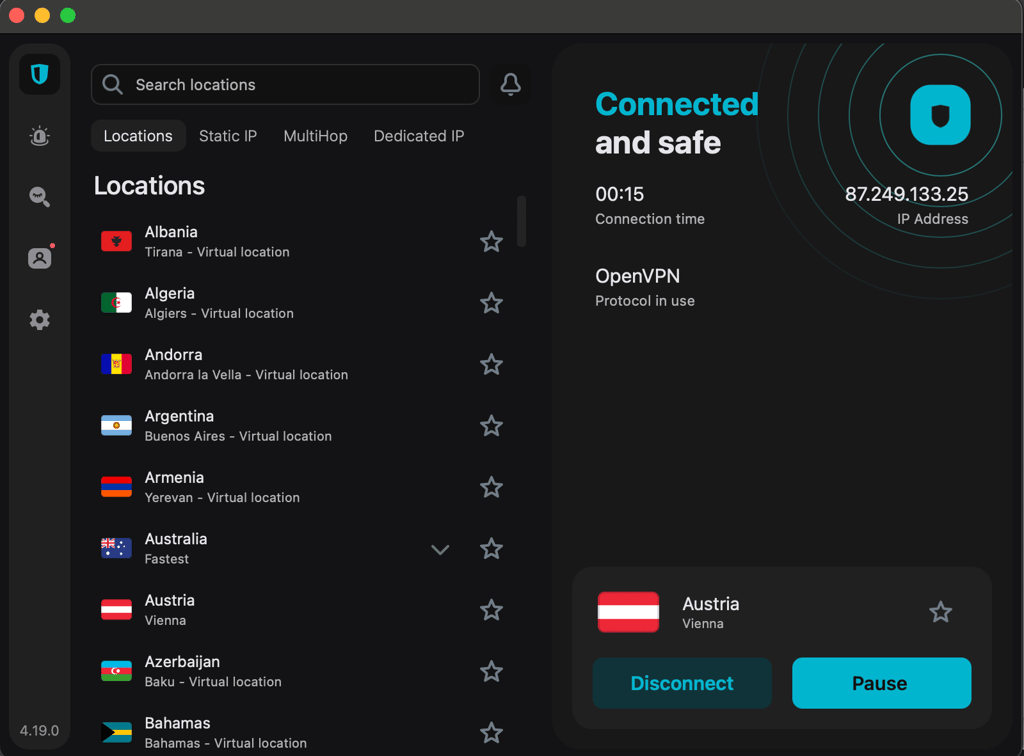
Meanwhile, IPVanish offers only 3,400+ servers in 112 countries. While the country coverage is pretty good, the overall server number definitely has room for improvement.
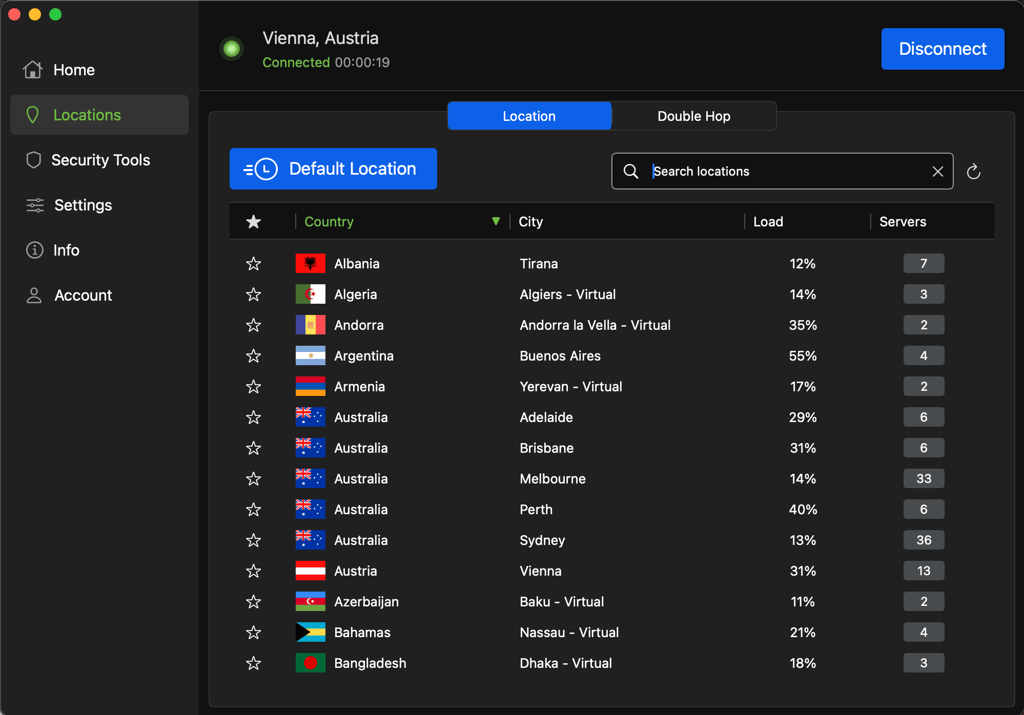
Another crucial difference between the two providers is that only Surfshark offers additional specialty servers, while IPVanish only has Double Hop and regular ones. For example, Surfshark offers Static IP servers, which are a unique option for those needing an unchanging IP address. Unlike dedicated IP servers, these servers are shared with all Surfshark users. The other category is MultiHop, which routes your connection through multiple servers in different countries. You can choose predetermined paths or create your own.

Security overview: IPVanish vs Surfshark
Surfshark and IPVanish are some of the most secure VPNs available, but they aren’t flawless in this category. For starters, both IPVanish and Surfshark are based in jurisdictions belonging to the Five Eyes alliance, which could be a concern to privacy-conscious users. On the other hand, both are audited by reliable third parties and have excellent technical security credentials, meaning they are reliable despite their flawed jurisdiction.
Below is a table with the essential details about Surfshark’s and IPVanish’s security features.
| Provider | Surfshark | IPVanish |
| Encryption | AES-256-GCM, ChaCha20, and Poly1305 | AES 256-bit, ChaCha20 |
| Hash | SHA-512 | SHA-512 |
| RAM servers | ✅ Yes | ❌ No |
| Five Eyes alliance | Yes (The Netherlands) | Yes (The US) |
| Independent audits | Audited by Deloitte in January 2023 | Audited by Leviathan in April 2022 |
| Kill switch | ✅ Yes | ✅ Yes |
| DNS leak protection | ✅ Yes | ✅ Yes |
Both providers have all the essentials for ensuring safe online connections under any circumstances. Surfshark and IPVanish use strong AES-256 and ChaCha20 encryption, offer kill switches with all apps, and have reliable DNS leak protection. Additionally, their independent no-logs policy audits are relatively recent (2022 for IPVanish and 2023 for Surfshark), meaning they’re great regarding reliability.
However, Surfshark has a few significant extras that make it more secure than IPVanish overall. For starters, all of Surfshark’s servers are RAM-only, making your data much more secure on a fundamental level. Moreover, its pricier subscription tiers unlock antivirus capabilities, which is an extraordinary cybersecurity benefit that most VPNs don’t include by default. While it costs extra, I think it’s a worthwhile option for security-minded users.
Jurisdiction
Unfortunately, both Surfshark and IPVanish are based in countries with ties to the Five Eyes alliance. More precisely, Surfshark is based in the Netherlands, while IPVanish is based in the US.
I think Surfshark is in a slightly better spot in this area because the Netherlands belongs to the Nine Eyes alliance, which isn’t part of the main surveillance group. Meanwhile, the US is one of the founding members of the Five Eyes alliance and thus likely engages in more severe surveillance. Moreover, America by itself has a poor reputation regarding user privacy. With legislation like the Patriot Act, agencies like the FBI can collect vast amounts of user data without due process.
However, I don’t think you need to worry about this since both providers have recently conducted independent audits of their no-logs policies. At the same time, that doesn’t mean a provider’s jurisdiction is completely irrelevant.
Infrastructure and encryption
Surfshark VPN’s server infrastructure runs entirely on RAM (random-access memory) servers. Briefly put, it means the provider doesn’t store any software or user information on hard drives that store data even when the servers are unplugged. RAM servers, on the other hand, store all data on volatile memory, which is deleted whenever the server hardware is unplugged or rebooted. Other providers with such infrastructure include NordVPN, ExpressVPN, and CyberGhost.
Sadly, IPVanish doesn’t employ RAM-only servers in its fleet, which is a severe downside compared to Surfshark. Upgrading to RAM servers would be a great improvement for its overall reliability.
Regarding encryption, both providers are practically on par. They use AES-256 and ChaCha20 ciphers with SHA-512 hash functions to encrypt user traffic. Details vary based on the VPN tunneling protocol you choose. The most obvious choice is WireGuard, which is fast, secure, and supported by IPVanish and Surfshark. Alternative options with either provider include OpenVPN and IKEv2.
No-logs policy
Both providers must have strict no-logs policies since their ties to the Five Eyes alliance are a potential drawback regarding reliability.
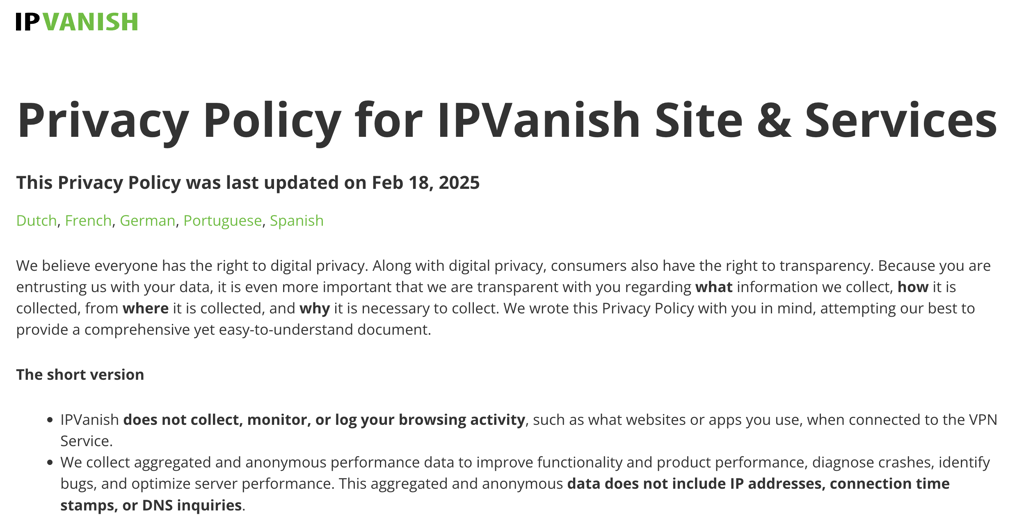
The Cybernews research team carefully analyzed both providers’ privacy policies to check for any potential red flags. With Surfshark, they couldn’t find any parts that were concerning. The only issue is that Surfshark is based in the Netherlands, but this country is also part of the EU, meaning customer data is protected by the GDPR.
Things are a bit more problematic with IPVanish. For starters, it’s based in the US, which has laws like the Patriot Act and the CLOUD Act that allow government agencies to request user data. Even worse, this information could be shared with allied countries. There’s also a case of IPVanish sharing customer data in 2016 for a criminal investigation. However, this is arguably no longer a concern since IPVanish’s no-logs policy was audited in 2022.
Kill switch
Surfshark and IPVanish provide kill switches to prevent IP leaks if your VPN connection unexpectedly drops. When enabled, the feature shuts off internet access whenever the VPN tunnel drops, thus preventing your IP address and location from leaking.
You can enable the feature on Surfshark by going to the VPN settings tab in the Settings menu. Similarly, IPVanish’s kill switch feature is in the Connection tab of the Settings menu. We tested both providers' kill switches, and they worked well in every possible scenario.
Independent audits
Surfshark and IPVanish have conducted a fair number of independent audits of their various technologies. For this comparison, let’s focus on no-logs policy audits.
Surfshark was audited by Deloitte in January 2023, thus confirming the provider doesn’t store any activity logs. The audit was quite extensive and covered various technical aspects like the VPN server configuration, deployment processes, API (application programming interface), SDN (software defined network), and more. You can find the full report on Surfshark’s website.
Conversely, Leviathan Security Group evaluated IPVanish in April 2022. Like with Surfshark, the auditor assessed the provider’s VPN servers, system configurations, and technical documentation and interviewed employees. The company confirmed that IPVanish adheres to its privacy policy. You can read the complete report on IPVanish’s website.
Features overview
Like any top-quality VPN should, Surfshark and IPVanish have a fair number of features included with their VPN packages. For this comparison, I’ll focus on the features available with the providers’ starting subscription plans since both services offer multiple subscription tiers with varying features.
| Provider | Surfshark | IPVanish |
| Split tunneling | ✅ Yes (Bypasser) | ✅ Yes |
| Stealth VPN | ✅ Yes (NoBorders mode) | ✅ Yes (Scramble OpenVPN) |
| Dedicated IP | ✅ Yes | ❌ No |
| Specialty servers | ✅ Yes | ❌ No |
| Web filters | ✅ Yes (CleanWeb) | ✅ Yes (Threat Protection) |
| Optional extras | Alert, Search, Antivirus, Incogni | Secure Browser, Cloud Backup, File Sync & Share, Phone Support |
The table above clearly highlights that Surfshark has more features than IPVanish. For streaming, you can optionally grab a dedicated IP address, but Static IP servers are a good free alternative. Speaking of which, Surfshark also has various specialty servers, while IPVanish doesn’t. Crucially, I think Surfshark is miles ahead of IPVanish because of its unique Alternative ID feature, which can greatly improve your online anonymity.
As for similarities, both have kill switches, split tunneling, stealth VPN, and web filters for blocking various online cyberthreats.
As always, it’s easier to see the difference between Surfshark and IPVanish by diving into the finer details. So, read on as I discuss each feature more thoroughly.
Split tunneling
Surfshark and IPVanish offer split tunneling, which allows users to customize their VPN connections on a per-app basis. Note that Surfshark calls its feature Bypasser. I like that both providers permit adding web domains to the exceptions list, which isn’t always available. For example, NordVPN’s split tunneling only allows adding applications. During our tests, both features worked as intended.
You can find Surfshark’s Bypasser by going to the main Settings menu, then clicking VPN settings, and then scrolling down to Bypasser. You can choose from two modes – Route via VPN or Bypass VPN. As for websites, they can only bypass the VPN. That seems acceptable to me because if you want to route websites through the VPN, then you can simply route the entire web browser. Alternatively, Bypasser is also available on Surfshark’s web extension.
It’s easier to find split tunneling on IPVanish’s app. Simply go to the Settings menu on the left and then pick the Split Tunneling menu. Unfortunately, IPVanish only allows choosing which apps and domains should bypass the VPN connection. That means you can’t choose which applications should have exclusive VPN connection privileges. Still, I think this is enough for most people because you should protect your entire web traffic and make exceptions in a few rare cases.
Stealth VPN
Stealth VPN, sometimes called obfuscation, is a feature that makes your VPN traffic appear as regular HTTPS traffic. This makes it easier to bypass online censorship measures targeting VPN traffic specifically. Both providers have this feature, but have unique names for it.
Surfshark actually offers two obfuscation features, but only one is explicitly available in the app. In the Settings menu, you can enable NoBorders mode, which improves your chances of circumventing online censorship. The second option is Camouflage mode, which is enabled automatically whenever you use the OpenVPN (UDP or TCP) tunneling protocol. Naturally, I believe Surfshark’s approach is better since you can alternate between the two if one doesn’t work.
With IPVanish, you must enable Stealth VPN manually to bypass online censorship. Go to the Protocol tab in the Settings menu and pick OpenVPN as your tunneling protocol. Then you must toggle on the Scramble feature, which will add obfuscation capabilities to your connection.
Web filters
Web filters are essential cybersecurity tools since they filter out various malicious content. They’re usually used to block ads but also restrict malicious domains, phishing attempts, and sometimes even malware. We tested each provider’s web filtering features using our standard ad blocker testing methodology. Overall, the results were very similar, but ultimately, Surfshark’s CleanWeb performed better than IPVanish’s Threat Protection.
CleanWeb garnered 56/100 points on Chrome and 70/100 on Firefox on Adblock Test. The results were significantly better on the D3ward test, where the service scored 92/100 on Chrome browsers and 94/100 on Firefox. Lastly, the CoverYourTracks said CleanWeb grants strong protection against tracking on Chrome and Firefox alike.
Threat Protection had identical scores to CleanWeb on Adblock Test (56/100 points on Chrome and 70/100 on Firefox). However, it scored lower on the D3ward test, garnering only 84/100 on Chrome and 93/100 on Firefox, which are still great scores. Finally, CoverYourTracks said the feature doesn’t protect against trackers on Chrome but gives strong tracker protection on Firefox.
As you can see, the results vary based on the tested browser. Both features are pretty effective, but the data shows that CleanWeb is better for overall protection than Threat Protection.
Dedicated IP
Once again, only Surfshark offers dedicated IP servers, while IPVanish doesn’t. This is an optional extra that will give you an exclusive IP address in a foreign country of your choice. It’s an excellent tool if you want consistent results when unblocking various content from another country without worrying about others overusing that IP.
As of May 2025, Surfshark offers dedicated IPs in 11 countries – the US, the UK, the Netherlands, Germany, France, Italy, Canada, Australia, Japan, Hong Kong, and South Africa. Prices start at $3.75/month.
Specialty servers
As the name suggests, specialty servers are servers optimized for better performance in specific tasks. They can also add extra security benefits, such as more encryption or routing through more secure locations. Unfortunately, IPVanish doesn’t have any specialty server categories.
Conversely, Surfshark has a few options. The most intriguing one is Static IP, which offers unchanging IP addresses in a few locations (Germany, Japan, Netherlands, Singapore, UK, US). They’re similar to dedicated IP servers, except these are shared with all Surfshark users, which undermines their effectiveness. Technically, this is a unique Surfshark feature, although other providers like Proton VPN allow you to choose individual servers yourself, rather than just the country location.
The second category is MultiHop, which is essentially Double VPN. You’ll find similar features with NordVPN and Proton VPN (Secure Core). What sets Surfshark apart is that it lets you customize your entry and exit locations, which greatly improves versatility. Moreover, Double VPN usually dramatically slows down your connection, but that will be less noticeable if you route your connection through nearby countries.
Platforms and ease of use
Surfshark and IPVanish offer excellent device compatibility and are generally easy to use. Both have numerous apps and support unlimited device connections, meaning the deciding factor regarding which is better lies in the finer details.
| Provider | Surfshark | IPVanish |
| Supported OS | Windows, Mac, Linux, Android, iOS | Windows, Mac, Linux, Android, iOS |
| Router applet | ❌ No | ❌ No |
| Dedicated Linux app | ✅ Yes | ❌ No |
| Other software and devices | Android TV, Fire devices, routers, and more | Android TV, Fire devices, routers, and more |
| Browser extensions | Chrome, Firefox, Edge | None |
| Usability level | Easy to set up | Easy to set up |
As you can see, some differences between these providers make Surfshark superior in terms of compatibility.
For starters, Surfshark offers a dedicated app for Linux, which is a pretty rare benefit even among the best VPNs for Linux. Meanwhile, IPVanish provides the all-too-common manual setup method, which is rather inconvenient but perhaps preferable to dedicated Linux users who like using the terminal.
The second win for Surfshark is that IPVanish has no browser extensions. Meanwhile, Surfshark’s extension works with Chromium browsers (Google Chrome, Microsoft Edge, Brave) and Firefox.
Desktop apps
The desktop apps for both VPN providers are pleasing and easy to use. With Linux, IPVanish users will have to use the service with the terminal by typing in the servers they want to connect to. Meanwhile, Surfshark has a dedicated app and terminal support, which is great for Linux newcomers and experts alike.
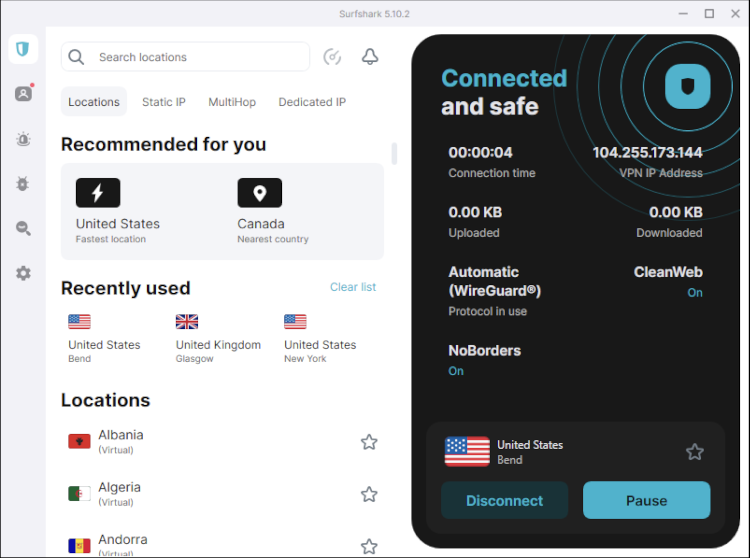
Surfshark’s Windows version has an attractive minimalistic interface where each feature is clearly labeled and easy to find. The app has no map interface for navigation like with IPVanish or NordVPN, but all the countries and possible connections are listed. The macOS version offers fewer features compared to the Windows counterpart. Also, there are two versions that you can choose from – the one you can download from Surfshark’s page or the Apple App Store. The difference between these two is that the webpage version has only IKEv2 and WireGuard protocols, and the app store one adds the OpenVPN protocol as well.
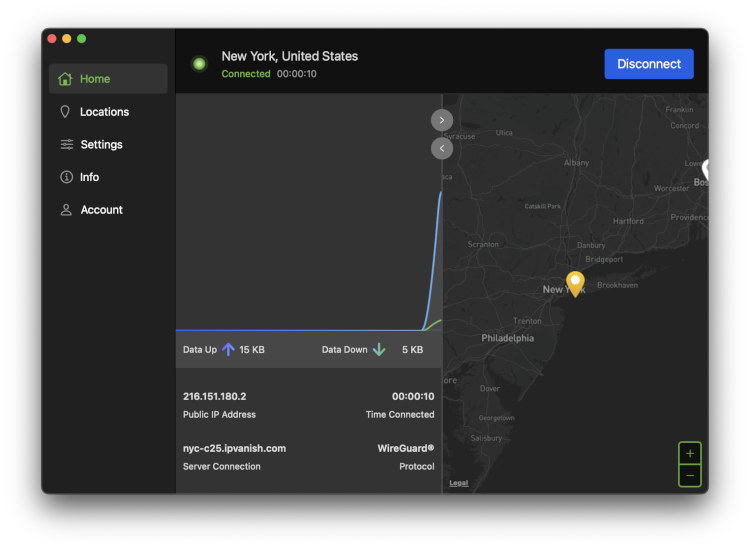
The IPVanish Windows app is pretty easy to use. It clearly groups the features into three categories. You can choose to view the possible connection countries in a list view or with a map interface. There are very few differences between the Windows and macOS versions of the IPVanish app. The Mac version has a less customizable kill switch and no PPTP tunneling protocol, but the user experience is the same.
Mobile apps
The rule that iOS apps offer fewer features than Android also applies to this Surfshark vs IPVanish comparison. Both providers have great Android app versions filled with useful features for staying secure on the go.
The Surfshark Android version has many of the same features as the Windows app plus the coveted GPS spoofing feature. It’s a very pleasant app to use with a great interface. The iOS version of the app looks nearly identical to the Android one but lacks certain features. For example, no GPS spoofing or Bypasser for Apple devices.
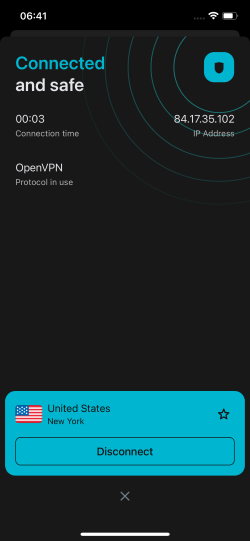
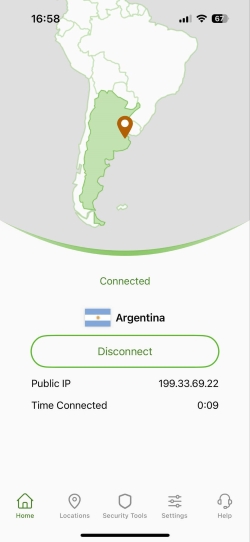
The IPVanish mobile device functions the same regardless of the OS. The main difference is that the iOS app looks more pleasing and is easier to use compared to the Android version. The Android version is filled with all the useful features included in the Windows version, while the iOS app is feature-light. It only has on-demand connections, Siri shortcuts, and alternate connection mode features.
Browser extensions
Surfshark has browser extensions for Chromium and Firefox browsers, which I think is more than enough for most users. The only drawback is there’s no Safari extension, which is probably disappointing for Apple users. The extension itself is pretty feature-rich and includes CleanWeb 2.0, which is a more customizable and powerful version of CleanWeb. During our tests, the feature was better at blocking ads.
Unfortunately, IPVanish doesn’t have any browser extensions. A workaround to secure your browser traffic would be to use the desktop app and enable split tunneling for your preferred browser.
Customer support
Customer support is one area where IPVanish beats Surfshark. Unlike many other VPNs, IPVanish offers a phone line during business hours if you need urgent assistance. However, note that this option is only available to Advanced plan subscribers.
Besides that, both services offer 24/7 live chat, email communication, extensive knowledge bases filled with guides, and FAQ sections on most pages with quick answers.
| Provider | Surfshark | IPVanish |
| 24/7 live chat | ✅ Yes | ✅ Yes |
| ✅ Yes | ✅ Yes | |
| Phone line | ❌ No | ✅ Yes (with Advanced plan) |
| Guides or articles | ✅ Yes | ✅ Yes |
| FAQs | ✅ Yes | ✅ Yes |
Personally, I’m not particularly interested in a VPN’s customer support options since I rarely encounter unsolvable issues that require assistance. Regardless, I had to test Surfshark’s and IPVanish’s customer support to evaluate the quality and speed of their responses. For this comparison, I asked both of them whether they could help me unblock US Netflix.
I began with Surfshark, and the initial experience was great. I was first connected to a chatbot, and it quickly asked a bunch of questions related to my initial query about Netflix issues. It also gave answer suggestions so we could get on with it more quickly. So far, so good. Then, I was connected to a real agent and they began by checking for a subscription on the email address I provided. I was a bit confused about this part because I didn’t think this was relevant. Anyway, I provided an anonymous email without a subscription, so I figured this wouldn’t go far. Plus, I didn’t actually have any Netflix issues because Surfshark is actually good for streaming.
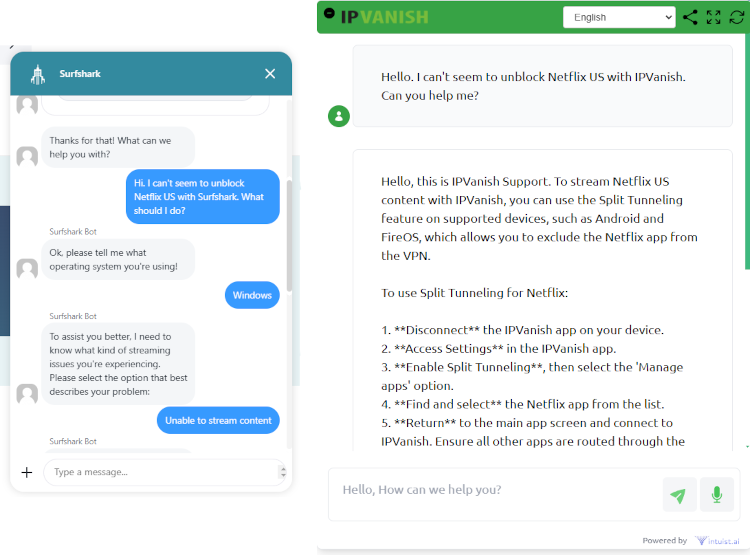
I then moved on to IPVanish and tried asking the same question. I received what appears to be an AI-generated response with some recommended steps on what to do. However, it didn’t seem particularly helpful because it recommended using split tunneling to stream Netflix. There were no additional questions to learn more about my particular issue. At least the bot included links to other guides so I could troubleshoot this issue myself. Or I could start a new chat.
Overall, the experience was better with Surfshark in my opinion. A bot first asked questions about my issue so that the human support specialist would have a better understanding of my problem. Meanwhile, IPVanish immediately gave an AI-generated solution, which wasn’t really tailored to my needs.

Comparison methodology
Together with our expert research team, we evaluated the key areas to compare Surfshark vs IPVanish as thoroughly as possible, using our VPN testing methodology. Here’s a rundown of all the criteria we took into account.
- Pricing (15%). This covers not only subscription prices, but also available free trials, money-back guarantees, payment methods, and refund policies.
- Security (15%). We tested all the included essential and extra security features that are vital for keeping your online identity hidden at all times.
- Connection speed (15%). The research team extensively tested the providers’ connection speeds with their fastest tunneling protocols to determine which is faster overall.
- Server network (15%). I analyzed the server network to see if the providers have an excellent infrastructure and plenty of connection options for customers to choose from.
- Bonus features (10%). Both providers offer extra tools that accompany the standard VPN package. I also briefly talked about the additions included in other subscription tiers.
- Ease of use (10%). We checked each providers' compatibility, what apps they offers, and how easy to use and intuitive they are.
- Streaming (10%). We checked how the providers fare when unblocking popular streaming platforms and streaming UHD video content from distant places.
- Torrenting (5%). We used both providers to download a few files using P2P technology to determine whether they perform well in this category.
- Customer support (5%). I compared available support communication methods and tried them to see which is better when you need assistance.
IPVanish vs Surfshark: final verdict
Surfshark and IPVanish are very similar VPN providers in many ways. Below, you can see my final verdict of the Surfshark vs IPVanish comparison:
| Category | Surfshark | IPVanish |
| Price | ✅ | ❌ |
| Security | ✅ | ❌ |
| Servers | ✅ | ❌ |
| Speed | ✅ | ✅ |
| Streaming | ✅ | ❌ |
| Torrenting | ✅ | ✅ |
| Ease of use | ✅ | ❌ |
| Features | ✅ | ❌ |
| Customer support | ❌ | ✅ |
It’s clear that Surfshark wins this VPN comparison because it offers better prices, stronger security, more features and servers, is easier to use, and is better for streaming. I must note that IPVanish is also good at these areas and falls behind Surfshark only by a margin. IPVanish, on the other hand, is as speedy as Surfshark, offers the same torrenting experience, and provides more customer support options, including a phone line.
If you’re looking for a speedy VPN, whichever you choose, both will work great. However, for those looking for a good mix of affordability, features, and a wide server network, Surfshark is an excellent option. Meanwhile, IPVanish is a better fit for users who prioritize dedicated customer support.
FAQ
When should I choose IPVanish over Surfshark?
You should pick IPVanish over Surfshark if you prefer its bonus cloud storage and file sharing features. With IPVanish, you also get phone support (with the Advanced plan), something that Surfshark doesn’t provide at all.
When is Surfshark a better option than IPVanish?
Surfshark is better than IPVanish in practically every way. It’s cheaper, grants more security features, has more servers, provides more apps, and has a better reputation. The two have many similarities, too, such as unlimited device support, speed, and multiple subscription tiers. But, after a thorough evaluation, Surfshark emerged as the superior VPN.
Is Surfshark better than IPVanish for streaming?
Our tests concluded that Surfshark and IPVanish are equally great in terms of streaming. Both easily unblock the most popular streaming platforms and ensure speedy connections for lag-free HD video. However, since Surfshark offers a dedicated IP feature, it’s a slightly better option for streaming.