Looking for a job? Beware, new study shows employment scams are up 1000%
Job scam fraud is having a moment, with a whopping 1000% surge of FTC complaints between May and July of this year, according to a new study released Thursday.

Image by Cybernews.

 Follow us
Job scam fraud is having a moment, with a whopping 1000% surge of FTC complaints between May and July of this year, according to a new study released on Thursday.
Considered the fastest-growing type of fraud in the US, experts at BrokerChooser, who conducted the study, say “growing job insecurity” in corporate America is partly to blame.
“Scammers are exploiting the pressures of a tough US job market,” the online broker comparison platform points out, citing nearly 700,000 job cuts in just the first half of 2025 – a roughly 80% increase in layoffs compared to the same timeframe last year.
The company did a deep dive analyzing all US Federal Trade Commissioin (FTC) fraud complaints since the beginning of 2025 as part of the study.
The researchers found that across the nation, employment scams now rank as the fourth most commonly seen fraud by the consumer watchdog agency. Here are a list of the top ten, with imposter scams, online shopping and negative reviews, internet services, and investment related scams rounding out the top five.






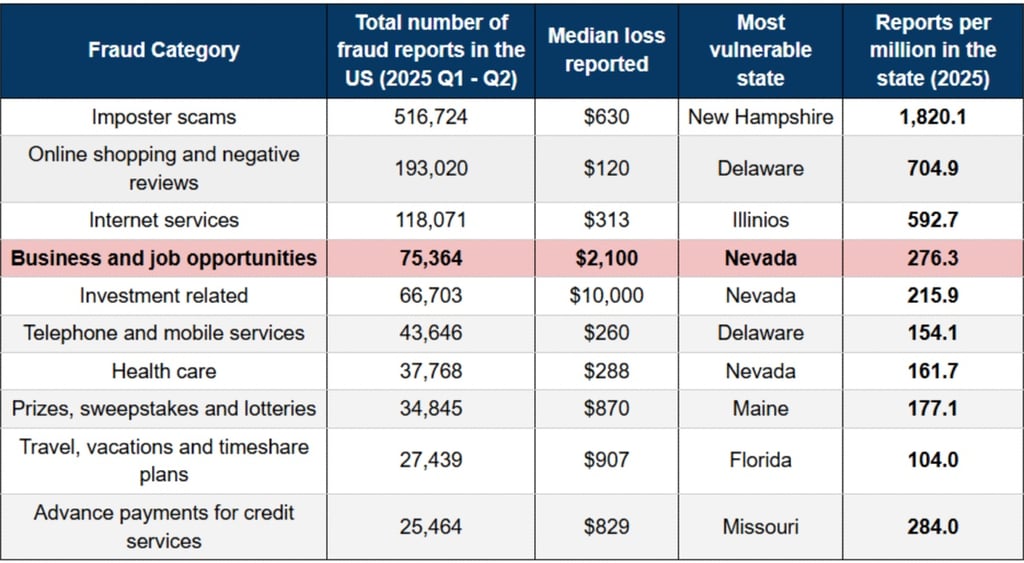
For rankings six through ten, other prevalent scams involved telephone and mobile services; healthcare; prizes, sweepstakes, and lotteries; travel and vacation; and lastly, advance payments for credit services.
Balazs Faluvegi, Senior Analyst at BrokerChooser, noted that, overall, employment scams had surged by 118% in recent years, again citing “a slowing job market and economic uncertainty, leaving workers more vulnerable.”
The senior analyst also believes the recent spike is driven by “the growing sophistication of scammers who now use AI, advanced algorithms, and even deepfake technology to create more convincing schemes.”






According to the study, a total of 75,364 people were impacted by job scams between Q1 to Q2 2025, suffering an average loss of $2,100 per victim totaling about $157 million in financial losses.
Although a small number of victims, when compared to the 516,724 reported imposter scams nationwide in the same time period, BrokerChooser says that investment scams are truly the most financially devastating.
The FTC records show that of the 66,000 reported investment fraud complaints in the first half of the yaer, the average loss per victim was tallied at $10,000.
“The allure of seemingly 'too good to be true' opportunities clouds critical judgment, ultimately leaving victims exposed to devastating losses. Job scams work similarly, with victims often promised sky-high pay for simple tasks,” explains Faluvegi.
Other key findings show that out of all fifty states, residents in Nevada, Florida, and Colorado were either the most targeted ot the most susceptible, with an average of 206 reports per one million residents.
Furthermore, Texans suffered the most significant financial losses due to job scams, costing Lone Star residents more than $27 million in 2025.
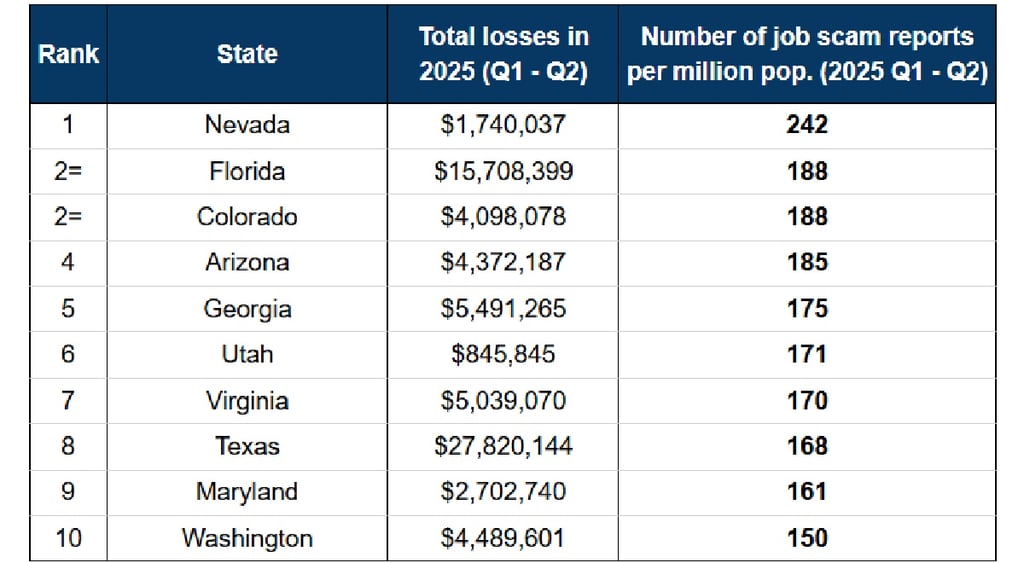
Sadly, Nevada was most targeted by job scams this year, with a 21% increase from the same time last year – attributed to it having the highest unemployment rate of any state for the past three years.
Dont fall victim, be aware
Not surprisingly, BrokerChooser said the number of internet searches for “is this job offer a scam” has also soared by 100% across the US in recent months.
BrokerChooser reminds job seekers that they can avoid falling victim by educating themselves about the latest threat trends and learning to recognize the red flags.
“Breaking this cycle requires awareness and ongoing education,” Faluvegi says, pointing out that most job searches are now conducted online.
“Scammers can easily pose as recruiters or companies to trick applicants into handing over personal information and even money,” which is a huge red flag, he says.
“Paying money or providing sensitive information should never be required for a job interview. Even detailed personal information is only requested by legitimate employers after you’ve been officially hired,” Faluvegi explains.
Other scenarios the FTC warns of that should raise hackles include:
- Recieving unsolicited texts with job offers.
- Asking for personal information before an interview.
- Job offers that seem too good to be true.
- Requests for upfront fees, such as for equipment or training.
- Communicating only through text or messaging apps.
- Requests to receive and send packages or money, known as “task scams.”
Additionally, Faluvegi says, “Job seekers should always verify employers and platforms.”
“Staying informed about the latest scam tactics is key to avoiding fraud and protecting personal information,” Faluvegi says.
Individuals who think they have fallen victim to a job scam can file a complaint on the FTC website, their state Attorney General’s office, or with the US Better Business Bureau.
Unlock more exclusive Cybernews content on YouTube.