AI’s four possible futures: crash, stabilization, nationalization, or breakthrough?
Is the AI bubble set to pop? We analyze the four economic futures for generative AI – Crash, Stabilization, Nationalization, or Breakthrough – with insights from top AI venture capitalists and tech experts on market risks and unsustainable valuations.

Image by Cybernews

 Follow us
Is the AI bubble set to pop? We analyze the four economic futures for generative AI – Crash, Stabilization, Nationalization, or Breakthrough – with insights from top AI venture capitalists and tech experts on market risks and unsustainable valuations.
A couple of days ago, a colleague asked me what my opinion was on the future of AI, and I couldn’t answer with clarity. He was asking in an economic and societal sense – not just a “Do you find ChatGPT useful?” kind of question.
He offered his insight that it could be overhyped and might be heading for a market correction in the near future.
We both acknowledged that it’s a complicated and unpredictable situation and wondered how many potential paths there could be.
After listening to various podcasts and communicating with experts and friends alike for just over a year now, the breadth of opinion is wide, but it usually comes down to four situations: a crash, stabilization, government nationalization, or a breakthrough.






I spoke to three voices in the field: John Brennan, Nick Davidov, and Mary Ann Miller. Brennan is the managing partner at Holly Ventures, an early-stage fund focused on cybersecurity. Davidov is the co-founder of AI-focused DVC (Davidov's Venture Collective), which has backed over 140 startups. And Miller works on AI systems used to prevent financial fraud in banks and fintech at Prove.
Situation A the big pop: oversupply and hype crash the market
My colleagues predict that investment in AI is inflating too rapidly and that the bubble might truly burst.
When we think about it, the market is so competitive, and ChatGPT in particular is going through a period of enshitification with ads and fluctuating personalities (and I mean switching at will here – not being toggled).
If investors have overpaid for AI companies, then the market should correct itself sharply. However, for those of us who are not economically minded, how does that work?
“When you look at it as a system, you see that the same money is being counted multiple times… Then we trade these companies at 100 times their revenue – which is not healthy,” Davidov explains.
In other words, that’s too much investment built on speculation, rather than sustainable growth.

And as the market dominance of the big five (Amazon, Apple, Meta, Alphabet, and Microsoft) swells, it’s increasingly difficult to know how any competitors will survive without the know-how.
Brennan emphasizes fundamentals – companies without solid business models are vulnerable.
“If you aren’t building companies with strong fundamentals, you’ll be in a lot of trouble, regardless of how AI-centric you are,” he says.
When Sam Altman himself has said that AI investment is in a bubble, and his company OpenAI has never turned a profit, then this path has to be taken with serious consideration, but there’s another scenario, less extreme:
Situation B the soft landing: growth cools, and AI stabilizes
In this scenario, we face a reality in which AI can still grow, albeit at a pace slower than the current hype. Think of it as transitioning from a state of intense hype to a practical, everyday tool.
Companies continue to solve real problems, but investors may see less explosive growth. In terms of cybersecurity, in this scenario, AI will still perform a vital real-world role, even if the hype fades. But what would cause this?
Miller points to obstacles, as it’s often noted that we're accelerating toward something with an unknown outcome.
“A soft landing will be from stops and starts from companies 'rushing to AI’ without truly understanding the problem that AI is solving… and a lack of guardrails to keep AI in production with accurate results.”
This situation is far from being a disaster, although it might be for the wealthy. And even if AI does stabilize, there could be a hit on the economy, though Brennan seems to think there’s a strong enough infrastructure to keep things motoring along:
For certain areas (e.g., security platform or agents), this will have a big impact on growth potential – but with a soft landing, it will still be an important attack surface to secure… I don’t see that slowing down.
Situation C the great nationalization: governments treat AI as a public utility
Then there’s the idea that AI could be considered a public utility, whereby governments do the responsible thing and agree to regulate it. However, it would take a lot for the US and China to agree on this.
Full nationalization is quite unlikely, but politics could play a significant role in shaping AI, especially if emerging threats from certain nations arise during its development.
“There would need to be an executive order passed intended to reduce the complexity of ‘too many rules from too many states’ that could have the potential to destroy AI in the US in its infancy,” explains Miller.
If there were a rule standardizing AI safety across all US states, it could, in theory, make it easier for startups nationwide.
But AI as an entity needs free market reigns, with some kind of regulatory policy, but perhaps not outright nationalization.
When we asked Brennan about the possibility of nationalization, he simply replied, “N/A.”
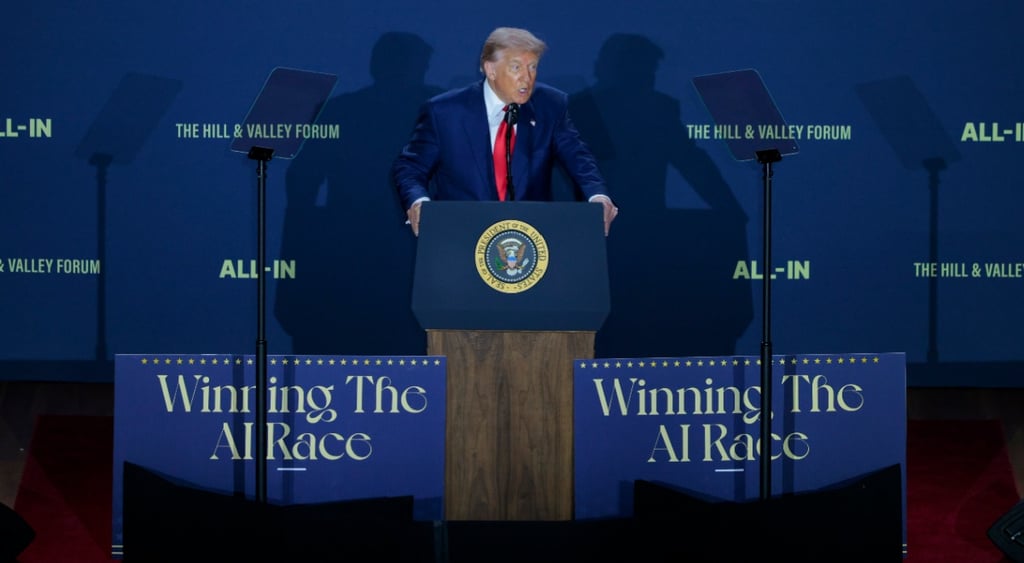
Situation D exponential takeoff: breakthrough into the mainstream
This is the one most people are expecting – AI becoming cheaper, faster, and smarter – and helping develop applications we haven’t even thought of yet, aside from large language models (LLMs) like ChatGPT and Gemini.
Companies that integrate AI well will thrive, with the idea that we’re in a bubble quite possible. As Brennan predicts, we might go back and face big pops or soft landings along the road first.
“I think we don’t even totally understand just how much change AI is going to drive… some pain (scenarios A – big pop – or B – a soft landing) before this becomes a reality.”
And that’s the difficulty of AI speculation. Making short-term predictions is difficult in itself.
Davidoff predicts, “as AI gets cheaper and better, the companies with real integrations, solid data, and working processes will turn profitable. Others will be revealed as hype when the tide goes out.”






Unlock more exclusive Cybernews content on YouTube.