Quantum computing race explained: fast and furious
The World Economic Forum (WEF) published several think pieces this year describing a post-quantum computing world in which the global chasm between developed and underdeveloped populations only grows larger. But could the gloomy forecast be rosier than expected?

Shutterstock/Cybernews

 Follow us
The World Economic Forum (WEF) published several think pieces this year describing a post-quantum computing world in which the global chasm between developed and underdeveloped populations only grows larger. But could the gloomy forecast be rosier than expected?
Between Twitter’s Elon Musk and Apple’s Steve Wozniak calling for a six-month pause on AI development, threats of mass job extinction, claims of sentience, and now the proclaimed “godfather of AI” Geoffrey Hinton quitting Google so he can warn of its dangers, public confidence in advanced technology is muted at best.
However, Cybernews found one industry insider with a glass-half full approach, making the unavoidable leap into the quantum field seem much more palatable.
Four is the magic number
The threat of digital inequalities plaguing entire nations echoes sentiments from scholars, economists, and geopolitical analysts alike, as expressed by WEF Founder and Executive Chairman Klaus Schwab.





He and his colleagues believe the inevitable coming of what is being called the Fourth Industrial Revolution will not only fundamentally transform “the way we live, work, and relate to one another,” but create a “quantum divide” among humankind that could negatively impact history in ways never imagined.

My colleague Damien Black published his own insider interview piece earlier this year, finding similar viewpoints between Protiviti’s quantum computing director Konstantinos Karagiannis and the WEF.
So when I spoke with Matt Johnson, co-founder and CEO of quantum computing development firm QC Ware, it was refreshing to hear an alternate take.
Johnson – a former intel systems Air Force captain and finance executive who took the plunge into quantum nearly a decade ago – described a world stage where, despite its challenges, quantum computing will be more accessible than ever, even to those nations struggling economically to invest in advanced technology.
Touching upon the quantum divide, policy vs funding, the race with China, encryption algorithms, and the almighty cloud, Johnson believes the key to ensuring future quantum technologies reach all levels of society will rely heavily on collaboration between the public and private sectors within nations already leading the way.
Do you believe quantum computing is bringing the world closer together or pushing it further apart?
The first thing that comes to mind is that quantum computing, which is a form of high performance computing, is being aggregated into the divide where the United States is putting up hard kind of borders around export of these critical technologies and semiconductors and quantum computing.
And so, yes, in areas where it's geopolitically tough, it's putting up boundaries. On the other hand, the United States is just as aggressively reaching out to partner with what they would call like-minded countries.
"There's a reason to bring information technology across all borders to prop up the entire global community." - Matt Johnson, co-founder and CEO, QC Ware
I think the US, if you want to consider this from a policy level, is being extremely pragmatic about this technology and saying, if we look back at the 20th century around information technology and nuclear technology, it's never been one country that's been able to pull it off. It's generally a consortium of experts from around the world.
So you do see at the governmental level, and kind of quasi governmental level, a lot of bridges being built for the quantum computer.
Would you say that those bridges are being built necessarily within our borders and with private companies? Or are you talking about other countries specifically, such as in Europe?
Other countries, certainly government-to-government agreements that are being signed. It's all about trying to jointly accelerate technology development for quantum.
Now on the private sector side, there's never borders that exist there. I mean, unless the US government said, you can't go there. Money flows to wherever there's going to be a positive return. In our case, for instance, I guess probably 70% of our customer base is non-US.
A lot of European and Asian corporations, they look backwards on other emerging technologies, such as machine learning, and they perceive there to have been historically a technology gradient between where the US is and where Asia or Europe are. And it’s something that has caused them to double down on investments into US startups or tech. If you look at the composition of investors, I think quantum enjoys a lot of non-US money.
The WEF focuses on the divide between China, the US and other countries, specifically regarding quantum investments. China has the most at $15 billion, while the US and Europe combined constituted a close second at around $10 billion.

But besides the 17 nations that have “national initiative or strategy to support quantum technology research and development,” more than 150 countries do not. So, it's interesting that you're saying a lot of non-US countries are investing in quantum technology. Do you think that means there will be some information sharing, but that it is ultimately our responsibility to share the technology once it's more advanced?
Sure. Just like every technology. You could, if you have a corporate conscience, of course. I think you'll find responsible corporations will definitely be doing that. And by the way, there's money there as well. So there's a financial incentive.
I don't see quantum computing explicitly as being a technology that is going to be less or more adopted by the developing world than any other new technology. There's a reason to bring information technology across all borders to prop up the entire global community.
There's been a lot of fear-based talk about something like another Cold War nuclear arms race between China and America.
You're right about that. And there's nothing that private sector companies can do. On the other hand, [while] the walls are being put up around China or North Korea, just the opposite is happening with the rest of the world. Like the EU and the US, as more democratic free-market areas, are always pushing hard to build bridges. Markets that you can sell into or that you can draw brainpower out of, tap into sources.
Is this because China has government control over its private industry? It seems it can cherry-pick a lot of technology from companies and put it all together in a way that the Western world does not, especially the United States, being that our private companies tend to keep a lot of theirs secret. Do you foresee the US government forcing them to share, to keep up in the technology race between East and West?
Well, certainly I would love to see them stimulate more. Right now, the US government, through National Quantum Initiative, has been very active and visible at the policy level. But at the funding level, what the government is putting into quantum technologies pales in comparison to what China is doing. I think there's a direct correlation between the amount of capital invested in the new technology and the rate that it gets developed and fielded.
On the one hand, the US has said quantum technologies are critical to national competitiveness and security. And on the other hand, there's just not a lot of money flowing from them [US government] to support that.
It almost seems like they're expecting the private companies to pick up the slack, so to speak, in that regard?
And that doesn't work well with fundamental research. It works well with applied research and product development: that's where the private sector is able to take risk. [But] historically, the moonshot, the nuclear weapons program, this is all government funding. I think it's a real problem.

Possibly in the next ten years, quantum will be able to break a lot of current encryption systems. Nefarious actors are now harvesting data, saving it until that time. That is going to affect not just government security but private companies in regard to intellectual property (IP) and whatnot. Do you think the government is hoping that companies are going to find ways to prevent that for their own interests?
Actually, I don't. I think the government, like agencies that care about cryptography, are alerted to this. They're trying to collaborate with industry to educate them on how to protect themselves against this impending threat.
But again, what I sense is that there's not much visible activity by the US government at all in this. Even though it's been described as a high priority, I don't see any action.
What do you think the ramifications of that will be in the future if we’re not keeping up with China on this?
That’s a leading question. Our sensitive data, intellectual property, those things could be at risk.
And there are other countries around the world who have traditionally adopted a very lazy way of innovating, and that is by stealing our innovation. And it’s very, very harmful to the US.
So, that's the consequence, right? It would be a very serious economic shock.
Some experts even say breaking encryption with quantum computers could happen in as little as three years. Do you think that is a realistic expectation?
There's one quantum algorithm out there that has been proven to be able to crack encryption. It's called Shor's algorithm. If you look at the size of the quantum computer you'd need to run that and break a real live key, it seems unlikely you'd have one large enough in the next three years. Anything outside of three years I think is possible, but speculative. You really don't know.
Now, the real threat is that there would be other quantum algorithms developed alongside Shor's which could do this kind of work with smaller computers that will be coming online. Developing algorithms is not that expensive. I'm sure every country around the world is trying to do that. I mean, there's a huge incentive for it. From their perspective, It’s like treasure hunting.
This would mean there is a huge incentive for cybercriminals to do the same thing?
Yes.
What of the socio-economic differences between countries that have programs to develop this technology? There are still countries that have issues even with being online: the WEF says 2.9 billion people are still offline and do not benefit from the digital economy. What do you think about the implications of this in health, medical advancements, education, energy, infrastructure, transportation, and so on? Will less-developed countries not be able to access quantum resources?
The way quantum computing systems are architected, they will attach to the cloud. So you won't need to wheel a quantum computer physically to a country that's impoverished.
What you will need is basic access to the internet. And that would allow this powerful resource to be disseminated to those countries. And of course, you'll be able to purchase quantum computing power on kind of a pay-as-you-drink basis through Amazon or Google Cloud.
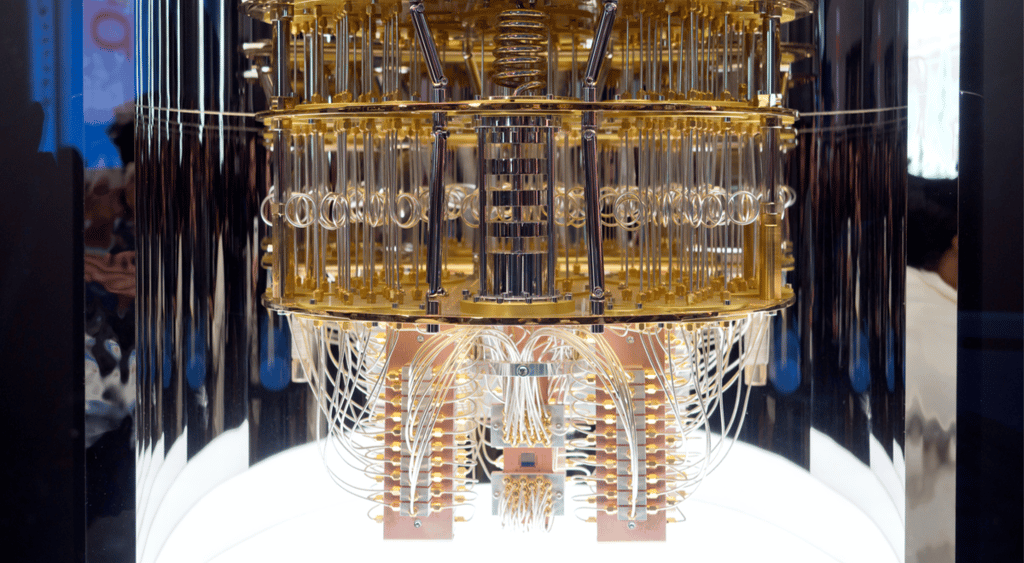
You can tap into that power for very little money, thanks to cloud computing. Thanks to a distributed internet that problem you're describing can be mitigated. The real key, frankly, is just to have more internet connectivity in those countries.
I firmly believe the issue is not that quantum computing will be too expensive or inaccessible. These machines will become easier to use over the next couple of years. There will be methods of utilizing quantum power for very little money. So there's nothing peculiar to quantum computing that would make it onerous to get into those [underprivileged] parts of the world.
But when it comes to developing the actual technology in the first place, do you think that is where the race is going on between East and West?
Yes, I definitely do. It's heating up. It's this potent technology: frankly I don't think anyone under any government really understands precisely what quantum computing will be useful for.
Certainly the industry and community talk about artificial intelligence and how quantum computing could be used for that. Think about that again at a nation-state level: the AI thing, that specter that is at once an opportunity and a threat. That's what people in government associate quantum computing with.
But coming back to the race, when it really accelerates is when those use cases, machine learning, material design, drug discovery, are validated a little bit more. Then that race would really heat up.
So you're saying once that information is discovered, it's going to be out there – easily available to other nations who aren't necessarily making the discoveries themselves?
Possibly, yeah. Look at the semiconductor industry. For several decades, Western allies including Taiwan have had a near-monopoly on the most advanced integrated circuits and chips. They've done that by very aggressively protecting their IP [intellectual property]. I think the same thing applies to quantum computing: there will be very aggressive protection of IP.