Hume Band vs Fitbit: which should you choose?
Being behind major reports like The Mother of All Breaches and RockYou2024, our in-house cybersecurity experts and journalists provide unbiased, real-world testing and in-depth analysis.
We maintain complete transparency by openly sharing our testing methodologies with our audience.
Learn more
Wearable health trackers have become our virtual coaches we count on daily. And, with the growing market, I've noticed a recurring question from readers: do you go with the popular Fitbit line or switch to the longevity-centric Hume Band? Both promise to improve your daily life, but they approach health differently.
In this article, I’ll take you through the Hume Band vs Fitbit comparison based on design, comfort, measurements, battery life, cost, and their respective apps.
Following my research and user analysis, I'll identify what each of these wearables does best and where it could let you down. By the time you're finished, you'll know whether you need a daily fitness buddy like a FitBit or a longer-term health Hume band to track resilience and future-proof your health.
After researching both wearables extensively, I'd say it comes down to what you're actually looking for. Fitbit is the winner in exercise diversity and alerts, but Hume Band is the winner if you value in-depth data, better build quality, and better battery life over over-the-top features.
At a glance: Hume Band vs Fitbit
Before we get into each of the wearable details, let’s quickly overview how they stack against each other in main features:
| Device | Hume Band | Fitbit |
| Rating | 4.8 | 4.6 |
| Key metrics | Metabolic momentum, recovery score, resilience, sleep, stress | Steps, heart rate, sleep stages, SpO₂, GPS, workout tracking |
| Sensors | Optical heart rate, SpO₂, movement, stress, recovery biomarkers | Accelerometer, optical heart rate, SpO₂, GPS, skin temperature (some models), ECG (some models) |
| Display type | No display (data shown in app) | Full-color AMOLED or LCD, model-dependent |
| Battery life | Up to 7 days | Up to 7 days |
| FSA/HSA eligible | ✅Yes | ✅Yes |
| Compatibility | iOS and Android | iOS and Android |
| Price range | Mid-premium | Budget-premium |
| Subscription cost | (optional) $8.99/month | (optional) $9.99/month |


Our team of in-house researchers, writers and editors reviews and analyzes health tech products using a research-driven approach. We gather data from multiple sources, fact-check all information, and conduct our research based on peer-reviewed studies, expert opinions, consumer ratings, and regulatory approvals.
You can learn more about how we test health tech products here.
How we test smart devices (methodology)
For the analysis of wearable devices like the Hume Band and Fitbit, we work together with the Cybernews research team and follow a structured testing methodology. That way, each comparison is consistent and reflects what real users actually experience. Our testing methodology is divided into five main areas:
- Features and technology (40%). We analyze health tracking, connectivity, and how well each gadget plays with other technology you already own.
- Design and comfort (20%). We test day-to-day wearability, comfort while sleeping, and whether the interface actually functions in real-world use.
- Cost and value (20%). We compare what you're paying upfront and on an ongoing basis to what you're actually receiving in return over time.
- Battery life (10%). We track how long the batteries last and how they hold up when you're using things like GPS intensively or getting tons of notifications.
- User reviews and reliability (10%). We analyze verified buyer reviews and professional reviews to confirm what we're finding in our own testing.
What is the Hume Band?
The Hume Band is a wearable band, which focuses on longevity metrics over short-term performance. It tracks:
- Sleep quality
- Recovery
- Stress
- Heart rate variability
- SpO₂
It introduces new metrics like Metabolic momentum and Metabolic capacity to reflect how habits build up to long-term resilience. Everything gets funneled into the Hume Health app, which offers a free version as well as an optional subscription for additional insights.
On the outside, the Hume Band resembles Whoop Band: it’s screenless and lightweight (while the app does the heavy lifting). You can find how the two wearables compare in our Hume Band vs Whop comparison.
I find Hume Band’s new metrics intriguing but still somewhat of a novelty; promising, but not yet as widely validated as more established measures.
What is Fitbit?
Fitbit is one of the most widely known wearables in health-tracking technology. It was established in 2007, is currently owned by Google, and offers a set of products: from budget-friendly fitness wearables like Inspire to more smart hybrid smartwatches like Charge, Sense, and Versa lines.
Fitbits monitor an extensive set of health data: steps, ongoing heart rate, sleep stages, SpO₂, stress signals, and even ECG and skin temperature sensors in more expensive ones.
It also has smartwatch-like features: notifications, GPS on most models, guided exercise, music control, and even tap-to-pay or mapping on newer models.
Fitbit supports both Android and iOS smartphones, offers a full-featured dashboard app, and has a paid subscription service (Fitbit Premium) for more in-depth analysis, software, and higher-level metrics.
Most popular Fitbit models
Here are the most popular Fitbit models:
- Fitbit Sense 2 – best for holistic health and stress tracking
- Fitbit Inspire 3 – best for beginners and everyday tracking
- Fitbit Charge 6 – best for fitness enthusiasts on a budget
- Fitbit Versa 4 – best for everyday smartwatch + fitness blend
Hume Band vs Fitbit: design and comfort
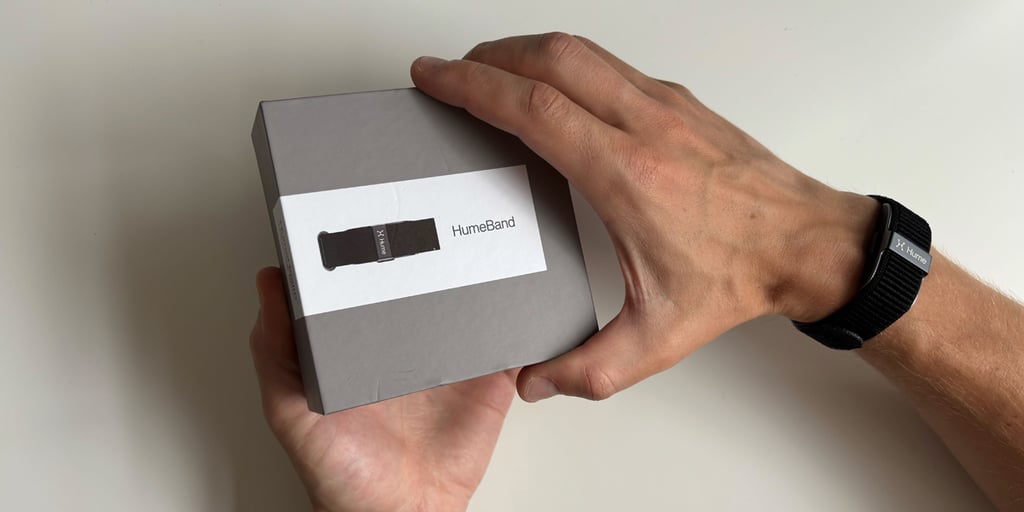
The Hume Band is deliberately minimalist, with a screen-free, distraction-free design. The idea is simple: no dopamine loops, no constant notifications, just data collected in the background and displayed in the app. From a research standpoint, this approach aligns with studies showing that constant smartwatch pings could potentially affect sleep quality.
The band is super light, water-resistant, and built for 24/7 wear, including during the night. Users feedback I’ve overseen highlighted how they “forget it’s even there,” which suggests the design succeeded in being unobtrusive.
Fitbit, on the other hand, takes a different approach. Its models include AMOLED or LCD displays, touch and button controls, and multiple strap options (from workout-ready silicone to dressier leather and steel).
That variety is great for personalization, but the trade-off is extra weight and bulk. From my user experience analysis, it seems that bulkier wearables are more likely to be removed during sleep, and I’ve noticed the same complaint among Fitbit users.
Hume Band vs Fitbit: metrics and tracking capabilities
One of the big differences between Hume Band vs Fitbit is the metrics they track and how a user can interpret and apply those in their daily life.
Hume Band is all about the things longevity researchers geek over: besides the basics, it tracks heart rate, HRV (heart rate variability), SpO₂ (blood oxygen level), recovery scores, and some of the more recently introduced metrics such as Metabolic capacity and Metabolic momentum.
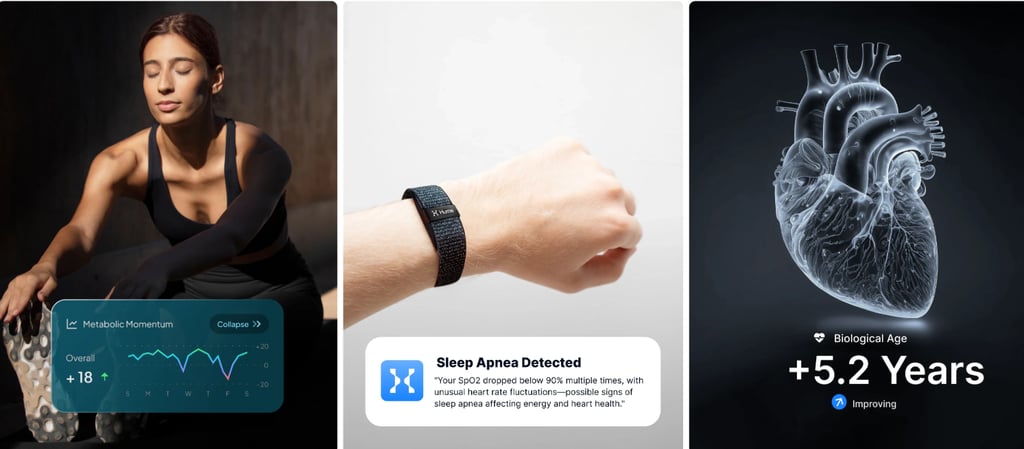
Fitbit, on the other hand, has a set of more conventional metrics like all-day HR, HRV, SpO₂, sleep stage analysis, onboard GPS, exercise tracking, ECG measurements, and even stress and skin temperature on some models.

As to the reliability of these figures, the Hume Band hasn't been thoroughly tested yet. Fitbit's been out for a little longer, but accuracy can break during intense exercise or if you're not wearing it right.

Hume Band vs Fitbit: battery life and charging
During my analysis, the Hume Band impressed me with its battery: it promises up to 7 days on a perfect charge.
Charging time from empty to full is 20 to 80 minutes, which is pretty impressive. Because Hume lacks a screen and notification lights, passive tracking doesn’t drain extra power, and its life holds up quite well.

For Fitbit, battery life depends on the model and the settings. A model like the Charge series can also manage nearly a week if you limit features like always-on display, bright screen, or heavy GPS use.
If you use an always-on display or use onboard GPS a lot, those features seriously consume battery.
Hume Band vs Fitbit: cost and value
When it comes to pricing, Hume Band and Fitbit are quite different. Hume Band is sold as mid-premium with initial purchase. You can have subscription-based add-ons like AI-powered coaching, but it’s not necessary for standard use.
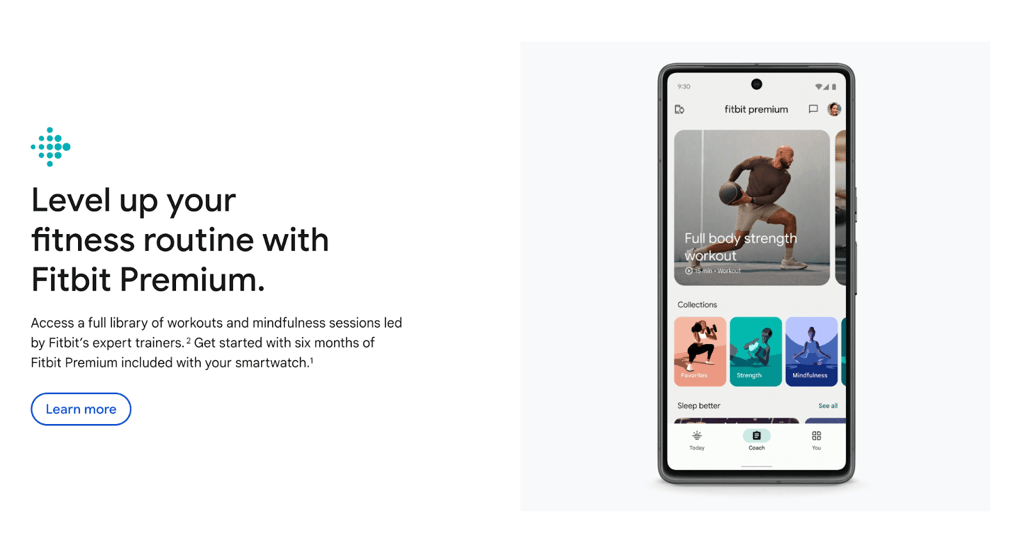
Fitbit does span a budget to high-end option (exact price depends on the model. The watch itself is less expensive upfront, but more advanced features are locked behind the Fitbit Premium subscription. Straps and chargers are additional accessories that add to the long-term cost.
To save money, you can use an exclusive Hume coupon code CYBER20. It secures a 44% discount off smart scales and bands.
Hume Band vs Fitbit: app
Both Hume Band and Fitbit run on Android and iOS, but their applications have a very different character. Hume Health is minimalist: it distills data down into daily and weekly scores like metabolic momentum or resilience. I found it easy to follow, though its integrations are limited (largely Apple Health and Google Fit) and export options aren't as flexible.

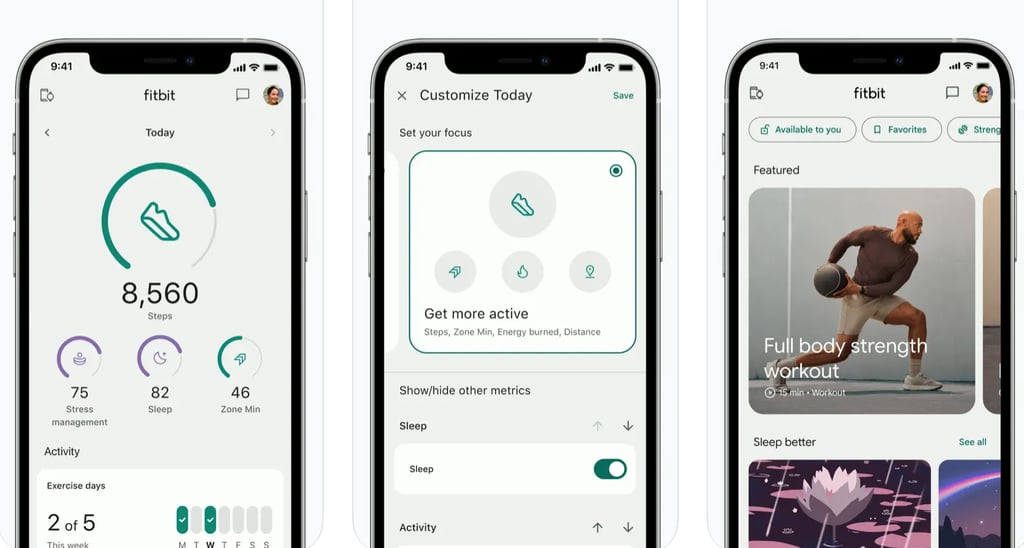
The Fitbit app, by contrast, is far more comprehensive. It tracks dozens of metrics in depth, with graphs and historical context, and integrates with popular services like Strava and MyFitnessPal.
Fitbit also has the bonus of an enormous user community, with challenges and forums that could increase your motivation. Data export is also more thorough, thanks to years of iteration.
Hume Band vs Fitbit: pros and cons
After analyzing both Hume Band and Fitbit, I made list of their strengths and weaknesses, so you can make an informed decision:
Hume Band pros and cons
Fitbit pros and cons
Hume Band vs Fitbit: which one should you choose?
The Hume Band takes the lead in the Hume Band vs Fitbit comparison. After looking into each device, I believe Hume Band trumps Fitbit with longevity-first emphasis and distraction-free design. Research also confirmed screen-free wearables could be more compliant with monitoring sleep, and in my comparison, Hume's minimalist measures enable long-term consistency.
At the end of the day, your winner will depend on your daily choices and goals. If you want a spartan device that gives you actionable health data without dopamine-releasing distractions, go with the Hume Band. If you need a fitness band with multiple functions that includes smartwatch features like GPS and notifications, Fitbit would be more suitable for you.
FAQ
Is Hume Band compatible with Android and iPhone?
Yes, it’s compatible with both Android and iOS through the Hume Health app. The app is free and you can opt for a premium option for advanced insights and tracking capabilities.
Does Fitbit track recovery like Hume Band?
Not exactly. Fitbit monitors recovery and stress markers, but not Hume's longevity recovery scores. Fitbit is better suited for short-term activity recovery, while Hume focuses on long-term resilience.
Which is more accurate for sleep and stress tracking?
Fitbit tends to be more precise for sleep and stress monitoring, as a result of larger datasets and verification. Hume Band measurement is pioneering but relatively newer and less independently validated at scale.
Can you use either without a subscription?
Yes. Both Fitbit and Hume Band are subscription-free. Core tracking is included but additional capabilities like Hume's AI coaching or Fitbit Premium programs require optional paid subscriptions.
How durable are they for fitness and outdoor usage?
Both wearables are durable. Hume Band is water-resistant and light, suitable for daily wear. Fitbit has broader durability ratings that vary model by model but heavier designs are less comfortable during time-intensive outdoor activities.