Kiierr vs iRestore: which laser hair growth device is worth your money?
Being behind major reports like The Mother of All Breaches and RockYou2024, our in-house cybersecurity experts and journalists provide unbiased, real-world testing and in-depth analysis.
We maintain complete transparency by openly sharing our testing methodologies with our audience.
Learn more

The average person loses up to 100 telogen hairs per day. These are resting hairs that have stopped actively growing and are shed as new hair grows. And while new hair usually grows back, for many, excessive stress can push more hairs into this resting state. In fact, 30-50% of men experience balding by age 50, and about 25% of women have visible female pattern hair loss by the same age.
This explains why the market is flooded with products that promise to spark hair regrowth, with Kiierr and iRestore offering some of the most talked-about devices today. But do these brands actually deliver on their promises?
To find out and to help you decide between these two, the Cybernews researchers and I conducted a thorough Kiierr vs iRestore comparison. We reviewed spec sheets, hair growth guarantees, pricing, and, most importantly, real user feedback to assess how these two brands perform. Below are our findings.
Kiierr vs iRestore overview
As always, I’ll kick things off with a quick comparison of the two laser hair growth brands. This way, you’ll know exactly what you’re dealing with in terms of key features and pricing:
| Brand | Kiierr | iRestore |
| Rating | ⭐ 4.7/5 | ⭐ 4.6/5 |
| Price | From $799 to $2,199 | From $499 to $1,799 |
| Effectiveness | Claims results in 6–12 weeks | Claims visible results in 3–6 months |
| Scalp coverage | Flexible (fits 23.5” heads) | Hairline, top of scalp, sides, temples, and crown |
| Diodes (low-level lasers/LEDs) | From 148 to 302 low-level laser diodes | From 120 to 500 low-level lasers and LEDs (in varying configurations) |
| Power output | From 740mW to 1510mW | From 600mW to 2500mW |
| Treatment time |
|
|
| Warranty | ✅ Yes (two years) | ✅ Yes |
| Financing options | ✅ Yes | ✅ Yes |
| Money-back guarantee | ✅ Yes (seven months) | ✅ Yes (12 months, but with a 25% return fee) |
| Shipping | Free (two-day shipping) | Free |
| What I like |
|
|
| What I don’t like |
|
|



Our team of in-house researchers, writers and editors reviews and analyzes health tech products using a research-driven approach. We gather data from multiple sources, fact-check all information, and conduct our research based on peer-reviewed studies, expert opinions, consumer ratings, and regulatory approvals.
You can learn more about how we test health tech products here.
Why you can trust Cybernews health tech reviews
When it comes to health-related gadgets, the Cybernews team employs an exhaustive, research-based, in-house evaluation system that goes far beyond mere manufacturer claims. Here’s what we pay close attention to:
- User reviews and testimonials (25%). We look beyond sensationalized claims and review user feedback across multiple platforms to assess real-world performance.
- Effectiveness claims (20%). While manufacturer claims don’t always hold up in the real world, we still assess whether health tech gadgets deliver on these promises.
- Ease of use, comfort, and battery life (20%). We assess user-friendliness, snugness, hands-free use, and, for battery-powered gadgets, how long they last on a single charge.
- Warranty, refunds, and customer support (20%). We consider whether manufacturers honor warranties and refund policies, and how easy it is to obtain a replacement or refund via customer support.
- Technical specs vs manufacturer claims (15%). Promises sometimes go beyond what the technology behind a health-related product can deliver, and we also evaluate that.
Understanding low-level laser or LED-based hair growth caps
While health tech manufacturers’ claims can get pretty wild, some hair growth devices may potentially deliver on their promises. These gadgets, including Kiierr laser caps and iRestore products, rely on a process known as low-level laser therapy (LLLT). But what’s that, you ask?
Well, LLLT is a non-invasive, clinically backed process that, in this case, uses red and near-infrared (NIR) light to stimulate cellular activity. In particular, the treatment stimulates the cell’s mitochondria, causing it to produce adenosine triphosphate (ATP), the cell’s primary source of energy.
As for the mentioned light in these products, LLLT uses varying configurations of red LEDs and near-infrared light. Here, LEDs typically emit red light at wavelengths between 630nm and 700nm for a surface-level effect. Meanwhile, near-infrared low-level lasers at wavelengths between 700nm and 1000nm penetrate deeper into the tissue and potentially promote cell regeneration.
How can light-based hair growth devices potentially help with regrowth?
Light-based gadgets that support hair regrowth may be new, but the underlying technology has been around for some time now. In fact, NASA conducted extensive research on LLLT in the 1990s, initially to grow plants in space. During this research, scientists accidentally discovered its potential to promote wound healing, which would later serve as a springboard for LLLT research on hair growth. But how does it all work?
At its core, LLLT, now mostly referred to as photobiomodulation (PBM), aims to boost ATP production in the cell’s mitochondria and potentially improve blood flow, which might help deliver nutrients. This may improve the overall follicular environment, encouraging dormant hair follicles to re-enter the growth (anagen) phase. As such, emerging evidence suggests red light therapy may help support hair growth and improve scalp health.
I should note that hair growth doesn’t happen overnight. Consistency is the name of the game here, and results might only be visible when these devices are used daily or every other day for weeks or even months. It’s also important to be realistic about your expectations, as completely bald individuals won’t suddenly get full heads of luscious hair.
It’s important to mention that red light therapy has been suggested to be helpful only in certain cases of hair loss, which include male or female pattern hair loss. However, hair thinning may be caused by many different reasons, some of which may require timely medical attention. So if you’re currently experiencing hair loss, talk to your healthcare provider first. They’ll identify the culprit behind your problem and tell you whether LLLT might be worth considering.
What is the Kiierr laser hair growth cap?
Kiierr is the newer of the two companies that I’m comparing today. It was founded in 2018 by a husband and wife, Mike and Jolene Anderson, after Jolene began suffering from postpartum hair loss, and Mike began searching for safe, non-invasive treatment options.
Several years later, Kiierr’s FDA-cleared, low-level laser-based hair growth caps are among the most talked-about gadgets in the industry. At first glance, these devices look like any other cap. But inside, they’re lined with medical-grade low-level lasers that emit 650nm and 808nm light at 5mW per laser.
Kiierr’s Pro, Premier, and MD Ultra Flex Caps have 148, 272, and 302 650nm low-level lasers, with total power outputs of 740mW, 1360mW, and 1510mW, respectively. Meanwhile, the newer DualWave and MD Dual Flex Laser Caps also feature 40 808nm low-level lasers alongside the standard 232 and 272 650nm low-level lasers, with power outputs of 1360mW and 1560mW, respectively.
While these aren’t the highest numbers on the market, the clinically proven LLLT-based lineup is ideal for users who want lightweight, easy-to-use, and highly portable hair growth devices that they can also discreetly wear in public.
What is the iRestore laser hair helmet?
iRestore hasn’t always been in the hair growth business. Founded in 2003 by Kevin Chen, the company actually began its journey as part of a clinic focused on helping smokers quit. Over time, it has evolved into a brand that helps combat androgenic alopecia (hereditary, or hormonal hair loss, also known as male or female pattern baldness).
Today, it offers clinically proven, FDA-cleared light-based devices that the brand claims can help reduce hair loss and even stimulate new hair growth. These non-invasive, helmet-like gizmos rely on varying configurations of red LEDs and near-infrared low-level lasers.
For example, the top-tier Elite model features 200 triple-wavelength LEDs (625nm/655nm/680nm) and 300 low-level lasers. It also has a total power output of 2500mW, making the Elite the most powerful device of its kind, according to iRestore. As such, these laser helmets are an excellent choice for at-home users who want the most robust option on the market.
Differences between Kiierr and iRestore
Now that you know more about the two brands and their hair growth devices, we can also explore the differences between them:
- Laser count and technology. Kiierr’s devices rely solely on dual-wavelength low-level lasers that emit 650nm and 808nm light at 5mW per laser. Meanwhile, iRestore gadgets use a combination of triple-wavelength red LEDs and near-infrared low-level lasers.
- Cap vs helmet design. Kiierr’s hair growth gizmos look just like any other cap, whereas iRestore devices use a helmet-like design.
- Portability and discretion. With Kiierr, the focus is on discreet sessions, as its highly portable devices are inconspicuous. Conversely, iRestore’s bulky helmets are far less discreet, effectively limiting them to at-home use.
- Price and overall value. Price-wise, the Kiierr laser caps vs iRestore helmet showdown always ends with the latter brand winning. But for many users, Kiierr’s lightweight, discreet caps offer better value.
- Session duration. Kiierr recommends daily 6-minute treatments for the MD Ultra Flex, DualWave, and MD Dual Flex models, and 30-minute sessions every other day for its Pro and Premier caps. iRestore, on the other hand, suggests three weekly 25-minute treatments for the Essential and Professional, and daily 12-minute sessions for the Elite.
- Warranty and guarantees. A two-year warranty and a seven-month hair-growth guarantee are standard across all Kiierr products. On the other hand, iRestore offers two-year warranties for the Essential and Professional, and a three-year one for the Elite. Users can also extend these warranties by another two years for $39, $49, or $99, depending on the model. A 12-month money-back guarantee is also present for all three helmets.
- Customer support reputation. While both companies enjoy solid online reputations, Kiierr’s customer service scores higher overall.
Once you consider all the aforementioned aspects, it becomes clear who these two brands are for. Kiierr is ideal for those who want a lightweight, cap-like hair-growth device they can use at home or on the go. Conversely, iRestore is an excellent choice for at-home-only users who want the most powerful product on the market.
Winner: Draw
Kiierr vs iRestore: features comparison
Both iRestore helmets and Kiierr caps are packed with diodes and designed for comfortable, hands-free use. But which brand takes the crown in this iRestore vs Kiierr comparison when it comes to features?
Depending on the model, iRestore’s devices have the following configurations:
- Essential. 51 low-level NIR lasers, 69 red triple-wavelength LEDs (620nm/655nm/680nm), and 600mW of power.
- Professional. 82 lasers, 200 LEDs, and an output of 1410mW.
- Elite. 300 lasers, 200 LEDs, and a whopping 2500mW.
All three models use the company’s patented ventilated design and feature adjustable foam pads, making them very comfortable, even for longer 25-minute sessions. However, they’re also wired; rechargeable batteries cost $79 to $99, depending on the model.
On the other hand, Kiierr’s gadgets have built-in batteries, so there are no extra costs here. They’re just as comfortable as any other cap, with the two newest DualWave caps offering a flexible carbon fiber design for an even better fit.
Here are the models:
- Pro. 148 red (650nm) low-level lasers, with a power output of 740mW
- Premier. 272 lasers and 1360mW of power
- MD Ultra Flex. 302 lasers and 1510mW of power
- DualWave. 232 red (650nm) and 40 NIR (808nm) lasers, with a 1360mW output
- MD Dual Flex. 272 red and 40 NIR lasers, with a power output of 1560mW
Importantly, both iRestore helmets and Kiierr caps are FDA-cleared, so despite their different designs and power configurations, they meet the same safety requirements for at-home hair growth treatments.
Kiierr vs iRestore: customer reviews and testimonials
With all the wild claims I’ve seen in the health tech industry, I believe feedback from real users is often the more important part of the story. That’s why I also dug into comparisons of Kiierr vs iRestore across Reddit, Trustpilot, Amazon, BBB, and various hair loss forums.
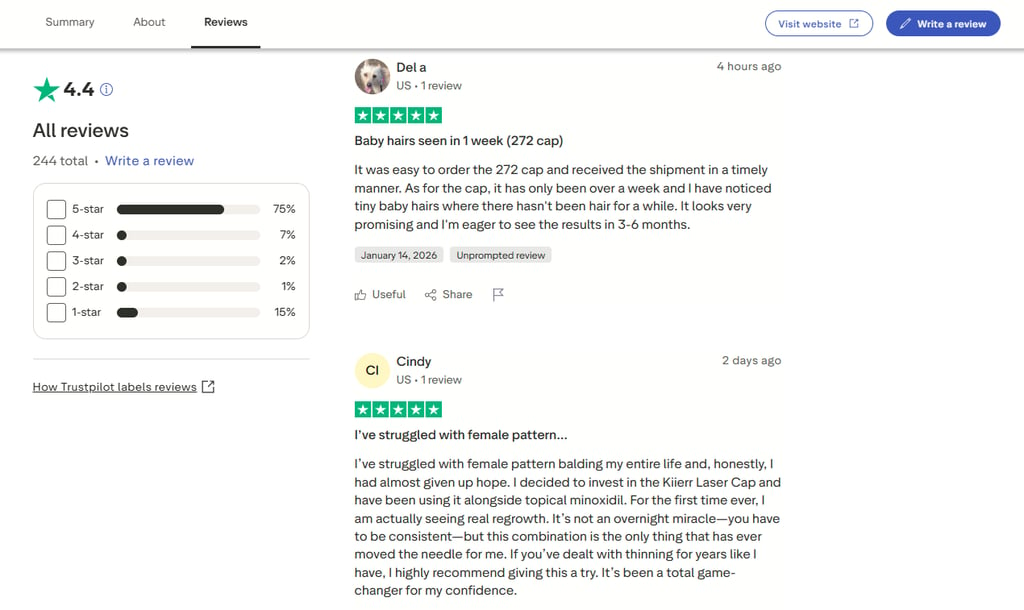
Kiierr’s users are praising both the quality and effectiveness of the hair growth caps and the company’s customer service. As for the negative feedback, it’s most often centered on comfort issues and shipping delays.
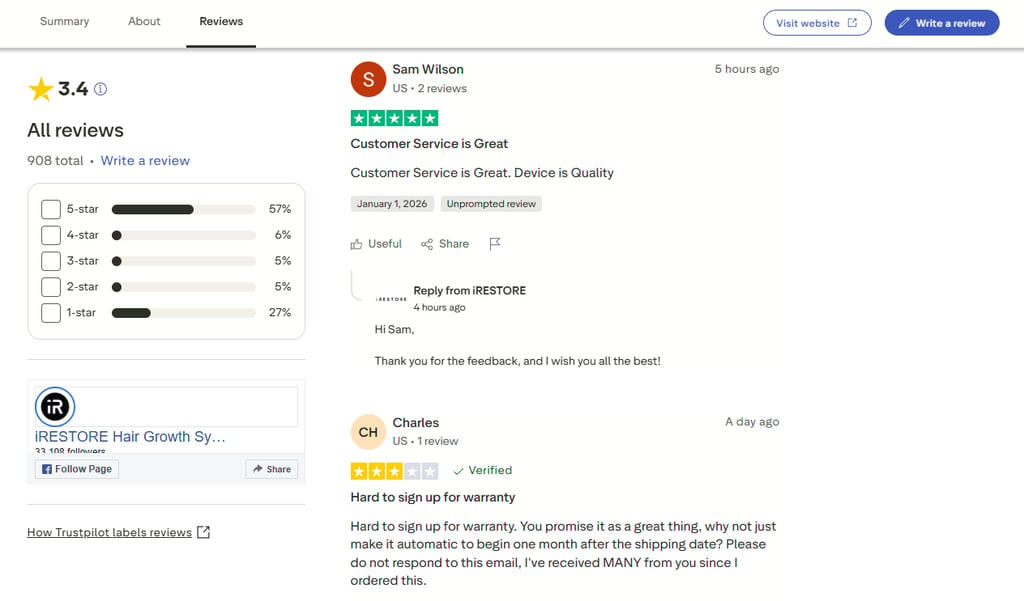
Things aren’t looking as positive on iRestore’s side. While most users appreciate the brand’s support agents and helmet quality, it appears iRestore may be experiencing more than a few shipping issues. In fact, delays seem to be the most common cause of negative feedback here.
Kiierr vs iRestore: which one should you choose?
Before I wrap up, I wanted to include a set of recommendations based on user type:
- Budget-conscious users. iRestore’s helmets are the better option in this segment, as they’re generally cheaper than Kiierr’s caps.
- Portability-focused buyers. Kiierr wins this round with its lightweight, cap-like hair-growth devices, no question about it.
- At-home-only consumers. Since most iRestore users find the brand’s helmets extremely comfortable, I’d recommend iRestore over Kiierr here.
- Discretion-first users. If you’re after an inconspicuous device, Kiierr’s laser caps are the way to go.
- High laser count seekers. While iRestore might seem like the better option here, its helmets also include red LEDs, so Kiierr’s devices actually have more low-level lasers.
Kiierr vs iRestore: final verdict
At the end of the day, you won’t go wrong with either of these two hair growth brands, but there are differences between them.
Kiierr’s softer, lighter, and more flexible caps are easier on the head, while their discreet design makes them easy to wear anytime, anywhere. Conversely, iRestore’s helmets focus on output power, with adjustable foam pads that make them ideal for comfortable at-home use.
That said, I’d award Kiierr the overall victory here. I’d also recommend it to anyone looking for a cap-style hair-growth device with built-in wireless usability, discreet design, and portability.
As for iRestore, I think it’s ideal for strictly at-home users who want utmost comfort, triple-wavelength LED exposure, and higher output power. It’s also the better choice if you’re already inside iRestore’s ecosystem and use its other red-light devices and supplements.
If you’re considering purchasing an at-home LLLT device for helping manage hair thinning, consult a board-certified dermatologist first. They’ll help you figure out whether these hair growth devices are safe and potentially effective for you.
FAQ
Are Kiierr and iRestore laser hair growth devices safe for long-term use?
LLLT, the technology on which both Kiierr and iRestore are based, is generally considered safe to use. Devices from these brands have also been cleared by the FDA. However, it still remains unclear to scientists if LLLT is safe to use long-term.
How long does it take to see results from Kiierr or iRestore?
Kiierr suggests results within 2-3 months for Ultra Flex users, nearly twice as fast as Premier’s 3-6-month results. As for iRestore, the brand claims initial results within 3-6 months, with really noticeable results taking at least 12 and up to 24 months of consistent use. That said, there’s still not enough research to determine for how long devices like these should be used to achieve visible results.
Which is more travel-friendly: Kiierr or iRestore?
If you’re looking for a more portable device, Kiierr is undoubtedly the better choice. Its cap-style hair growth devices are lightweight, flexible, and easy to pack in a bag and take with you.
-
Sukhbir Singh. 2021. Indian Journal of Plastic Surgery
Practical Approach to Hair Loss Diagnosis
-
Leila Asfour. 2023. EndoText
Male Androgenetic Alopecia
-
G. Fabbrocini. 2018. International Journal of Women’s Dermatology
https://pmc.ncbi.nlm.nih.gov/articles/PMC6322157/
-
Shirin Farivar. 2014. Journal of Lasers in Medical Sciences
Biological Effects of Low Level Laser Therapy
-
Howard B. Cotler. 2014. Current Orthopaedic Practice
A NASA discovery has current applications in orthopaedics
-
Jisha K. Pillai. 2021. Journal of Cutaneous and Aesthetic Surgery
Role of Low-Level Light Therapy (LLLT) in Androgenetic Alopecia
-
American Academy of Dermatology Association
Is red light therapy right for your skin?
-
MedlinePlus Medical Encyclopedia
Hair loss