Synthetic identity fraud: how it works and how to defend against it in 2026
Our in-house experts test identity theft protection services themselves, using real-world scenarios and established testing methods. We look at how well each service monitors personal information, how quickly and clearly it sends alerts, what recovery support it offers, and how it handles customer data.
We assess every provider using the same criteria and explain our testing process clearly, so readers can compare services and make a more informed choice.
Learn more

Traditional identity theft steals a person. Synthetic identity fraud builds one – stitching a real Social Security number (SSN) to a made-up name, fake date of birth, and a fabricated address until banks treat the fiction as a customer.
There's no victim filing a police report, because the “person” never existed. That's why the Federal Reserve has called it the fastest-growing financial crime in the United States, and why most banks still log the losses as bad debt instead of fraud.
Synthetic identity fraud at a glance
- Definition: A fabricated identity built by combining real personal information (usually an SSN) with invented details
- Why it's dangerous: No real victim means no fraud alert and no police report – the "person" never existed
- Scale: Industry estimates point to $20-40 billion in annual exposure for US lenders
- Primary targets for SSN harvesting: Children, the deceased, and the elderly – people unlikely to monitor their credit
- The fix: Freeze your credit (and your kids' credit), and reduce the personal data sitting on data broker sites
Defining synthetic identity fraud
Synthetic identity fraud means building a fake person – usually by pairing a real SSN with made-up details like name, date of birth, and address. The goal is to pass as a real customer, open credit lines, and disappear.
It's not like traditional identity theft, where someone steals your details and impersonates you. This is closer to building a kit car from stolen parts. Fraudsters lift an SSN from someone who won't notice – a child, an inmate, a deceased person – then wrap a plausible-looking identity around it.
That last detail is what makes it so hard to catch. There's no matching person on file to raise a flag. The fake identity can sit quietly for months while fraudsters build its credit history from scratch.
Synthetic identity fraud vs traditional identity theft
| Feature | Traditional identity theft | Synthetic identity fraud |
| Identity used | A real person's complete profile | A fabricated profile from mixed data |
| Victim awareness | The victim notices – denied credit, strange charges | No "victim" exists to raise the alarm |
| Detection trigger | Customer disputes, fraud alerts | Internal modeling, often months later |
| Loss classification | Logged as fraud | Often logged as bad debt or charge-off |
| Time to monetize | Days to weeks | 12-24 months of cultivation |
That last row is what makes synthetic fraud so dangerous and effective. A traditional scheme has a short window before the victim catches on. A synthetic identity has all the time in the world.
Anatomy of a Frankenstein identity
The industry nickname for synthetic fraud is "Frankenstein identities" – stitched together from parts that each look clean on their own.
- A real, unused SSN
Children's numbers are the gold standard. The Social Security Administration (SSA) randomized SSN assignment in 2011, so there's no easy way to flag a number as belonging to a minor. Inmates and the deceased work for the same reason – nobody's watching the credit file.
- A fabricated name and date of birth
Generic enough to clear law-enforcement watchlists. The date of birth ages the identity to adulthood, which passes off the blank credit history as "first-time borrower."
- A real, working address
Mail has to land somewhere – usually a drop house, virtual mailbox, or an address the ring reuses across multiple identities.
- Synthetic supporting documents
This is where 2026 changed things. Generative artificial intelligence (AI) churns out fake utility bills, paystubs, and social media histories on demand. Deepfaked selfies now defeat basic verification checks too.
Each piece looks legitimate in isolation. Banks running siloed verification see a clean record. The fraud lives in the combination.
The slow burn: how a synthetic identity gets cultivated
Professional rings don't just apply for a $50,000 loan on day one and run. The play is slower – a four-stage cycle that ends in a coordinated cash-out.
Stage 1 – seeding
The fraudster applies for credit knowing the lender will reject it. That's the point. The rejection triggers a credit inquiry, which causes the bureaus to create a "thin file" and register the identity as real.
Stage 2 – piggybacking
Someone – sometimes a paid collaborator – adds the synthetic identity as an authorized user on a "seasoned" credit card account. That account's payment history transfers to the synthetic file, inflating the score in weeks.
Stage 3 – cultivation
Now the fraudster has a working score. Small credit lines open, payments come in on time, and lenders respond by raising limits. This runs for a year or more.
Stage 4 – the bust-out
When limits hit the target, everything drains at once – cards maxed, personal loans drawn down, buy-now-pay-later accounts liquidated. The synthetic identity disappears. The lender writes off the loss.
A single ring runs hundreds of identities in parallel, staggered so one batch is always mid-cycle when the last one busts out.
The 2026 shift: AI-generated identities
Synthetic identity fraud used to be slow, manual work – assemble a few documents, mail in an application, wait. That's no longer true.
Generative AI has collapsed the cost of producing every component. Fake faces, fabricated documents, and deepfaked liveness videos take minutes instead of weeks. The Federal Bureau of Investigation issued a public warning in late 2024 that criminals are using generative AI to scale financial fraud.
Two developments stand out:
1) Autonomous fraud agents
Software agents apply for credit at dozens of lenders in an afternoon, learn which signals trigger rejection, and adapt in real time.
2) Deepfake injection attacks
Fraudsters feed fabricated video streams directly into the verification software development kit, bypassing the camera and defeating "selfie plus blink" liveness checks entirely.
Any defense built on static data matching is now obsolete.
Detection: why traditional KYC isn't enough
Static data matching used in KYC asks whether the data points are real. Synthetic identities answer yes to every one.
Modern detection asks two harder questions:
1) Does the identity behave like a real person?
Real users type, swipe, and hold their phones in characteristic ways. Vendors like BioCatch and LexisNexis Risk Solutions score such signals and flag when the behavior doesn't match the claimed identity.
2) Is it linked with other suspicious activities?
A single synthetic identity is hard to spot. A ring of fifty sharing an IP address, device fingerprint, or shipping address is much easier – and graph platforms surface those clusters automatically.
Synthetic fraud reveals itself in the metadata, not the application.
Protection against synthetic fraud for individuals
Most synthetic fraud defense lives at the bank level – behavioral biometrics, graph analysis, everything above – catching the scheme after it's already in motion. But there's a supply side too: the harvested SSNs and personal data that make plausible identities possible to build. Shrinking that data footprint is where individuals have real leverage.
That supply-side leverage matters, because the consequences of synthetic fraud aren't limited to lenders. Lenders take the direct financial hit. But individuals aren't fully off the hook.
Take a child whose SSN someone used for such fraud, for example.
That child arrives at adulthood with a credit file full of someone else's history – accounts, addresses, a recent default they had nothing to do with.
That file follows the SSN. It can block a first apartment, a car loan, a job offer. Disputing it means filing separately with every bureau, and it takes months.
The financial loss stays with the bank. The administrative mess lands on you.
1. Freeze your credit – and your kids’ credit (most important)
A credit freeze stops new accounts from opening in your name unless you lift it. For a child whose SSN hasn't been used yet, that's the whole game – the bureaus won't create a thin file for a frozen SSN.
Parents and guardians can freeze a minor's credit at no cost. The Federal Trade Commission confirms it. Contact each bureau separately:
- Equifax: equifax.com/personal/credit-report-services/credit-freeze
- Experian: experian.com/freeze
- TransUnion: transunion.com/credit-freeze
Each bureau needs proof of identity for both parent and child. It's free, it's reversible, and it stays in place until the child lifts it.
2. Cut off the data supply with Incogni (recommended)
The addresses, phone numbers, family relationships, and dates of birth that make synthetic identities plausible sit on hundreds of data broker sites. Fraud rings buy or scrape that data to build a supporting profile around a stolen SSN.
Incogni automates the cleanup – sending removal requests to 420+ brokers on your behalf, then re-submitting every 60-90 days because brokers reliably re-list profiles.
To see how exposed your data already is, the free Digital Footprint Checker shows exactly where your information sits before you start.
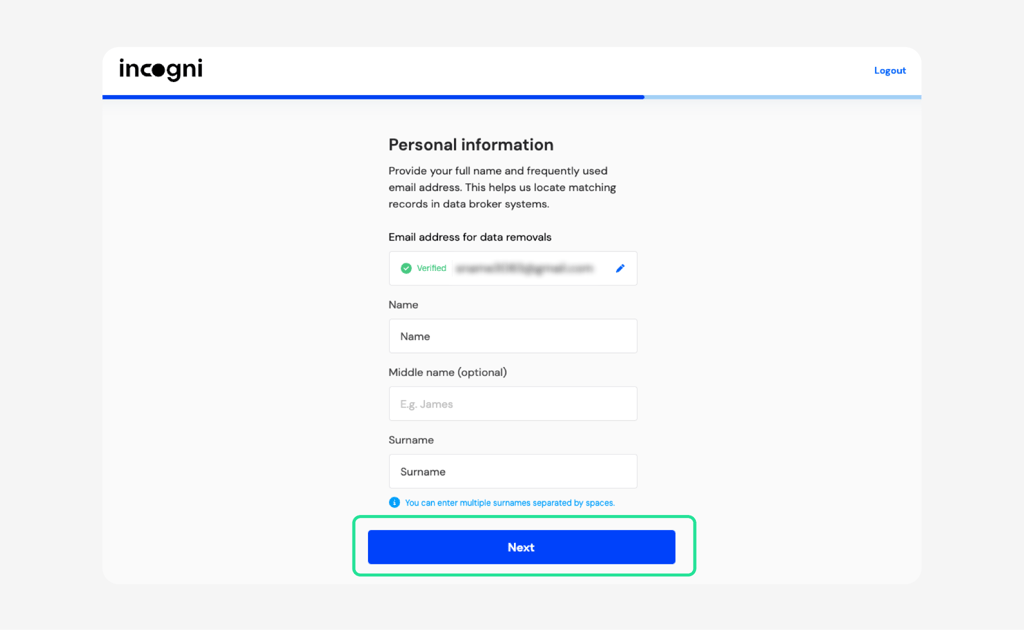
-
Sign up at Incogni's website and provide the basic details needed to find your profiles
-
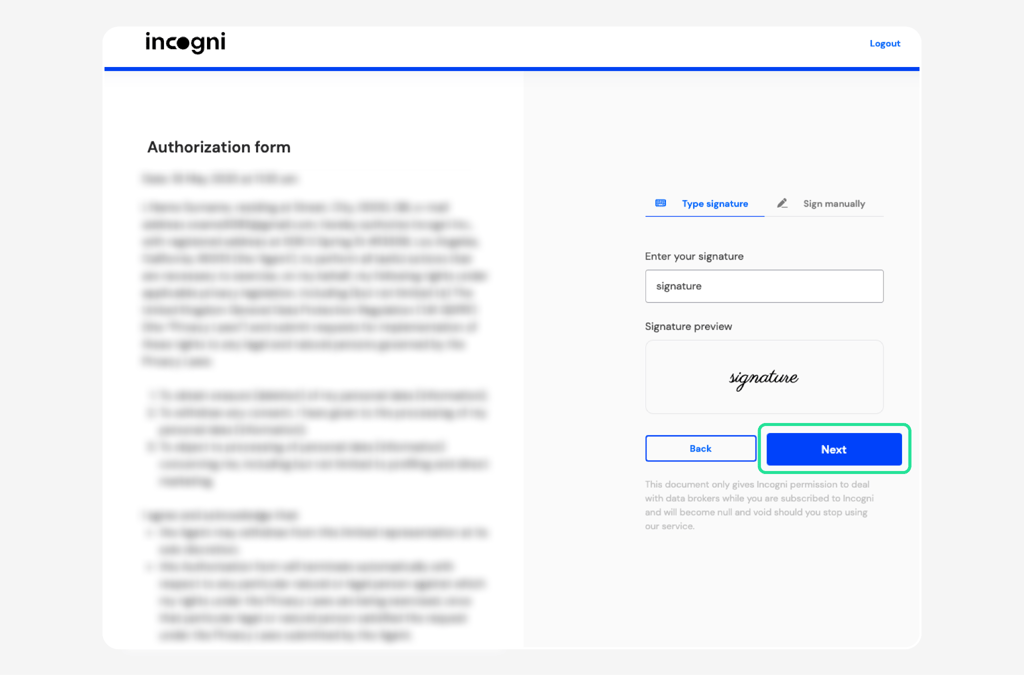
Sign the authorization form so Incogni can act on your behalf
- Let Incogni run – it handles the scanning, the requests, and the re-submissions automatically
3. Check your SSA earnings record annually
Log into ssa.gov/myaccount and review your earnings history. If an employer you’ve never worked for shows up there, someone’s using your SSN – for employment fraud, or as the foundation of a synthetic identity tied to a fabricated job history.
4. Pull your free credit reports weekly
You’re entitled to free reports from each bureau weekly through annualcreditreport.com. Look for accounts you didn’t open, addresses you don’t recognize, and inquiries from lenders you’ve never contacted.
Bottom line
Synthetic identity fraud is hard to see and harder to stop because the victim is a person who doesn't exist. Banks book the losses as bad debt, the SSN owner often never finds out, and rings run on multi-year timelines that most monitoring systems never catch up to.
For individuals, the leverage is on the supply side. Freeze your credit, freeze your kids', check the SSA earnings record once a year, and shrink the personal data footprint that makes the whole scheme possible. Incogni handles the broker-side cleanup automatically.
None of these is foolproof. But together they make your SSN – and your child's – a much harder target.
FAQ
What are the red flags for synthetic identity fraud at the application stage?
The clearest signal is a "thin file" – a high credit score built almost entirely through authorized-user piggybacking, with almost no independent credit history behind it. Other flags: mismatched SSN-and-date-of-birth combinations, multiple unrelated identities sharing an address or device fingerprint, and applications from IP addresses tied to prior fraud.
What is an example of synthetic identity fraud?
A fraudster takes a 7-year-old's SSN from a healthcare data breach, pairs it with a fabricated name and a date of birth that ages the identity up to 28, and uses a virtual mailbox. They apply for a few credit cards expecting rejection – that's enough to seed a credit file – then have a paid collaborator add the synthetic identity as an authorized user on a long-standing credit card. After 18 months of small purchases and on-time payments, the synthetic identity has a 720 score and qualifies for a $25,000 personal loan – which the ring takes and disappears with.
Is synthetic identity fraud a federal crime?
It is. Prosecutors charge it under 18 U.S.C. § 1028 – sentences up to 15 years – and almost always add 18 U.S.C. § 1028A, Aggravated Identity Theft, which mandates an extra two years consecutive whenever a real SSN is involved. Bank fraud, wire fraud, and mail fraud charges typically stack on top.
How long does a synthetic identity stay active before the bust-out?
Most rings cultivate identities for 18-24 months before cashing out. Longer cultivation means higher credit limits – but also more time for behavioral and graph-based monitoring to catch them.
Can a credit freeze stop synthetic identity fraud?
Only if the abused SSN is yours and you've already frozen it. That's why freezing children's credit matters – without a freeze, the bureaus create a thin file the first time someone applies using the child's SSN, which is exactly what the fraudster needs.
Why do banks treat synthetic identity fraud as bad debt instead of fraud?
Because the borrower of record looks like a real customer. When the synthetic identity defaults, no one disputes the charges and no one files a fraud claim. Collections books the loss as uncollectable debt – and moves on.