Similarweb vs Ahrefs: which platform delivers more accurate insights?
Being behind major reports like The Mother of All Breaches and RockYou2024, our in-house cybersecurity experts and journalists provide unbiased, real-world testing and in-depth analysis.
We maintain complete transparency by openly sharing our testing methodologies with our audience.
Learn more

For website owners, digital marketing and SEO are two of the most crucial focus points, and tools like Similarweb or Ahrefs are where they overlap. Each helps you fetch reliable data to optimize your outreach strategy and grow your brand and its online presence.
Still, one question persists: which is a better pick, Ahrefs or Similarweb? To answer that, I’ve gone through the nitty-gritty of both, and I’ll present my findings in this Similarweb vs Ahrefs comparison.
Together with my team of Cybernews experts, I’ve examined the traffic analysis, SEO, and marketing tools of each to lead you to a tailored fit. Join me as I break down the main benefits and drawbacks of each, and expand on features, pricing, and insights.
Ahrefs vs Similarweb overview
The best way to compare Ahrefs vs Similarweb is to review their key features at a glance. The table below will show you what makes them stand out:
| Traffic analysis tool | Ahrefs | Similarweb |
| Rating | 4.8 | 4.4 |
| Market segments | SEO professionals, digital agencies, link builders | Marketing teams, enterprise-level companies, digital strategists |
| Key features | Comprehensive keyword explorer, site explorer, rank tracker, backlink database | Website traffic analysis, competitive benchmarking, insights like audience demographics |
| Free trial | ❌(free tools are available) | ✅ (7-day free trial) |
| Price | Starting from $129/month | Starting from $125/month |

Ahrefs pros and cons
Similaweb pros and cons
Our methodology
While crafting this Ahrefs vs Similarweb comparison guide, I’ve mainly focused on the key features and categories defined by my team of Cybernews experts. Here’s what we based our search on:
- Data accuracy (25%). I mainly focused on the accuracy of the fetched website data, comparing the outputs of both with third-party analytics tools.
- Features & insights (25%). Moving on, I wanted to check all the features, including keyword depth, referral analytics, engagement analytics, and more.
- Ease of use (20%). I then focused on testing the layout itself, checking if it’s intuitive enough for first-time users.
- Pricing & value (15%). While higher-tier plans from both Ahrefs and Similarweb won’t hurt the budgets of enterprise-level companies too much, I also wanted to see and compare the affordability of their entry-level plans for everyday users.
- Customer feedback (15%). Last but not least, I checked existing user reviews and feedback on renowned platforms like Trustpilot and forums like Reddit to see how existing users feel about each.
Ahrefs vs Similarweb: plans and pricing
It’s a pretty close battle between the two when it comes to subscription-related Ahrefs vs Similarweb comparison. Both platforms start at nearly identical price points, with Ahrefs' Lite plan at $129/month and Similarweb’s entry-level plan at $125/month.
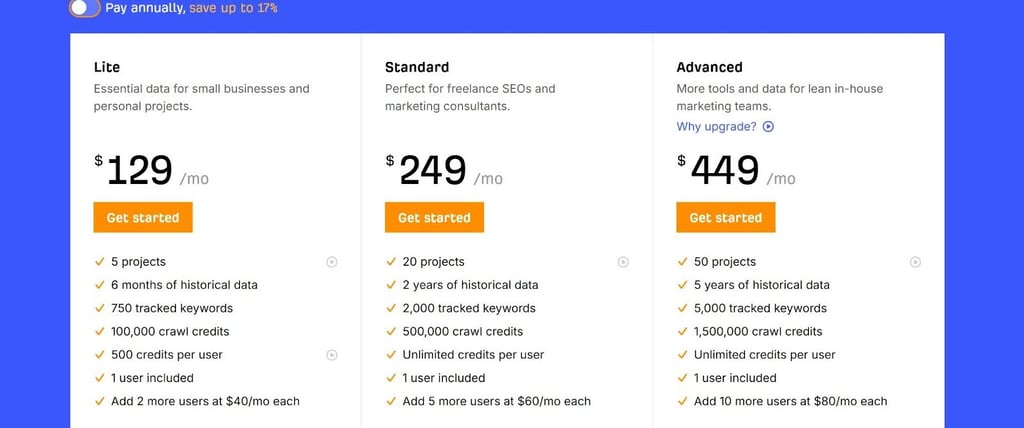
Speaking of Ahrefs’ Lite plan, it includes basic features like the site explorer and keyword explorer, with an overview of historical data. On the other hand, those seeking advanced features such as SERP comparison and batch analysis will need to choose the Standard plan.
The Advanced plan further ups the ante with Google Data Studio integration and historical SERP tracking. There’s also an enterprise plan with custom pricing and on-demand inquiries. On the flip side, Similarweb starts at $125/month for traffic analysis and customer demographics.
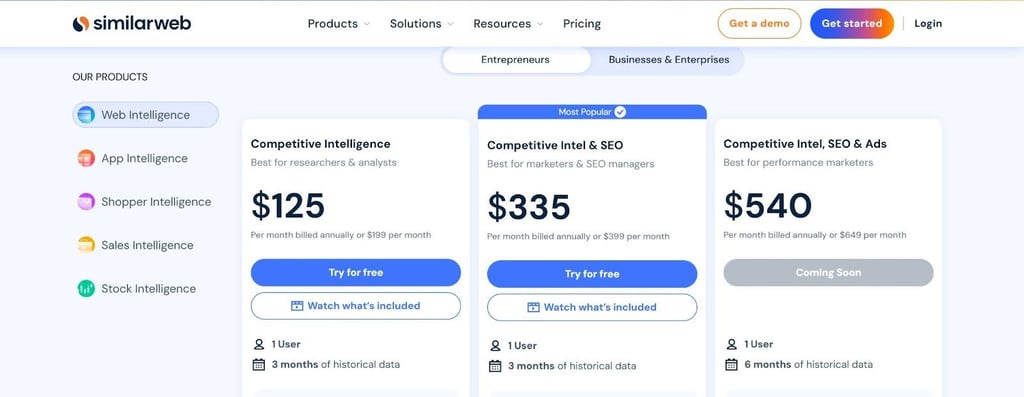
You’d have to go for the $335 plan for SEO features, such as organic keyword search and the rank tracker. Finally, digital marketers might need to choose the $540 plan for advanced Ad Intelligence features, including paid search, display marketing, and campaign insights. There’s also a custom, on-demand plan for enterprises.
Ahrefs vs Similarweb: data analysis
Another key component of the Similarweb vs Ahrefs comparison is the focus on data analysis. Both tools do an excellent job in this category, starting with Ahrefs and its comprehensive data collection features. The main feature is the web crawler, which handles most of the keyword tracking and backlink indexing.
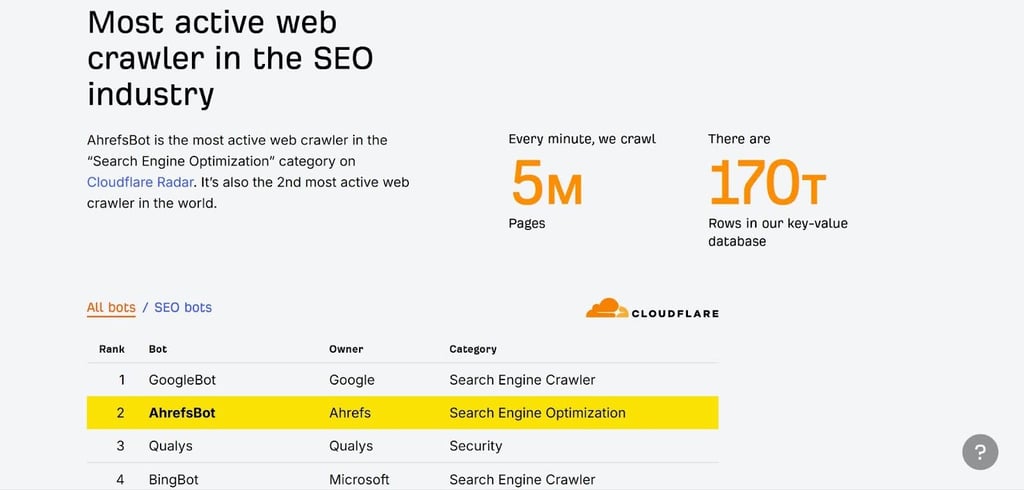
It also includes the Site Explorer feature, which analyzes a website's organic traffic and keywords using a database of more than 600 million keywords. The backlink database is even bigger, spanning over 35 trillion backlinks.
Similarweb is also quite effective in this category, but not in the same way. It’s more based on the data collection network, which blends traffic estimates across categories such as paid, organic, referral, social, and email traffic.
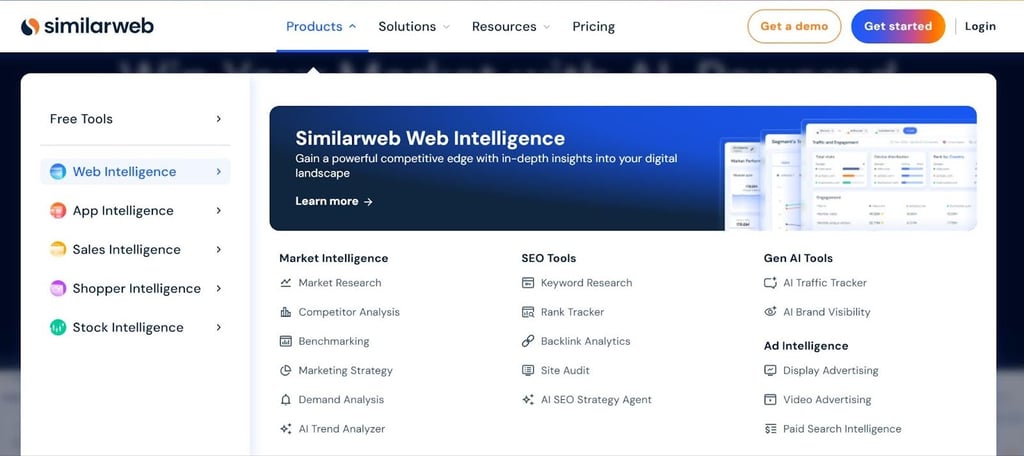
One thing that Similarweb does better is track engagement metrics. It will display the bounce rate, average visit duration per user, and the number of pages per visit.

Similarweb vs Ahrefs: SEO auditing capabilities
SEO auditing features are on Ahrefs’ side, as the tool is primarily designed with SEO in mind. You can use the official Site Audit feature to get a comprehensive SEO analysis by simply entering a website URL. Ahrefs even allows you to try this feature for free.
I was thrilled to see how detailed the SEO reports are, with the focus not just on keywords and links, but also on meta tags, indexability, and content type and length. The SEO audit displays results from over 40 related points, so it’s as comprehensive as you can get.
Similarweb, on the other hand, has a slightly different approach to SEO auditing. It’s mainly based on Search Intelligence tools that provide insights into a website’s performance compared to competitors in the same niche, so it’s less technical and more data-driven.
Similarweb vs Ahrefs: traffic estimation accuracy
Up next, I wanted to compare Similarweb vs Ahrefs in terms of the data accuracy and precision of their traffic analysis tools.
Ahrefs mainly estimates traffic based on keyword rankings and other SEO insights. It’s an excellent tool for showcasing organic traffic volumes, but it has a fair share of flaws when it comes to direct, paid, or social traffic.
On the other hand, Similarweb takes a more data-driven approach, focusing on modeling and sampling. In fact, Similarweb features some additional traffic estimation options, including public data extraction and direct measurements.
Wrapping up
Overall, Ahrefs provides better estimates of organic traffic using its SEO and traffic analysis toolkit, but Similarweb delivers more comprehensive results.
Winner: Draw
Ahrefs vs Similarweb: keyword research and content planning
One thing that might significantly affect your website’s content strategy is keyword research, and Ahrefs takes the spotlight here. It’s designed to be a crawler and a keyword research tool from the start, with a staggering database of more than 28 billion topics via the Keywords Explorer tool.
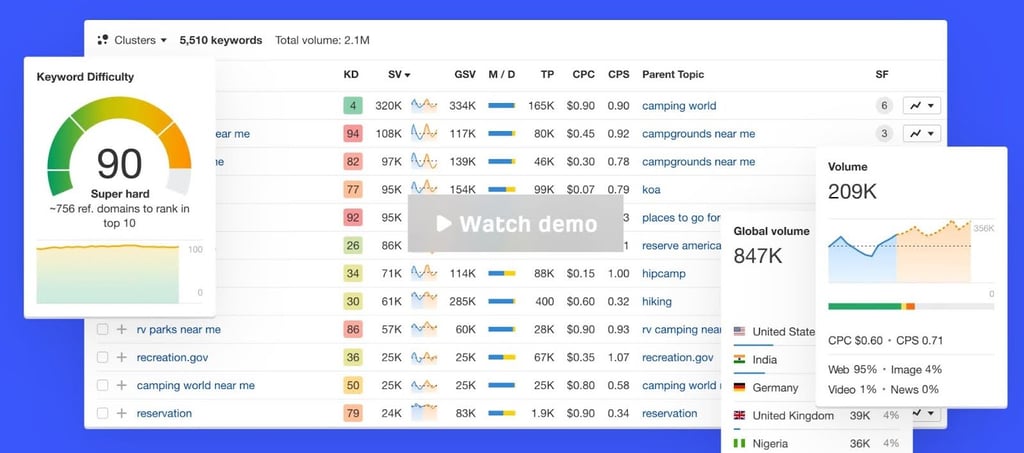
It shows the search volume of specific keywords, while you can also use the Keyword Difficulty toolkit to see how tough it is to rank for them based on competitor research and the current market positioning.
Plus, they’ve recently added AI-powered features, like keyword brainstorming and presets. Similarweb does a decent job in this category, but it focuses more on traffic patterns and visitor behavior.
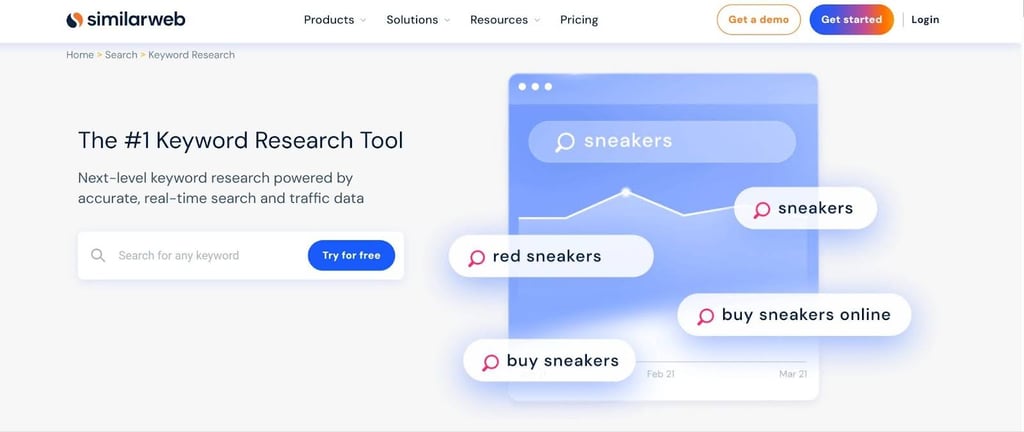
It gives you more context to help you understand who searches for particular keywords and why. Understanding your audience leads to better keyword and content strategy overall, and that’s where Similarweb excels.
Wrapping up
For those looking for keyword research at its core, Ahrefs does a better job than Similarweb with a larger keyword database, but Similarweb is a decent choice for search intent analysis.
WINNER: Draw
Similarweb vs Ahrefs: ease of use
One question that kept popping up in my mind while doing this review was: “How easy is it to use Similarweb vs Ahrefs for site audits?” While Ahrefs gives off an impression of a complex tool, its keyword analysis and SEO dashboard are intuitive even for beginners.
The dashboard also features customizable reports, which is the only function that someone unfamiliar with the subject matter may struggle to understand. Thankfully, there are valuable resources in the Academy section, including tutorials and documentation to help you get started.
Similarweb focuses on data visualization, so their reports and representations are fun and insightful. Even features like traffic insights and competitor analysis are easy to use.
Ahrefs vs Similarweb: user reviews
Before wrapping up with my Ahrefs vs Similarweb features comparison, I wanted to check the available user reviews. Surprisingly or not, both platforms did quite well, with Ahrefs users praising its clean layout, depth of data, and SEO toolkit.
Most users also praised the user-friendly keyword and backlink analysis features. Still, some were let down by unclear and on-demand enterprise pricing.
Similarweb also has stellar user reviews, mainly praising detailed market research and competitor benchmarking tools. However, some have complained about the steep learning curve required to understand the advanced traffic analysis features.
Ahrefs vs Similarweb: final verdict
Ultimately, you have to understand some Ahrefs vs Similarweb key differences to judge which one is better overall. Based on my research, I’d suggest going with Ahrefs if you’re mainly focused on SEO features, particularly keyword research and technical site audits.
If you need market-level insights and detailed breakdowns of audience demographics and competitor analysis, go with Similarweb. It all depends on what you’re going for, but my guide should set you on the right track for the big decision.
Other guides from Cybernews:
Alexa vs Similarweb: which one offers better website insights?
Top 10 SEO tools in 2026: free and paid options to boost traffic
10 best SEO tracking tools in 2026: top options
FAQ
What are the main differences between Similarweb and Ahrefs?
The main differences between Ahrefs and Similarweb lie in how each handles data fetching. Ahrefs relies on SEO-focused data obtained from a database of over 35 trillion backlinks and more than 28 billion keywords, while Similarweb focuses on market research and competitive intelligence.
Can Similarweb replace Ahrefs for SEO analysis?
No, Similarweb can’t completely replace Ahrefs for SEO analysis, as it lacks advanced technical SEO features and has a comparatively smaller database.
Is Ahrefs worth it for small businesses?
Yes, Ahrefs is a good tool for small businesses looking to boost their online presence with a focus on SEO, as well as companies in need of the best website crawler, second only to Google.
Does Similarweb offer a free version or trial?
Yes, Similarweb offers a 7-day free trial that you can use to try out basic features like traffic analysis and audience insights.