Pushed to use AI tools, frustrated tech pros choose to walk away
AI doesn’t have to replace human workers. Even the enthusiasts of the technology claim it’s merely enhancing our own capabilities. But the reality is that it’s the employees themselves walking away and quitting their jobs because they don’t want to use tools they don’t trust.
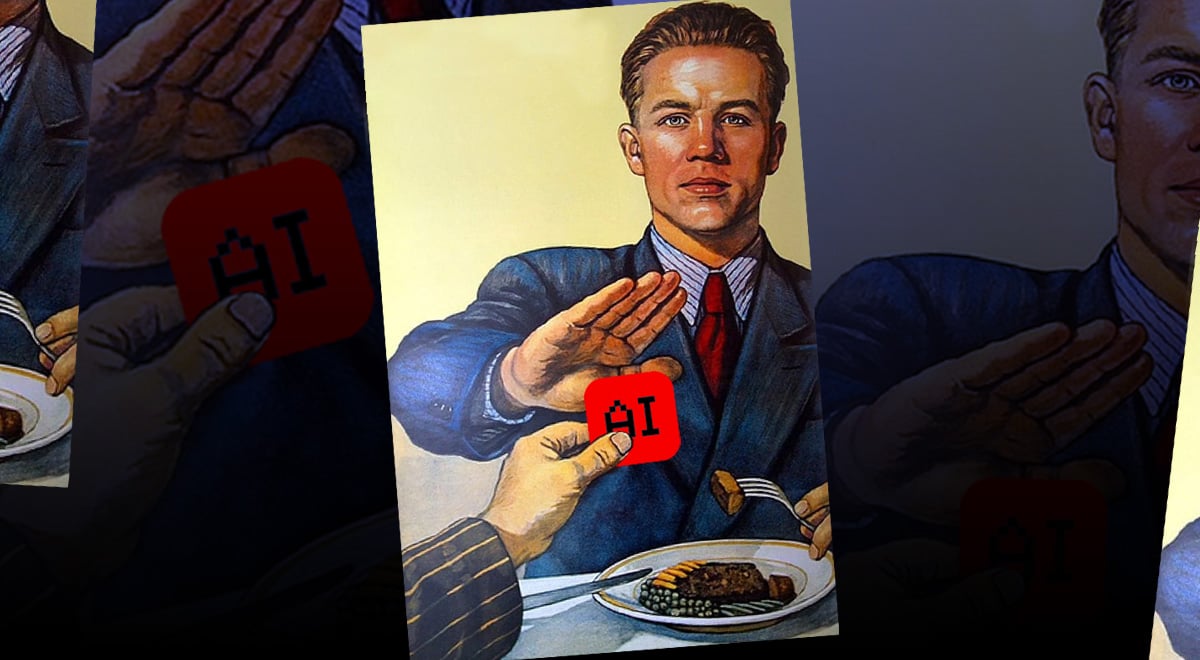
Image by Cybernews.

 Follow us
AI doesn’t have to replace human workers. Even the enthusiasts of the technology claim it’s merely enhancing our own capabilities. But the reality is that it’s the employees themselves walking away and quitting their jobs because they don’t want to use tools they don’t trust.
“Being forced to use AI makes me want to leave the industry,” one senior software engineer recently posted on Reddit before explaining that she felt the AI trend was extremely “vast and disruptive.”
“I’ve wondered whether I would ever reach a point of ‘old man yelling at clouds’ because in general I’ve embraced new technologies,” she said.
“But having used AI and having to hear about it all day, all I see is a plagiarism machine accelerating the destruction of our planet and making people less capable of learning anything themselves.”










In short, the engineer would rather not talk about AI. However, her employer is now forcing workers to use AI. She’s frustrated: “I thought I’d be working in tech for the long haul but all this just makes me want to leave.”
Ready to go and deliver pizzas
It’s the story of the many, not the few. Companies across the United States are making their workers use AI tools whether they want to or not.
But this is backfiring as experienced workers who think AI is pure hype are rather choosing to quit – even though they will probably be interviewed by an AI avatar for another position, as is the trend at the moment.
And if they’re not quitting yet, they’re certainly complaining about their predicament – loudly. On that same Reddit thread, a code auditor is very open about what AI means for them.
“This thing produces a mediocre code, very often with bugs. <...> It’s syntactically correct nonsense. Coding is not based on pattern recognition. It’s based on logic. AI is not,” the user said.

“What it produces needs to be refactored and reviewed, plus time for constructing the prompt. There are people like us who’ve been skeptical. And the amount is growing because one can’t deny facts. It doesn’t deliver performance nor quality.”
It’s also pretty bad for medical researchers, it seems. More people choose to trust the AI chatbots rather than professionals, even though the machines hallucinate and simply make things up in an industry where mistakes can be very costly or even deadly.
“AI is also bad for us. Mostly because AI excels at producing emotionally engaging ragebait spam, and that seems to be convincing everyone to get measles nowadays,” one researcher said.
The general feeling out there seems to be that workers – in tech and, actually, everywhere else – think that the AI-loving managerial caste actively, although unnecessarily, makes life and work harder for them. It’s also boring to some.
AI excels at producing emotionally engaging ragebait spam, and that seems to be convincing everyone to get measles nowadays.A medical researcher.
“I expect that within 2-5 years, I'll be delivering pizzas for a living, not because I can’t hack it anymore, just because reviewing and fixing AI-generated code does not appeal to me as a career,” said another coder.
With AI, what’s left of your job satisfaction?
The sentiment is echoed in the recent US Census Bureau study of tens of thousands of manufacturing firms.
It found that AI adoption often causes a short-term productivity drop, averaging 1.33 percentage points and sometimes much higher, before improvements appear – if they do at all.
Of course, productivity gains recover as firms gradually shift toward more AI-compatible operations, often investing in automation technologies like industrial robots. But does that help human workers and their sense of job satisfaction?

Gavin Yi, a tech adoption expert and CEO of Yijin Hardware, sees potential in AI but warns that forcing its use can undermine sectors where strict quality control is non-negotiable.
“AI can be valuable, but when it’s pushed without proper planning, it slows work, creates mistakes, and risks costly damage,” Yi said. “In manufacturing, a single wrong calculation can ruin expensive equipment. Leaders walk away when they’re told to use tools that don’t fit the job.”
“When AI becomes a box to tick instead of a tool to improve the work, pride and craftsmanship disappear, and that’s when you start losing your best people,” he added.
Instead of using their skills to solve problems, experienced workers end up fixing AI’s bad output.
According to Yi, when workers are forced to use AI, errors can multiply and slow down projects. Besides, not every job works the same, but AI mandates are often the same for everyone.
An almost blind push to simply use AI for the sake of it shifts the focus from solving real problems and ignores industries where accuracy and safety matters.
Perhaps most importantly, instead of using their skills to solve problems, experienced workers end up fixing AI’s bad output. Over time, this makes their work less valuable and less satisfying.