Microsoft and Epic Games face AI backlash as gamers cry hypocrisy
Who owns creativity in the age of AI?
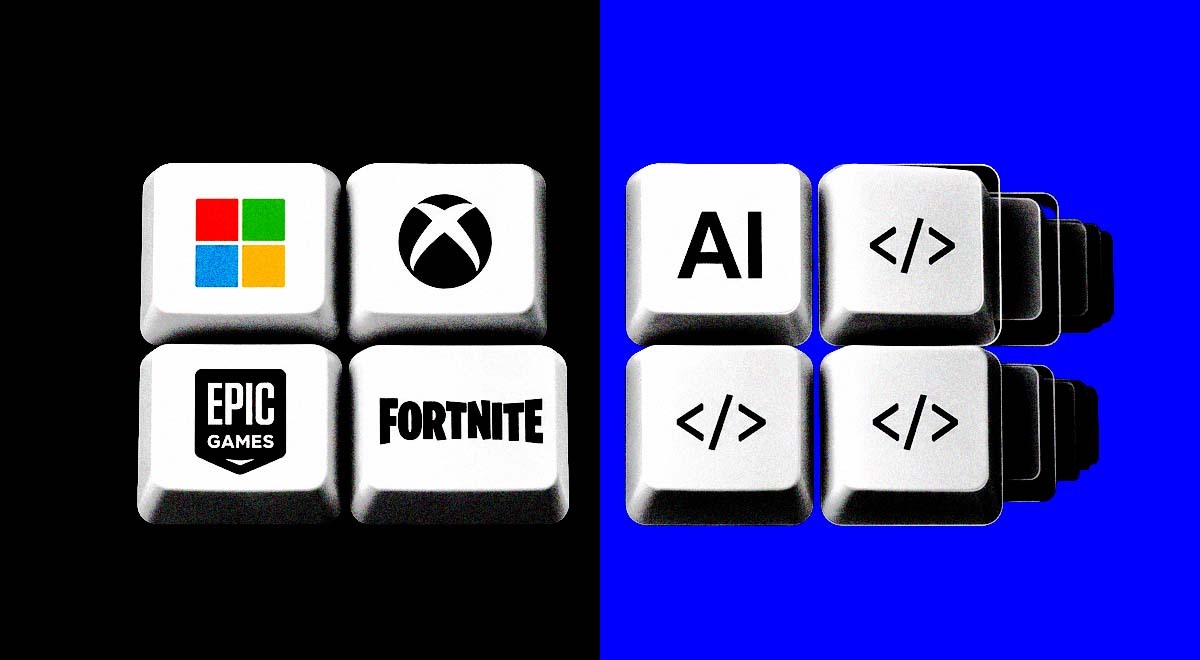
Split-screen of Microsoft and Epic Games' organic efforts and that of AI. Image by Cybernews.

 Follow us
- Microsoft and Epic Games are taking down browser-based clones of Minecraft, Call of Duty, Halo, and Fortnite.
- Critics say the companies embrace AI for game development but object when others use it to copy their work.
- Independent studios face similar copycat risks but often lack the money to defend their games.
- The backlash highlights unresolved questions over copyright, fair use, and ownership of AI-assisted creativity.
Key Takeaways by nexos.ai, reviewed by Cybernews staff.
Microsoft and Epic Games face accusations of AI hypocrisy as they crack down on game clones while embracing AI development. The backlash raises questions about copyright, fair use, and who owns creativity
Many big AI companies have, by and large, embraced the AI boom, but Microsoft and Epic Games are currently facing scrutiny over copyright enforcement.
While both companies maintain they are simply continuing their long-standing, routine practice of protecting their intellectual property from unauthorized clones, critics have been quick to contrast these strict DMCA takedowns with the companies' enthusiastic embrace of AI development
AI coding tools, commonly known as vibecoding, mean that renegade developers can build copycats in weeks, as opposed to months or years, as it used to take.





Microsoft has reportedly sent takedown notices to projects that let people play fan-made versions of Minecraft, Call of Duty, and Halo in a web browser. Epic Games took similar action on October 10th against an AI-assisted project that recreated Fortnite as a browser game.
It poses a conundrum not only for gaming titans like Microsoft and Epic but also for independent studios, which often lack the financial means to issue takedowns and defend their intellectual property.
As reported by gaming site Kotaku, Digital Millennium Copyright Act (DMCA) takedown notices have been issued for rip-offs of independent titles like Slay the Spire 2, Celeste, and RimWorld, despite the original indies not including any AI content.
For critics, this creates a frustrating optical clash, especially when AI is presented as a revolutionary tool, yet at the same time as a threat when intruders use similar techniques to reproduce their work.


Stay updated with our latest stories and follow us on social media
Be the first to discover new stories, ideas, and updates from our team.
Facing up to AI hypocrisy claims
Epic Games boss Tim Sweeney has previously has recently predicted that AI will herald “a golden age of gaming,” which is quite contrary to his previous stance.
A few months before that, Sweeney told PC Gamer that AI companies had “shitty practices” in that they used pirated training data.
As Epic instructs its developers to ramp up the use of AI development to build a game in conjunction with Disney and Marvel, there is an ethical question of whether this will use any pirated material.
The AI engine that Epic revs up is Anthropics Claude, which has caused controversy in and of itself, by illegally obtaining books to train the chatbot.
Sweeney, posting on X, attempted to clear up that the company has strict copyright on Fortnite, but that its policies regarding AI training are more nuanced, and are undergoing changes.
This conflates a number of different things. Here is a breakdown of the separate components of what is happening - - Does Epic let people use Fortnite IP without permission or compensation? No. - Does Epic restrict AI training on outputs of Unreal Engine and MetaHuman? Yes currently but we are working to remove this restriction from EULA terms, though each game using these tools is released under terms of the developers’ choosing which can allow or restrict AI training. - Do we allow training on content developed by others which we host in places such as Fab? This is up to each developer with the NoAI tag. - What does the law say on the copyright issues associated with training on content? The Anthropic court ruling found they were liable for copyright infringement when torrenting pirated content (as the article quotes me on), but they found that the training itself was fair use. Other courts have found that whether particular content produced by AI was infringing dependent on its similarity to the copyrighted work.
undefined Tim Sweeney (@TimSweeneyEpic) October 27, 2026
Microsoft faces a similar question about consistency. The company has heavily invested in AI infrastructure and pushed Copilot, while AI-generated artwork in Call of Duty: Black Ops 6 and Black Ops 7 as examples of AI entering mainstream game production.
One executive described large language models scraping the internet as the “largest theft of labor in human history,” while another internal memo warned that the company's AI content strategy could create a “doom loop” for its models and the wider web.
Redditors run riot
The ethical discussion was put under the microscope on the Reddit forum r/technology.
One submission argued that big tech companies changed the goalposts when it suited them, and that all they cared about was profits.
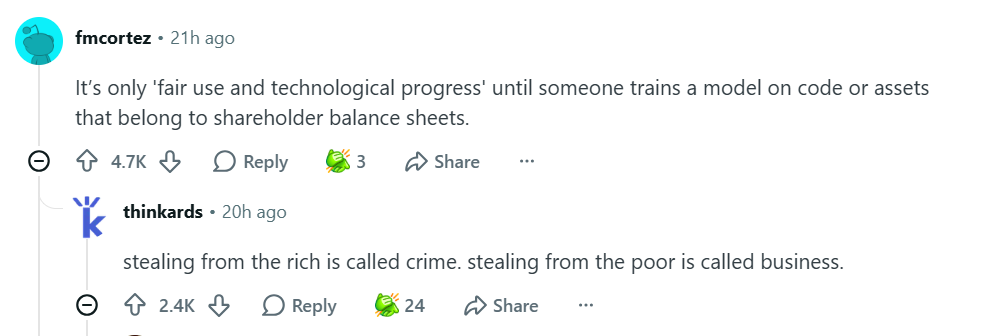
It’s only 'fair use and technological progress' until someone trains a model on code or assets that belong to shareholder balance sheets,opined one Redditor in the r/technology subreddit.
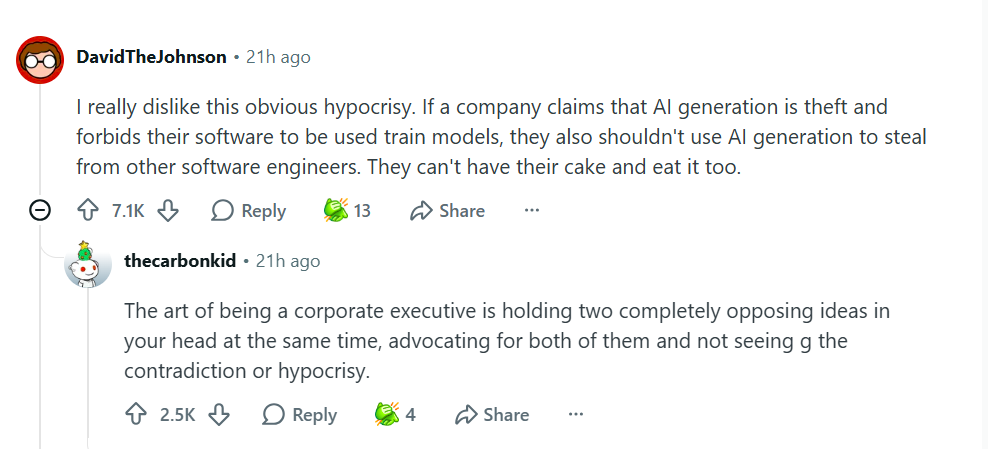
Another Redditor said that claiming strict copyright against developers stealing their intellectual property shouldn’t allow Epic or Microsoft to then, in turn, plunder from others.
As developers and gamers push back against the industry's double standards on AI, the AI gold rush is turning into a messy battle over who gets to own creativity.