Epic Games CEO predicts AI will usher in a “golden age of gaming”
Yet gamers are not convinced.

Half breathtaking AI generated gaming, and half slop. Image by Cybernews.

 Follow us
- Tim Sweeney says AI could make expensive game ideas viable by lowering development costs.
- Epic is using AI in production and moving developers to speed up work.
- Some gamers expect better tools, while others worry AI will lower game quality.
- Cheaper development may not mean cheaper gaming if AI demand raises component prices.
Tim Sweeney, CEO of Epic Games, the developer of Fortnite and Unreal Engine, has predicted that AI will herald “a golden age of gaming” by enabling designers to create more ambitious projects at a fraction of the cost.
Sweeney argued that games costing several times more to develop than they could earn back may soon become viable thanks to AI-assisted production.
Generative AI serves as a digital assistant for these studios, capable of handling the bulk of menial tasks, such as writing basic code and fleshing out scripts for minor characters. A recent Bloomberg report highlighted this shift, revealing that Epic Games is moving towards an “AI first” production model.
Sweeney’s argument is that faster development should mean more than cost-cutting, giving teams more time to experiment, playtest ideas, and build better games rather than simply producing the same titles with fewer people.






The games we've long wanted, which didn't exist because they'd cost several times more to make than they'd earn back, will soon become possible…It'll be a new golden age of gaming,Sweeney said on X.
The games we've long wanted, which didn't exist because they'd cost several times more to make than they'd earn back, will soon become possible. As will the games developers wanted to build, but couldn't with the resources available. It'll be a new golden age of gaming.
undefined Tim Sweeney (@TimSweeneyEpic) October 17, 2026
“A huge pivot underway”
Sweeney also posted a week earlier that AI coding tools have improved dramatically.
He said on October 12th that Epic is moving developers between teams to achieve “maximum AI acceleration” and help them build “MORE and BETTER stuff.”
The CEO has cited productivity gains ranging from around 20% in technical disciplines to as much as fivefold in web development, while predicting an overall threefold productivity boost by the end of 2026.
That could mean a developer could build more complex worlds and experiment with riskier mechanics that would otherwise have proven too expensive.
The potential shift comes as game development faces mounting financial pressure. Increasing production costs, market saturation, and gamers gravitating towards older titles mean that studios find it hard to justify splashing the cash on expensive new projects.
We have a huge pivot underway here at Epic, moving developers around to retool for maximum AI acceleration. The aim isn't to do the same stuff with fewer people, but to enable everyone here to build MORE and BETTER stuff, and to bring the benefits to all teams using Unreal.
undefined Tim Sweeney (@TimSweeneyEpic) October 12, 2026
How did the gaming community react?
The reaction to the post was split, with the gaming community debating the quality of AI output.
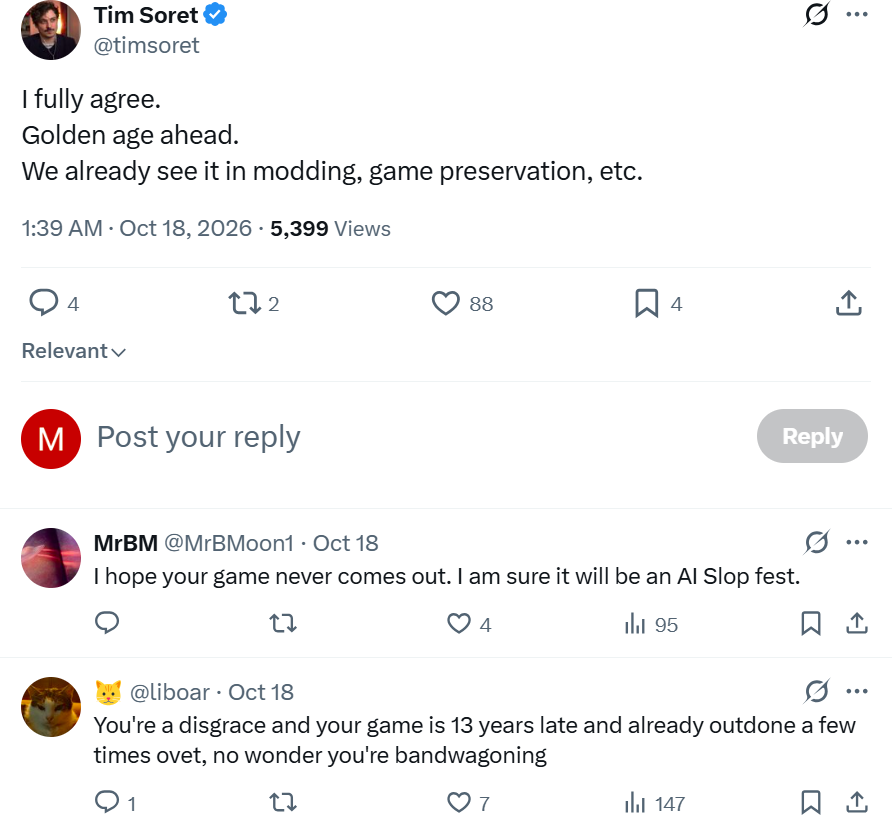
Game Director Tim Soret championed the cause, highlighting opportunities for communities to preserve games and modify hardware and software, also known as modding.
Meanwhile, opponents cited AI slop as an issue and accused Soret of bandwagoning, since his own game took too long to release.
Another reply to Sweeney’s original post weighed up the “golden age” mention. While the niche nature of gaming could mean AI will allow players to modify aspects to their own tastes, the community may not be able to enjoy tweaks in unison, the post said.

Epic has already faced criticism over its AI ambitions, including its use of conversational AI characters in Fortnite and reports that its revamped game launcher was built using AI-assisted coding.
And AI’s potential to make games cheaper to develop doesn’t mean that it will make them cheaper to play.
One insider speculated that a PlayStation 6 could cost over $1,000 in the future, as the AI boom is causing shortages and price spikes in memory and storage components.