SK Hynix launches $28 billion US listing to ride global AI wave
The South Korean company is a key supplier of AI chips for Nvidia and Google.
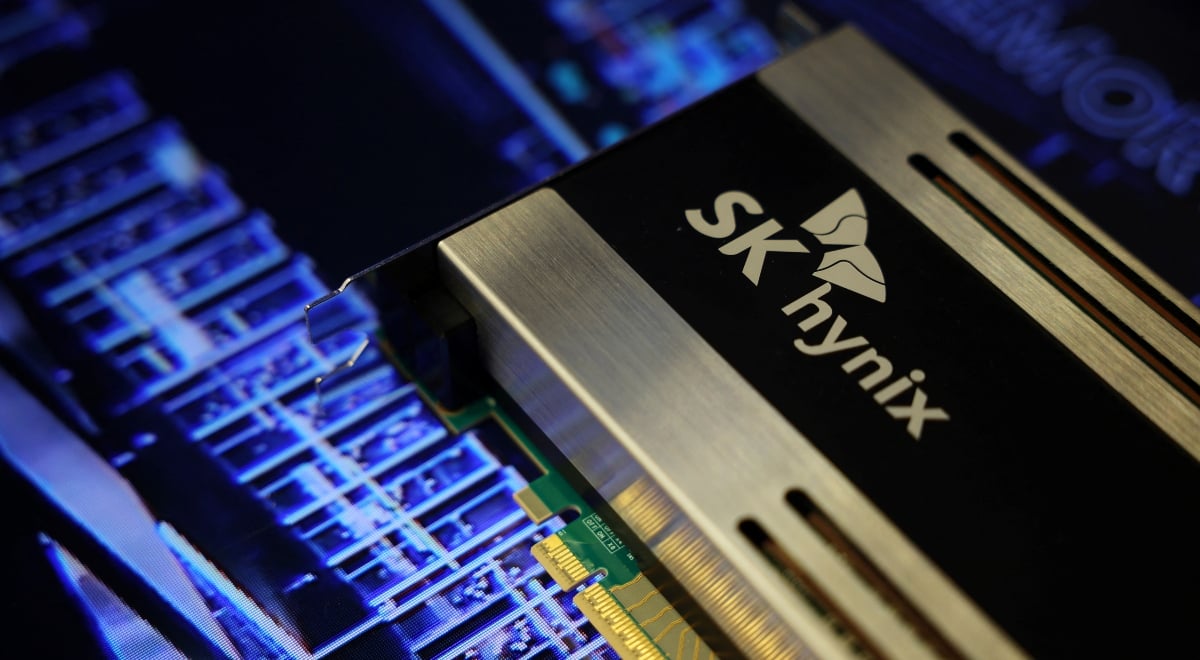
The logo of SK Hynix on one of its products. Photo by REUTERS/Kim Hong-Ji
 Follow us
- SK Hynix launched a $28 billion US ADR sale to fund chip factories and equipment in South Korea.
- Major investors signaled interest in up to $7 billion and SK Hynix shares ended Monday down 3.4%, but the stock is still up 260% this year.
- Investor caution remains as memory chip stocks fluctuate and concerns grow about the durability of AI spending.
Key Takeaways by nexos.ai, reviewed by Cybernews staff.
South Korean chipmaker SK Hynix has launched a US share sale to raise 43 trillion won ($28.07 billion) and drew indications of interest for up to $7 billion from major investors, as it capitalizes on the global AI boom with one of the world's largest new share sales.
Baillie Gifford Overseas, investment funds managed by Coatue Management and Situational Awareness Partners have each separately indicated interest in buying up to a combined $7 billion worth of SK Hynix's American depositary receipts, or ADRs, SK Hynix said.
Baillie Gifford Overseas declined to comment, while Coatue Management and Situational Awareness Partners did not immediately respond to a request for comment.
The company will sell 17.79 million new shares through the ADRs on the Nasdaq; 10 ADRs will represent one common share and a Monday filing gave a reference price of 242,500 won per ADR, based on SK Hynix's July 3rd closing price in Seoul.




The deal comes as Asian chip companies tap strong global demand for AI-related stocks. Taiwan's Unimicron Technology is also seeking to raise about $1.4 billion through a sale of global depositary shares, or shares listed overseas that represent its local stock.
SK Hynix's shares ended Monday down 3.4% at 2,343,000 won, but the stock is still up about 260% this year. South Korea's KOSPI was down 0.5% on Monday.
Memory chip stocks have been volatile in recent sessions due in part to renewed investor concerns about how long the boom would last.



Stay updated with our latest stories and follow us on social media
Be the first to discover new stories, ideas, and updates from our team.
"We are in the midst of a memory super cycle, with all three major suppliers - Samsung, SK Hynix, and Micron – riding the AI-driven demand wave," said Di Zhou, portfolio manager at Santa Fe, New Mexico-based Thornburg Investment Management with $60 billion in assets. It owns SK Hynix's Korean ordinary shares.
She added that SK Hynix's ADR listing was positive because it would broaden the company's investor base and potentially narrow its valuation gap with US rival Micron.
"While market volatility has been quite high recently, I would expect demand for SK Hynix shares to remain relatively robust," said Albert Yong, a managing partner at Petra Capital Management.
South Korea last week unveiled a sweeping industrial strategy centred on semiconductors and AI, including a $576 billion chip investment program in the country's southwest to help spread returns from the boom.
SK Hynix and Samsung Electronics will anchor the investment program, the government said.
South Korean President Lee Jae Myung on Monday ordered officials to move quickly to get to work on major chip and AI projects announced last week.
He warned that delays in permits, land acquisition, and securing power and water supply could undermine the country's bid to dominate advanced industries.
Memory inflation
SK Hynix has been among the world's largest beneficiaries of the AI fervour as it outperformed its major rivals Samsung and Micron.
"This is more than a liquidity event," said Dave Mazza, the chief executive officer of Roundhill Investments in New York, which manages an exchange-traded fund tracking DRAM manufacturers, which is one of the most popular ways for U.S. investors to trade SK Hynix's stock. "SK Hynix has been one of the most important companies in the world that most US institutions could not easily own."
"The listing removes an accessibility discount, not a quality discount."
Steve Sosnick, chief strategist at Connecticut-based Interactive Brokers, said individuals and smaller institutions would benefit from the US listing, rather than large investors.
"The new listing will make it easier for capital-hungry Hynix to directly access a new group of momentum-hungry investors," Sosnick said.
SK Hynix said the proceeds from the listing of the American Depositary Receipts will be used to build chip factories in South Korea and buy chipmaking equipment including an extreme ultraviolet scanner made by Dutch equipment maker ASML.
The final price of the New York listing is due to be set on Thursday, ahead of the stock starting trade on Friday, regulatory filings showed. The company's management will meet global investors on a roadshow this week.

Check if your data was exposed
Find out if your email and related personal information have appeared in known data breaches.
The deal is expected to be the second-biggest share sale after a record $85.7 billion initial public offering by SpaceX last month, surpassing Saudi Aramco's $25.6 billion IPO in 2019 and Alibaba's similar-sized offering in 2014.
Some investors were cautious that memory "inflation" would dent spending on AI infrastructure, mobile phones and PCs.
"We expect better access, but timing of the memory cycle is equally important," said Sundeep Gantori, Standard Chartered's chief investment officer of equities. "We believe the memory cycle is beyond the early phase and now in the mid-cycle stage."
SK Hynix is a key supplier of high-bandwidth memory chips used in AI systems by customers such as Nvidia and Alphabet's Google.
SK Hynix is expected to join the chip-heavy Philadelphia SE semiconductor index, analysts said, helping pave the way for a surge in passive investments.
Last month, HSBC said it would raise its valuation of SK Hynix by applying a 20% premium to its previous price-to-book multiple of 2.8 times, implying a multiple of 3.4 times, "reflecting more proactive shareholder-friendly initiatives and improved accessibility to global investors."
Global coordinators for SK Hynix's offering include BofA Securities, Citigroup, Goldman Sachs and J.P. Morgan.