Everything you need to know about Ohio’s age verification laws


-
Ohio’s law takes effect on September 30, 2025 – Adults must verify their age before accessing websites where at least 33% of the content is adult-only.
-
Verification must go through third-party services – Sites will use outside providers to check IDs or secure transactional data to confirm users are 18 or older.
-
Ohio joins a growing national trend – With this law, Ohio becomes 24th state introducing age verification for online pornography.
-
Privacy and free speech concerns are growing – Critics warn that storing IDs and personal data increases risks of breaches and could limit access to legal content.
Starting September 30, 2025, Ohio will roll out strict rules that force websites with a large share of adult content to verify every visitor’s age. The law requires anyone in the state, not just minors, to provide proof that they are 18 or older before entering sites that lawmakers label “harmful to children.”
Supporters say the measure protects children. Critics warn it puts adults in a tough spot, since proving age often means handing over sensitive documents like IDs or payment data to third-party services.
Ohio is now the 24th state, after Arizona, to introduce an age verification law for online pornography. The move adds to a growing national debate over how to protect children online while also safeguarding adult privacy, with some resorting to digital privacy tools.






Ohio finally moves forward with age verification laws

After years of failed attempts, Ohio lawmakers finally pushed through an age verification mandate this summer. The measure was folded into the state’s 3,000-page budget bill and approved in June 2025. Just two months later, the requirement is officially set to become law.
Under House Bill 96, Ohio residents will need to provide either a government-issued photo ID or transactional data—such as employment or education records—to access content judged “obscene or harmful to juveniles.” For ongoing accounts, platforms must re-check users’ ages every two years.
Privacy advocates say the law goes too far. John Perrino, Senior Policy and Advocacy Expert at the Internet Society, told TechRadar that while protecting kids online is reasonable, requiring every adult in the state to hand over sensitive ID information poses major risks.
“It’s another thing entirely to require everyone in a state to hand over an ID and risk their online privacy and security to access legal material,” Perrino said.
Critics also point to the vague language in the law. They fear the broad definition of “harmful” content could extend beyond pornography to sweep up valuable resources like health information and sex education materials, effectively limiting adults’ access to legitimate content.
Location Tracking and the Geofence Rule
Ohio’s new law also requires online platforms to install a “geofence system” that checks where users are located before granting access to restricted content.
If someone’s digital location shows they are in Ohio, the site must block adult material until the person’s age is confirmed through an approved verification method. The most common way to determine location is an IP address, though other data points can also be used.
Because IP-based checks can be fooled, tools like virtual private networks (VPNs) make it possible for users to appear as if they are browsing from another state. Lawmakers in Michigan have already proposed rules aimed at curbing VPN use for this very reason, raising alarms among privacy experts who say such measures could undermine Americans’ rights to security and free expression online.
Commenting on this risk, Laura Tyrylyte, a privacy advocate at NordVPN, in an interview with TechRadar said: “Restricting access to these technologies not only jeopardizes individual liberties but also sets a worrying precedent for increased government control over the open internet.”
Ohio’s law does not yet include any restrictions on VPNs, but that could change if officials decide these tools weaken the effectiveness of geofencing.
People are turning to digital privacy tools
As Ohio prepares to roll out its new age verification law, many residents are becoming more aware of the risks tied to handing over sensitive personal data like IDs and payment details. Similar laws in other states have already pushed internet users to explore ways to strengthen their digital privacy.
One of the most common responses has been the rising use of privacy tools such as Virtual Private Networks (VPNs). These services encrypt internet traffic and hide IP addresses, helping users keep their browsing activity and personal information out of reach from third parties.
A look at Google Trends shows a sharp increase in searches for “VPN” in Ohio. Interest began climbing as the September 30 rollout drew near, and now that the law is live, search activity has reached a peak, reflecting how strongly residents are seeking out privacy solutions.
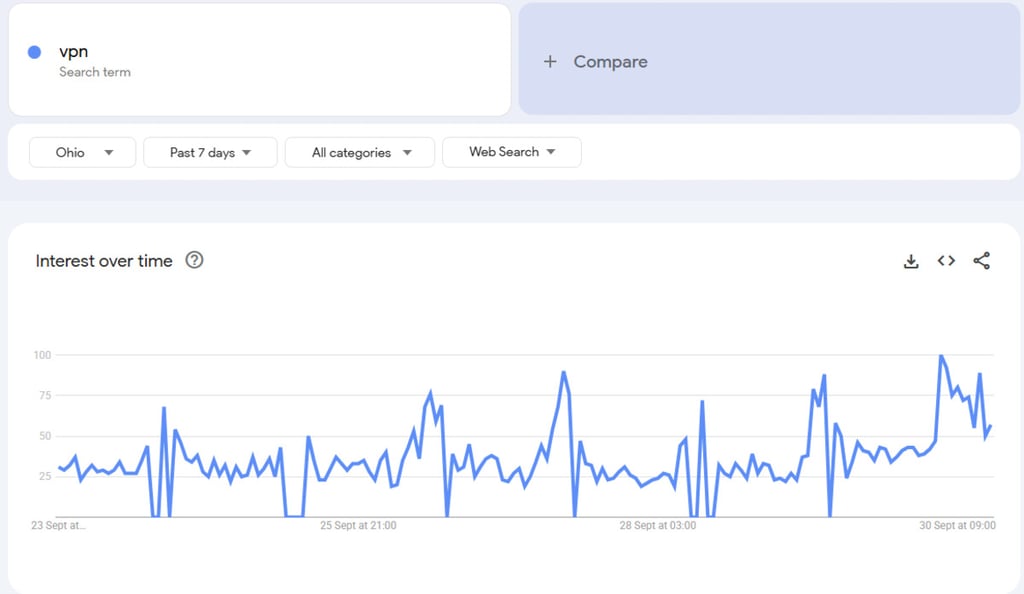
Privacy advocates say this trend highlights a growing gap between lawmakers’ intent, to protect children from explicit material, and public concern, which centers on data security and potential government overreach. For many Ohioans, tools like VPNs represent a way to regain control over their digital footprint at a time when online platforms are being asked to collect more information than ever before.