British kids using fake mustaches, IDs, and VPNs to bypass online age checks, study finds
The UK Online Safety Act (OSA) is supposed to protect children online. Now, kids are using VPNs, fabricating data, using someone else’s IDs, or even drawing on fake mustaches to bypass age verification on various platforms. Still, most families welcome the change and see improvements, a study suggests.

Image by Cybernews.

 Follow us
The UK Online Safety Act (OSA) is supposed to protect children online. Now, kids are using VPNs, fabricating data, using someone else’s IDs, or even drawing on fake mustaches to bypass age verification on various platforms. Still, most families welcome the change and see improvements, a study suggests.
A study by Internet Matters, a non-profit organization backed by big tech and offering child internet safety advice, found that 46% of children think that age checks online are easy to bypass.
A third of children (32%) admitted to bypassing age checks.
“I did catch my son using an eyebrow pencil to draw a mustache on his face, and it verified him as 15 years old,” a mum of a 12-year-old boy said.
The report also quotes a boy who confirmed that he used one of his parents’ IDs when online services asked him to upload a photo.






These are just some of the common methods children have been using recently to circumvent age restrictions.






Over the past two months, 13% of kids said they entered a fake birthday, 9% used someone else’s login, including their parents or siblings, 8% accessed services using someone else’s device, and 7% admitted to using a VPN.
Some kids (3%) even used a random photo to pass the facial age estimation checks.
“I don’t class [age verification] as being a deterrent. If anything, because they’ve had a barrier put up, kids will do everything they can to be the first one to get through it,” one of the mums said.
A quarter of parents themselves help their children to bypass checks: 17% actively helped their children, and 9% allowed it or “turned a blind eye” when they believed the activity was safe.
“Notably, a third (34%) of children chose not to complete the verification process when prompted. Some reasons given for this included it being too much effort, or because the process made them realize the content was for older audiences, so they stopped trying,” the study reads.
Most kids want access to social media platforms
Accessing a social media platform they were not old enough to use was the most common reason children gave for circumventing age checks – 34%. The close second reason is joining an online game or gaming community (30%), as well as using chat or messaging apps (29%).
The circumvention methods vary depending on the platform and content. VPNs are mostly used to access games, streams, or other content, while entering a fake birthdate is enough on platforms with a lower barrier to entry.
Half of children report experiencing harm online
Despite stricter new regulations, nearly half of children still report experiencing harm online, ranging from exposure to violent or hateful content to receiving nude or nearly nude images.
The most reported cases include seeing violent content, the content promoting unrealistic body types, and racist, homophobic, or sexist content – 12%,11%, and 10% respectively.
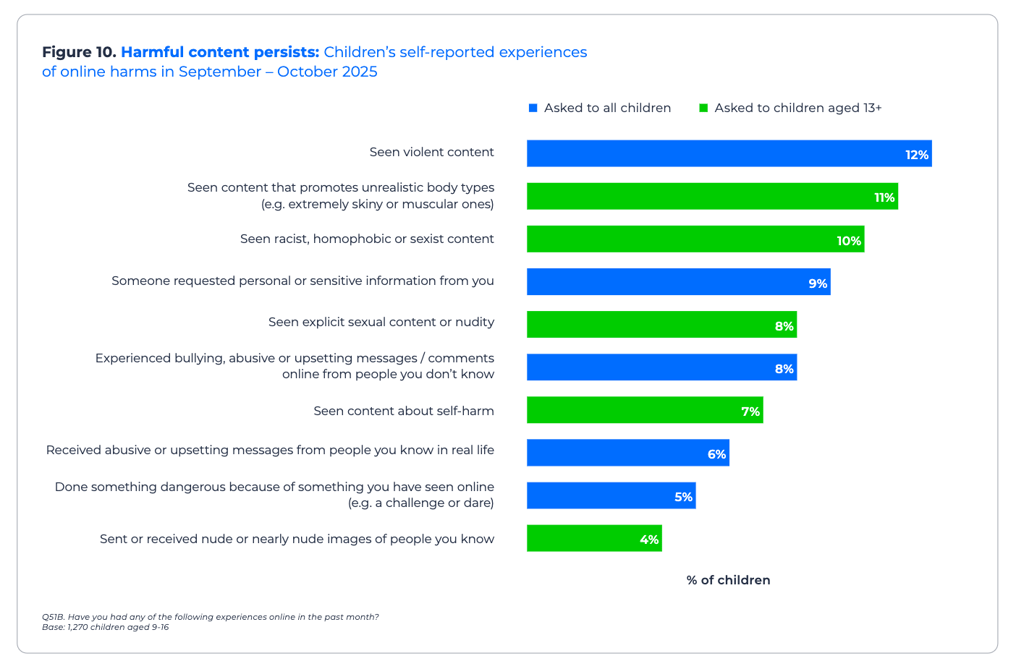
The study suggests that both parents and children view the new safety measures positively. Children noticed easier ways to block or report someone, but were unable to message certain people, such as adults or strangers, or access certain features, including live streams or comments.
Parents noticed enhanced parental controls, such as more ways to manage a child’s privacy settings, more screen time controls, more ways to limit age-inappropriate content, check on a child’s friends and other connections, add spending limits, and other controls
Around 40% of both children and parents acknowledge that the online world has become safer. However, around 28% of parents and 16% of kids see it as less safe, while a third of both groups didn’t notice a change.
More needs to be done?
The study suggests that parents and children want more action and stronger enforcement of the OSA, because, for many families, it has not led to measurable change in children’s online experiences or reduced the time children spend online.
“Questions remain about whether current regulations are sufficiently robust, effectively enforced, and adaptable to an evolving digital landscape,” said Rachel Huggins, CEO of Internet Matters.
Just 22% of parents and 31% of children believe the government is doing enough. The study calls for stronger action, including stricter age checks, restrictions on harmful features, and stronger enforcement of the Online Safety Act.

Check if your data was exposed
Find out if your email and related personal information have appeared in known data breaches.
The non-profit sees split views on a complete social media ban for children. While support is strong among parents, “many also think it will be ineffective and others believe the cost would be too high for children’s wellbeing.”
It’s worth noting the potential for a conflict of interest.
Internet Matters was founded in 2014 by the UK’s four largest internet service providers, BT, Sky, TalkTalk, and Virgin Media, and has since expanded its partnerships to include Meta, TikTok, Google, and other major tech companies with direct interests in how the regulations are shaped.
Meta has been one of the loudest advocates for age verification, while more than 400 security and privacy researchers and scientists from 30 countries urged it to reconsider “flawed” online age verification laws.
Unlock exclusive Cybernews content on YouTube.