Antigravity A1 review: features, camera quality, and value

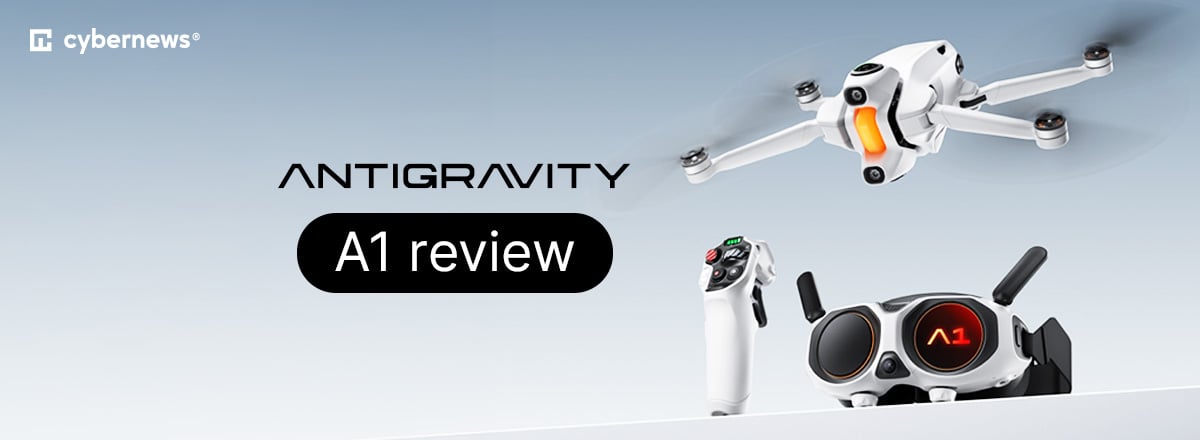
In this Antigravity A1 review, I dive into Antigravity’s 8K 360 camera drone. This device is a “point-and-go,” lightweight, creator-focused quadcopter drone meant for immersive capture and autonomous flying – rather than traditional drone use.
You’re probably wondering whether it’s innovative, practical and worth its premium position. To answer that question, I, together with the Cybernews research team, reviewed publicly available specifications, official Antigravity materials, and aggregated expert and user feedback to evaluate the Antigravity A1.
In this review, I’ll assess: the camera system, features, ease of use, pricing, user remarks, and some key alternatives. My goal is to help you understand whether the Antigravity A1 is worth it for you.
Quick overview of Antigravity A1
Below is a quick glance at the Antigravity A1. I based the evaluation below purely on Antigravity’s official specifications and launch materials:
| Overall rating: | 4.2/5 |
| Short product description: | Marketed as “World’s first 8K all-in-one 360 drone,” light 249g drone with top and bottom dual lenses for 8K 360 video, with 360 immersive flight, Smart Obstacle Avoidance, and Auto Edit. |
| Camera system (360°, resolution, sensor): | 360 dual-lens, up to 8K (7680 x 3840) at 30fps, 1/1.28-inch sensor, up to 55MP photos |
| Flight time and range: | 24min/13km (standard) or 39min/23km (high-capacity) |
| Autonomous / AI features: | Deep Track, Sky Genie flight moves, Auto Edit, Return-to-home, forward/downward sensing |
| Controller and app support: | Vision Goggles and Grip Motion Controller, Antigravity App and Antigravity Studio editing/export |
| Price range: | $1,599-$2,119 (depends on bundle) |
Our methodology
At Cybernews, the team and I score drones via desk research and a weighted scoring system. I combined official specifications from Antigravity’s official website and launch materials – with aggregated expert and user sentiment to score the A1:
- Camera quality and imaging features (30%): I assessed modes – 8K/5.2k/4K – bitrate, sensors, and photo modes. I considered 360 reframing vs stitching and low-light limits.
- Flight performance and stabilization (20%): I checked flight-time claims, wind resistance, speed features, navigation capability, and hovering. I also checked obstacle sensing and Return-to-home success.
- Autonomous modes and software (15%): I analyzed Deep Track, Sky Genie, and other tools for usable shots. I also assessed Auto Edit and the export workflow.
- Ease of use and setup (15%): I looked at how quick it is to set up. I also noted how easy it is for users to use the goggles. I then analyzed controller ergonomics.
- Battery life and portability ( 10%): I compared the standard vs high-capacity batteries. I evaluated battery-life loss while recording, plus portability and charging.
- User reviews and brand reputation (10%): I took recurring praise and complaints from expert reviews (such as tech, drone, and camera portals), retailer listings, forums, and any user feedback.
What is the Antigravity A1?
The Antigravity A1 is a compact autonomous drone with an integrated 8K 360 camera. It has top and bottom dual-lenses for 360 capture. It can be flown manually or flown in assisted/autonomous modes. Software stitching makes the drone “invisible” – with post-reframing in Antigravity App or Antigravity Studio. The drone has forward/downward vision sensing and infrared navigation. There’s also “Return-to-home” with an obstacle avoidance system.
In the box, you get a live view with Vision Goggles – at 2K resolution at 30fps – via OmniLink 360. You also receive the Grip Motion Controller for “point-to-fly” control. There’s 20GB of internal storage for footage – expandable with a microSD up to 1TB – also available with the “Ultimate” package. Footage exports to INSV/INSP formats.
The Antigravity A1 is typically used for travel or action content – where 360 footage can be revisited and edited. It’s also suitable for solo creators – for cinematic shots and social media.
Core Antigravity A1 features
The Antigravity A1 shares some core features with rivals like the DJI Mini Pro series. Here are its core features:
- 360-degree camera system and reframing: Dual-lens 360 camera shoots 8K at 30fps video, plus 55MP photos. Stitching and reframing features in Antigravity software hide the drone.
- Autonomous flight and tracking modes: Deep Track follows a subject, and Sky Genie runs preset moves. Sky Path replays routes, while Return-to-home returns the drone.
- Obstacle avoidance and sensing: Forward/downward vision sensors plus bottom infrared sensors are for obstacle sensing and positioning. Good light and textured surfaces required for best results.
- Stabilization and horizon leveling: Hovering accuracy is rated within 0.1m with vision positioning or within 0.5m via the Global Navigation Satellite System (GNSS). Good lighting is key.
- App-based editing and export: Auto Edit identifies highlights and adds moves synced to music. Export via the app or Antigravity Studio in INSV/INSP. Photos also support DNG
- Compact/foldable design: Folded size: 141.3 x 96.2 x 81.4mm. The drone weighs 249g with the standard battery. Weight rises to 291g with the high-capacity battery – and flight time rises to a maximum of 39 minutes.
Camera quality and video performance
I analyzed camera quality and video performance information ranging from resolution, photo vs video quality. I discuss how the 360 camera compares to standard drone cameras, plus strengths for social media/cinematic use:
- Resolution, frame rates, and HDR: 8K (7680 x 3840) at 30/25/24fps, 5.2K (5248 x 2624) at up to 60fps, and 4K (3840 x 1920) at up to 100fps – 170Mbps maximum bitrate. A 4K slow-motion mode is available. HDR is available for photos (plus Burst and AEB). Video supports H.264/H.265.
- Photo vs video quality: 55MP maximum (or 14MP) with DNG raw support for deeper editing. For video, the more you crop 360 content, the more detail you lose.
- Low-light limitations: The 1/1.28-inch sensor and ISO 100-6400 sensitivity seems technically capable, but some feedback suggests visible grain at dusk. That’s expected with 360 capture and stitching.
- 360 capture vs standard drone camera: 360 capture allows reframing, but stitching may introduce artifacts or loss of detail in close-ups. A traditional drone camera produces cleaner images overall.
- Strengths for social media vs cinematic use: For socials, reframing allows 9:16 exports from a single flight. For cinematic edits, 8K 360 footage allows keyframed camera moves.
Flight performance and usability
For the A1, flight time depends on the battery inside – the standard or high-capacity one. As standard, Antigravity says the drone flies for up to 24 minutes – whereas it’s 39 minutes with the high-capacity option. In reality, weather conditions and other factors may lead to lower runtime.
For stability in the wind, the drone handles Level 5 wind resistance (10.7m/s) in a controlled setup – when small trees begin to sway. The forward sensors plus bottom infrared detect obstacles. The front ones are rated to detect obstacles from 0.5-18m at flight speeds up to 12m/s, while the downward ones are rated for 0.3-7.5m at speeds up to 6m/s.
Antigravity says discernible patterns and lighting above 15 lux – plus diffuse reflectivity above 20% like cement – is important for optimal performance. Performance may drop in very low light, indoors, over smooth and uniform textures, or around thin obstacles like branches.
Who is Antigravity A1 best for?
In my view, Antigravity A1 really fits solo creators and vloggers. It’s an intuitive smart drone – with “point-to-fly” and goggles-based operation. It’s easier to master vs dual-stick drones. Footage can be edited/reframed later.
It’s also a good fit for making action content and travel content. Here, the 360 capture helps you choose several angles that would otherwise be missed with a traditional capture system. You can even produce cinematic shots without much flying skill – thanks to tracking and one-tap flight moves.
This drone is less ideal for professional drone pilots – who want precise manual control and traditional camera framing. It’s also less ideal if you need long flight times or interchangeable cameras.
Antigravity A1 price and availability
According to the official website, the Antigravity A1 prices are as follows:
- $1,599 – Standard Bundle
- $1,699 – Standard Bundle + High-capacity Flight Battery
- $1,899 – Explorer Bundle
- $1,999 – Infinity Bundle
- $2,119 – Ultimate Bundle
The entry-level Standard Bundle includes: 1x A1 drone, 1x Vision Goggles, 1x Grip Motion Controller, 1x Flight Battery, 1x A1 Drone Carry Case, 4x Spare Propeller. Depending on your bundle choice, add-ons include – a High-Capacity Battery, more spare propellers, a Sling Bag, Charging Hub, Quick Reader, Replacement Lens Kit, 256GB MicroSD card, and Landing Pad.
Availability and specifications vary by region – the High-Capacity battery isn’t sold in European regions. The drone ships to the US and globally via the official store – except to military conflict zones.
Transmission bands depend on local laws. Remember, ongoing costs include microSD storage, optional Antigravity Care ($199.99-$319.99), and accessories. Always check local drone regulations before flying.
Privacy, safety, and regulatory considerations
The 8K 360 footage captured by the A1 drone passes through Antigravity’s software – meaning it’s important to consider your privacy. Review your device permissions and any account or connectivity requirements before you fly. Meanwhile, keep others’ privacy in mind – don’t hover over private property or film others without consent.
Safety-wise, the drone has vision and infrared sensors, plus a payload-detection system that doesn’t allow excess weight to stop misuse. Antigravity says the drone can’t be activated in certain areas – like those identified as military conflict zones. It uses preloaded no-fly instructions.
Whether you need drone registration/“Remote ID” to fly depends on where you fly – according to the company. Where EASA rules apply, it depends on whether you’re flying a heavier “Infinity Bundle” or a lighter “Standard/Explorer Bundle.”
User praises and complaints
From what I’ve read online, users like the drone for its creative potential most – especially the “fly first” and frame later concept, missing fewer shots. Others praise the “Virtual Cockpit” experience.
Users also praise the ease of use – thanks to point-to-fly control and the immersive goggles experience – compared to traditional drones models. Many say the concept is genuinely different from other compact drones.
As for the criticisms, they mostly revolve around cost. Many users say that it’s pricey compared to established camera drones, while others compare the standard vs higher-capacity battery cost. Image quality is another one – where some users mention stitching artifacts on close objects and weak low-light results. Software is another theme – since the company is new – where users questioned software maturity, mentioned jumpy video transmission, and that the app is resource-heavy during reframing and export.
Antigravity A1 alternatives
It’s important to consider alternatives to the Antigravity A1 before purchase. The competition includes DJI, Insta360, and Skydio models:
| Best for | Key difference | Price range | Trade-offs | |
| DJI Mini series (Mini 4 Pro as reference) | Reliable, traditional aerial video/photo | Forward-facing gimbal camera and mature ecosystem vs 360 capture | $759-$1,159 | No 360, you must frame shots in-flight |
| Insta360 camera + traditional drone (X5 + DJI Mini 4K) | Budget creators who need 360 and drone shots | Two-device workflow, ground 360 camera plus standard drone footage | $959 (X5 $659.99 plus Mini 4K $299) | More gear, no “invisible drone” aerial 360 capture |
| Skydio (X10) | Autonomy-focused operations in complex environments | Enterprise-grade autonomy vs creative 360 reframing | $21,000+ (starter kit) | Enterprise pricing and procurement, too much for casual consumers |
Final verdict: is Antigravity A1 worth it?
The Antigravity A1 is bold and innovative – with its built-in 8K 360 camera system, intuitive flight system, “Virtual Cockpit,” and lightweight construction. However, the entry-level bundle costs $1,599 – at up to $2,119 (without a care program) for the Ultimate Bundle – and some rivals cost much less.
The Antigravity A1 8K 360 drone makes sense for creative explorers and 360 video enthusiasts. It’s clearly different from most drones out there. Then again, the company is brand new – so it’s worth waiting for a revised software system. Feel free to come back to this Antigravity A1 review for more information.
FAQ
Is Antigravity easy for beginners to fly?
Yes – the Antigravity A1 is designed so that beginners can fly it – you point the controller where you want to go. It also has obstacle avoidance features and other safety aids.
Can Antigravity replace a traditional camera drone?
No – it’s a forerunner in the immersive drone niche – but traditional drones are faster, more acrobatic, and some have mechanical multi-axis gimbals for more precise framing. Those also manage low-light better.
How long does the Antigravity A1 battery last?
The standard battery lasts up to 24 minutes in windless conditions. The High-Capacity battery lasts up to 39 minutes in those conditions. Real-world weather can significantly lower those numbers.
Does it require a smartphone to operate?
No – you can pilot it entirely via the goggles and controller. However, you may need a smartphone for the initial activation, updates, and full-range operation.
Is Antigravity worth the price for casual users?
No – not at a base price of $1,599. It’s a lot pricier than simple, “beginner-friendly” drones.