Best RFID blocking card – protect your credit cards


Frauds are constantly coming up with new, more subtle ways to steal your money or even identity, with digital pickpocketing and contactless payment fraud among less obvious – yet still real – threats. If you carry an ID or a credit card with you, there’s always a chance of your data being illicitly scanned.
Luckily, a RFID blocking card is a good and affordable way to ensure peace of mind – all you need to do is slip it into the purse and enjoy the additional level of protection. But which blocking card would suit your needs best?
Together with the Cybernews team, I researched various RFID blocking cards and selected the top 6 options worth your time. In this article, I’ll take a closer look at all the options and how they compare to each other, what makes a good RFID blocking card, and if the technology is worth the hype overall.
Best RFID blocking cards – shortlist
- Credifence – best RFID-blocking card
- VAULTCARD – the most durable option
- CardShield – best for easy card access
- BUISAMG – best bundle option for whole-wallet protection
- Boxiki Travel – best sleeve set for organizing multiple cards and documents
- Boxiki Travel (12-Pack) – best lightweight sleeve set for everyday carry
The best RFID blocking cards compared
Before taking a closer look at each model, it’s important to understand how they compare against each other when it comes to some of the most essential features. Below, is a quick overview of such qualities as thickness, materials used, and more.
| Product | Color | Thickness | Material | Best for |
| Credifence | Black | ~1.1 mm | Not specified | Busy users and everyday carry |
| VAULTCARD | Black | ~1.2 mm | Plastic | Users who prioritize durability |
| CardShield | Black | ~13mm | Carbon fiber | Users looking for a secure and sleek design |
| BUISAMG | Black | ~0.76 mm | Polycarbonate (PC) | Users who want to protect the entire wallet with one card |
| Boxiki Travel (15-Pack Sleeves) | Navy Blue (color-coded set) | ~0.1 mm | Aluminum foil (RFID blocking material) | Users who want separate protection for each card and passport |
| Boxiki Travel (12-Pack Sleeves) | Navy Blue | ~0.1 mm | Art paper and aluminum foil | Users who want simple protection for individual cards |
6 best RFID blocking cards – my detailed list
Below is a closer look at all the top 6 picks and what makes them stand out.
1. Credifence – best RFID blocking card in 2026

| Pricing: | On a premium side |
| Color: | Black |
| Thickness: | ~1.1 mm |
| Best for: | All-rounded protection |
If you have plenty of documents to protect but don’t want to stack your wallet with countless RFID-blocking cards, Credifence is a great option. According to the manufacturer, it has a wide active protection radius that is enough to shield all 13.56 MHz cards and passports on you with a single blocking card. Another plus – no charging needed.
Another plus is its durability, which makes up for a slightly higher-than-usual price. Credifence is water-proof and tear-resistant, with an expected lifespan of at least 3 years, meaning you won’t need a replacement too soon.
2. VAULTCARD – best premium option

| Pricing: | Premium |
| Color: | Black |
| Thickness: | ~1.2 mm |
| Best for: | Users with a bigger budget, durability |
VAULTCARD uses an active jamming technology for enhanced security, with its power automatically adjusting to protect you even from the strongest skimming signals. It also doesn’t have a battery and is powered from a RFID scanner to ensure maximum durability.
Most users compliment the card for its mostly stable blocking qualities and design that makes a good fit for different wallets. However, many also criticize the lack of price-to-quality balance, noting that the performance doesn't make up for the premium cost.
3. CardShield – best compact design

| Pricing: | Mid-tier |
| Color: | Black |
| Thickness: | ~13mm |
| Best for: | Users looking for a secure and sleek design |
CardShield is one of the best options on my list. The conductive carbon fiber core generates an active scrambling field, neutralizing unauthorized RFID and NFC signals targeting 13.56MHz cards. Thus, it protects your credit cards, IDs, and transit passes any add-ons.
Another great perk, beside the sleek design that fits in your pocket, is the great durability. Thanks to the carbon fiber, CardShield resists stretching, cracking, and fatigue over time.
4. BUISAMG – best bundle option for whole-wallet protection
| Pricing: | Affordable |
| Color: | Black |
| Thickness: | ~0.76 mm (0.03”) |
| Best for: | Users who want to protect the entire wallet with one card |
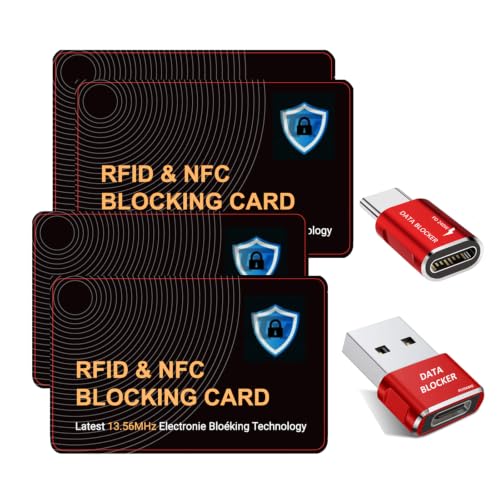
BUISAMG is a practical pick if you want something simple that actually covers more than just one card. Instead of dealing with separate sleeves, you can just keep this card in your wallet, and it creates a blocking zone around the cards next to it.
One thing why this bundle stands out is how little space it takes. At roughly the thickness of a regular card, it doesn’t make your wallet feel bulkier, which is something you definitely notice with thicker or stacked solutions.
The fact that it uses an active jamming chip and doesn’t need a battery also helps, because there’s zero maintenance. The included USB data blocker is a nice extra, especially if you often charge your phone in public places.
5. Boxiki Travel – best sleeve set for organizing multiple cards and documents

| Pricing: | Affordable |
| Color: | Navy Blue (color-coded set) |
| Thickness: | ~0.1 mm per sleeve |
| Best for: | Users who want separate protection for each card and passport |
Boxiki Travel is a straightforward sleeve set for those of you who prefer keeping each of their cards and documents separately protected. Everything is simple; you just have to slide your cards and passport into individual sleeves and keep using your wallet as usual.
What stands out here is how thin these sleeves are. Even with a few of them in your wallet, the difference is barely noticeable, which isn’t always the case with bulkier sleeves or thicker cards. The color-coding is actually really useful for everyday use, not just a design, but they’re also water and tear-resistant, which makes them a great choice for travel or daily use.
6. Boxiki Travel (12-Pack) – best lightweight sleeve set for everyday carry

| Pricing: | Affordable |
| Color: | Navy Blue |
| Thickness: | ~0.1 mm per sleeve |
| Best for: | Users who want simple, no-fuss protection |
What worked for me with this Boxiki Travel set is the fact that you get 12 sleeves, so every card has its own place. I didn’t have to think about positioning or coverage, because I’ve just slipped the cards in and kept using my wallet like I always do. It’s a simple setup, but it makes sense if you carry more than just one or two cards.
Many people also liked how thin and light these sleeves are. Even with a few of them in my wallet, it didn’t start to feel stiff or bulky. The color-coding turned out to be more useful than I expected for telling cards apart quickly, and the material feels sturdy enough for everyday use, including travel and the occasional rain or spill.
My methodology
For this article, I worked together with the Cybernews research team to provide an extensive and in-depth analysis of the best RFID blocking cards. While we did not physically test the cards ourselves, we evaluated the models based on specifications, user feedback and expert commentary. Here are the factors we prioritized:
- Effectiveness (30%). We analyzed how well the card blocks or jams RFID scanning, and how effective it is on different distances.
- Build and durability (20%). We looked at the materials used and their quality, thickness, and bending resistance. Last but not least, we paid attention to the card’s overall lifespan.
- Ease of use (15%). We paid attention to how easy the card is to use, fit in your wallet, and carry around. The more natural it looked and felt – the better.
- Price and value (20%). We analyzed the options’ prices and how they compare against each other, paying attention to both affordable and premium models.
- User feedback (15%). We focused on what real users had to say about the blocking cards, and the pros and cons they outlined in their reviews.
How do RFID blocking cards work and what do they protect against?
RFID or radio-frequency identification is a technology that can be found in many modern credit cards, passports or IDs. It uses radio waves to identify and track objects, animals, or people automatically, sometimes multiple at once – and, unlike barcodes, doesn’t require direct contact. The information transmitted by scanning can include various sensitive data, including your card number and details.
However, this transmission can be interrupted by a RFID-blocking card. It uses conductive materials like aluminum or specialized fabric blends to disrupt the radio waves so they don’t reach your documents and cards. Additionally, it’s usually in the form of a card or a card case itself which allows it to blend into your wallet naturally, without taking much space.
RFID-blocking cards can be a helpful tool against unauthorized scanning of your contactless cards, which is somewhat popular among frauds and can happen in crowded or busy surroundings. For users who travel a lot or have a hectic lifestyle, such card can provide additional peace of mind.
Why RFID protection matters
Frauds often use RFID scanners in plain sight to access your information – and this method is quick, subtle and hard to detect. That’s why you should take RFID protection seriously, with several potential threats to look out for:
- Identity theft. Among the documents frauds can access are driving licenses, passports and other forms of ID. They might use this information to try and access your banking accounts or even impersonate you.
- Unauthorized transactions. Some frauds use terminals to withdraw different amounts of money from others’ cards. That’s why, unless you have contactless payment disabled for your card, you may want additional safety measures to protect your funds.
- Card cloning. If you’re using an electronic key card, it can be scanned – with data used to create your card’s clone and access your apartment or hotel room.
While not the most common form of pickpocketing, RFID skimming can still happen in crowded settings. Frequent travelers or busy city commuters usually get targeted the most, so it’s better to stay extra cautious. And even if you avoid crowds, a RFID blocking card can still make you feel safer – as well as boost your data’s safety overall.
Do RFID-blocking cards really work and are they worth using?
Over the years, RFID blocking cards proved a pretty helpful tool for card protection, although their effectiveness can vary depending on the model and the specific card's overall quality. Some cards can be bypassed under certain conditions, which is why it’s important to select the model you’re confident about.
It’s also important to remember that while RFID-blocking cards can offer you an additional protection layer and confidence in crowds, transit hubs or during travel, it’s a supporting tool that should be considered part of a bigger system, not used as your main safety measure. Remember that it can defend you from a limited number of threats and in specific situations only.
While RFID skimming is not the most common form of fraud, you may still encounter it, so consider your blocking card a supplementary measure and a way to feel safer in crowds or when traveling.
Features to consider when choosing the best RFID blocking card for your needs
When choosing a RFID blocking card, there are certain features to keep in mind. Here’s what you should pay attention to in the first place:
- Size and thickness. The card should fit into your wallet easily. If it’s thicker than around 1mm and too bulky, it won’t be a good fit.
- Technology (passive vs active). Passive card models block signals only, while active ones also jam it, offering more protection – however, they require active power, with devices often less subtle.
- Durability. Features like scratch resistance, water resistance, or rigidity that prevents bending, can all increase your card’s durability and overall lifespan.
- Design options. If you plan to carry the card daily, you may prefer a more aesthetic or even custom design that makes it look less like a device and more like an accessory.
- Price and value. There are both more expensive and more wallet-friendly options, when it comes to RFID blocking cards. Compare the prices against each other and against alternatives, such as RFID-blocking wallets. Go for the option that offers the biggest value.
Extra tips to protect your info beyond RFID blocking
While a RFID blocking card can be a great way to protect your data and cards, it’s far from all you can do to protect yourself. Here are a few tips to keep in mind:
- Monitor bank statements regularly. Look out for even the smallest unusual charges – they may be signaling a potential threat.
- Use contactless only when needed. Consider changing your card settings to an insert method only to make it harder for frauds to perform transactions. Use contactless payments only when completely necessary.
- Enable two-factor authentication. This is a must for all your financial and identity accounts, which can protect you from various kinds of fraud, identity theft and data breaches.
- Consider secure wallets or passport holders. Some models even have a built-in RFID lining, which may offer additional security.
- Combine security measures. Combine physical devices like a blocking card or wallet, with additional safety measures such as 2FA and an overall responsible approach to digital safety. Being cautious can already prove life-saving.
Final verdict: the best RFID blocking card
A RFID blocking card can be a simple and affordable, yet effective tool against unauthorized RFID scanning. Easy to use and convenient, it provides you with an additional protection layer and peace of mind even when the risks are low.
While RFID skimming is not the most common threat, it’s still something to keep in mind – especially for commuters and frequent travelers. If you often find yourself in crowds or just prefer to take all precautions possible, a RFID blocking card is for you.
During my research, I found Credifence the best model overall, with a reliable balance of effectiveness, durability, and affordability. However, to make the best possible choice, be sure to compare all options – and select the model that fits your needs best.
Other guides from Cybernews:
NFC vs RFID: understanding the key differences
FAQ
How does an RFID blocking card differ from an RFID-blocking wallet?
A blocking wallet looks just like a real wallet, with all of your cards shielded behind RFID-blocking material. Meanwhile, a RFID blocking card like Credifence is similar to a regular credit card and is usually put into your existing wallet. While the RFID-blocking wallet may provide bigger coverage, you can also use several RFID-blocking cards for more extensive protection or purchase one of the premium card models with a wider protection range.
Can RFID-blocking cards protect passports as well?
Yes, in most cases. Passports typically use the same 13.56 MHz frequency standard, so depending on the design and placement of your blocking card, it may offer some protection. In fact, some passports already include RFID-blocking materials woven into their covers, which protect the documents when closed.
Do I need more than one RFID-blocking card in my wallet?
No, not necessarily. However, having multiple cards can improve coverage, especially if you’re looking to shield several cards or your blocking card has a narrow protection range. For example, you can place one card in front of your payment card and another – in front of your ID card.
Are active RFID blocking cards more effective than passive ones?
Yes, active RFID blocking cards can be more effective due to the jamming signal they emit to disrupt RFID communication, in comparison to passive cards that just create a physical barrier. However, their effectiveness still varies depending on overall quality. They can also be overcome, similarly to passive cards.
Where can I buy the best RFID blocking cards?
You can find RFID blocking cards on most online selling platforms, such as Amazon or other dedicated sites. Some brands also have an official website, allowing you to purchase the card directly.