Heartbreaking trend rocks Arizona: people in search of love losing $44M yearly
Today, you might receive a love message, but it could leave you more miserable than getting nothing at all.

Image by Cybernews

 Follow us
Today, you might receive a love message, but it could leave you more miserable than getting nothing at all.
- Arizona residents lose approximately $43.5 million annually to romance scammers. With 1,084 reported victims, it is the most affected state in the US.
- Retirees, socially isolated individuals, and those with significant savings are prime targets.
- Scammers now use AI-generated images and communicate exclusively through encrypted channels like WhatsApp or Telegram, making it increasingly difficult to identify fraud.
- Some banks have implemented "romance scam alerts" for suspicious wire transfers, and experts propose mandatory 72-hour cooling-off periods for large transactions.
Key Takeaways by nexos.ai, reviewed by Cybernews staff.
Out of 50 states, these 10 are ranked as the most catfished states in the US. What are the reasons, and can anything be done about it?
It might seem that, thanks to infamous stories like Tinder Swindler, who scammed multiple women out of ten million dollars, and more victims opening up about ways they were scammed, more people are becoming aware and more careful when communicating online.
However, these scams keep occurring, with a recent report by adult image and video generator Seduced AI revealing which US states are the biggest victims of catfishing, and showing quite a different trend.






The report was released at the beginning of this year and analyzed scam trends across all 50 states. It used data from the Internet Crime Complaint Center (IC3) state-level reports to reveal which states had the highest rates of scamming, how much money residents lost, and how many people sought help afterward.
What insights does it provide into romantic scams that have been on the rise in the past several years?

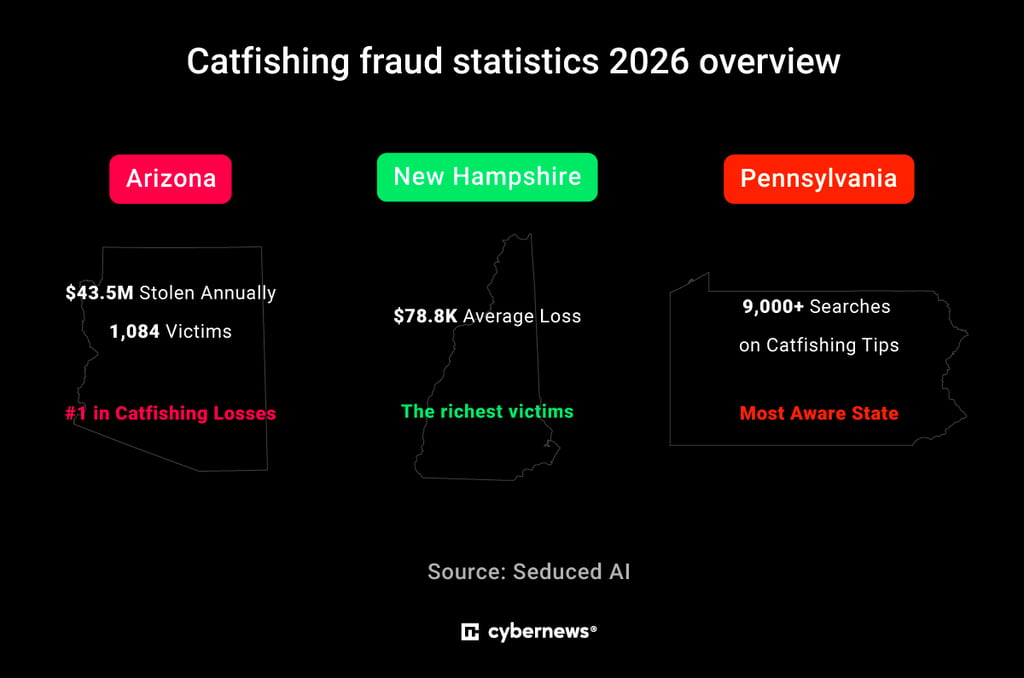
Catfishing fraud statistics 2026 overview
The study focused on three key details: where individuals are most likely to encounter catfishing, how much they have lost, and how actively they search for safety tips and reporting procedures online.
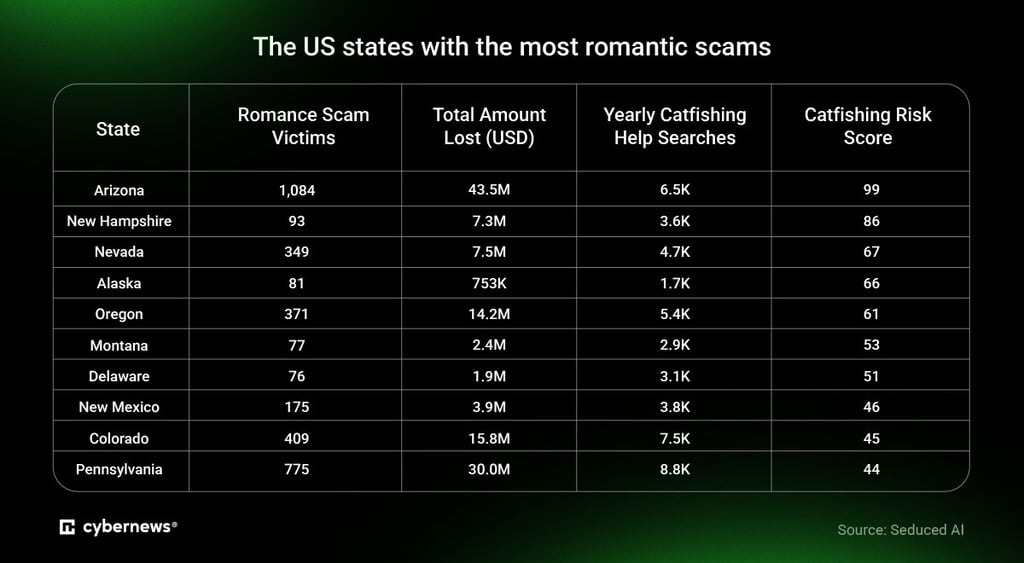
The research reveals that Arizona is the state with the biggest victims of romantic catfishing, with scammers stealing around $43.5 million annually from 1,084 victims.
The second is New Hampshire, with significantly fewer yearly reported victims (93), but considered “the richest victims,” with residents losing $78.8K on average. Nevada takes the bronze medal as the most catfished state in the US, with almost 350 people getting scammed out of $7.5 million a year.
The top five countries where people are most often scammed also include Alaska and Oregon. Alaska was the only state in the top 10 list with total losses that were under one million, with only 81 romance scam victims losing a total of $753K.
However, given its small population, the numbers are still worrying: 11 residents have fallen for catfishers per 100K people, notes a Seduced AI spokesperson.
The fifth place in the list goes to Oregon, where scammers took $14.2 million from 371 people who reported the scam. What makes Oregon stand out is that its residents lost “second-most money to catfishers in the top 5,” the study suggests.
Do scammers care where you’re from?
While scammers often target people en masse, meaning that they don’t usually focus on one location or area, perhaps looking at the rise of scams in these specific states could give some insights into who these con artists are going after.
Arizona, the number one state by both victim count and total losses, could be targeted, as it is among the states with the largest retiree populations.
Already retired residents tend to be quite well off, may also be divorced or widowed, and have more free time to engage in online relationships, notes Yagub Rahimov, the CEO at Polygraf AI.
“The average loss per victim in Arizona is around $40K, suggesting there are people with a lot of liquid assets,” also suggests the expert.
Data on New Hampshire suggests “an older, wealthier demographic with big retirement savings. Small state, wealthy population, and possibly less digital literacy among older residents,” says Rahimov.
With online scams becoming trickier and more aggressive, it's harder for older users not to get sucked into them. This has already been a headache for users looking for ways to protect their elderly relatives, who are eager to use electronic devices but don’t necessarily understand the dangers of accidentally clicking a malicious link.
However, this issue can’t be attributed solely to age. With Nevada placed third in the study, its high ranking could be related to “transient population and the gig economy workers in Las Vegas – people who may be more socially isolated despite living in a dense urban area,” notes Rahimov.
Considering that the top 10 states don’t include densely populated states, the situation may indicate that scammers thrive in states with “demographic vulnerability, social isolation, and possibly weaker community-based fraud awareness networks,” says the expert.
How often do victims report romanticized scams?
The study also examines how likely victims are to recognize and report these scams by analyzing Google searches for terms such as “signs of catfishing,” “report romance scam,” and “Tinder catfish.”
According to the study’s “Yearly Catfishing Help Searches" metric, the most aware state on the list is Pennsylvania, with almost 9,000 people looking for information about catfishing each year.
The second is Arizona, with 6,500 people searching for help online. Numbers shouldn’t be surprising considering that Arizona is the number one on the most catfished US states list.
While higher search volumes may hint at a large number of people who were scammed and are now seeking help, they may also indicate that more users are becoming aware of this issue and are seeking information to confirm their suspicions.
There have been multiple reports that online scams are becoming more elaborate and harder to untangle, especially with the rise of AI and deepfakes.
Turning to online dating apps to meet someone has become a new normal. However, it also became a place for romantic scammers to find their victims. By now, some of their patterns are known to the public, thanks to victims who report and speak out about these situations.
These stories reveal the patterns scammers follow. They first build a person’s trust, and once that’s achieved, that’s when they start asking for money.
At the beginning, their requests are small and perhaps even sound valid, a few hundred for an emergency, which later escalate to bigger sums and riskier “opportunities.”
What are some of the patterns that could help indicate a scam?
“Scammers ask victims to send money, only communicate on encrypted channels like WhatsApp or Telegram, and refuse face-to-face communication,” says Angie Waller, an intelligence specialist at Graphika, which tracks online disinformation.
She also notes that scammers use AI, making it harder to determine whether the images they send are real.
“When we are questioning an image’s authenticity, a reverse image search often reveals similar images under other accounts and names, which is a dead giveaway that something is off,” notes the expert.






Should banks have more say?
One of the most well-known cases of a romantic scam is the story about Simon Leviev, also known as Tinder Swindler, who left multiple women with massive debts after they took out loans to help out Leviev.
Since often romantic scam victims are left in a vulnerable position financially, not only left with nothing, but also racking up debts, should institutions such as banks have the right to intervene?
Rahimov notes that some banks have already started using "romance scam alerts," put in place to detect suspicious wire transfer patterns, such as “international wires or multiple transactions to cryptocurrency exchanges.”
However, the expert notes that such measures aren’t always effective as victims tend to be “emotionally compromised.”
What he proposes is a multi-step framework in which banks would have “mandatory cooling-off periods” for large transactions when there are signs of fraud.
For example, a “72-hour hold on a $50K wire transfer could give family members time to intervene,” notes Rahimov.
He also proposes that specialists, such as financial advisors managing retirement accounts, be trained to recognize red flags and have protocols in place to alert family members or close contacts when a suspicious request is pending.
While getting insurance is often a way to protect oneself from unexpected situations in the future, currently, traditional insurance companies don’t offer such an option.
Nevertheless, there’s a rise in cybersecurity insurance, with companies such as Boxx Insurance offering coverage for fraud, identity theft, and cyberbullying associated with such scams.
Unlock more exclusive Cybernews content on YouTube.