Russia’s covert UK subsea cable operation exposes link between physical and cyber warfare
Newly-released images and UK intelligence reveal Russian submarine activity near critical undersea cables, highlighting growing risks to global data, energy infrastructure and cybersecurity.

Image by Cybernews

 Follow us
Newly-released images and UK intelligence reveal Russian submarine activity near critical undersea cables, highlighting growing risks to global data, energy infrastructure and cybersecurity.
The UK’s Ministry of Defence confirmed yesterday that the vessels operated in and around the North Sea, where they were observed near critical undersea pipelines and cables.






The covert Russian submarine operation in and around British waters was revealed by Defence Secretary John Healey at a Downing Street press conference.
According to the MoD, a Russian Akula-class attack submarine entered international waters in the North Sea several weeks ago.




The vessel was tracked continuously by the Royal Navy with monitoring lasting around one month, involving more than 450 hours of aerial surveillance.
Officials believe the submarine acted as a decoy, while smaller vessels linked to Russia’s Main Directorate of Deep Sea Research (GUGI), conducted activity in other locations.
GUGI units are understood to specialize in deep sea operations, including surveillance and reconnaissance around undersea infrastructure.
The attack sub "retreated home" after being identified, Healey said, but the two GUGI vessels that remained were left in no doubt “that their attempted secret operation had been exposed” and they too have “now left UK waters and headed back north.”
Healey added that there is no evidence they caused any damage to undersea cables or pipelines and he said that the activity was in the UK's "wider waters" – which stretch deep into the North Sea alongside Norway – rather than close by shore.
New images of GUGI units released by MoD
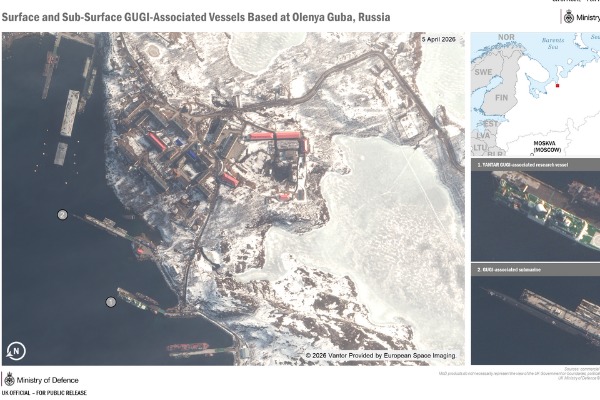
For the first time the MoD has released satellite images of the GUGI base and of these vessels.
The images show the Russian naval facility at Olenya Guba, a remote Arctic base used by vessels linked to deep-sea operations. Smaller inset images highlight specific assets, such as a research vessel and a submarine believed to be involved in underwater surveillance activity.
According to the MoD, British forces deployed sonobuoys to track underwater movements and deter potential interference – a demonstration of the UK’s ability to monitor and respond to submarine activity in its surrounding waters.
Speaking at a Downing Street press conference yesterday, Healey said the government was making the activity public to expose the continuing Russian activity that threatens the UK.
“I am making this statement to call out this Russian activity. And to President Putin, I say this: we see you, we see your activity over our cables and pipelines. And you should know that any attempt to damage them will not be tolerated, and will have serious consequences.”UK Defence Secretary John Healey
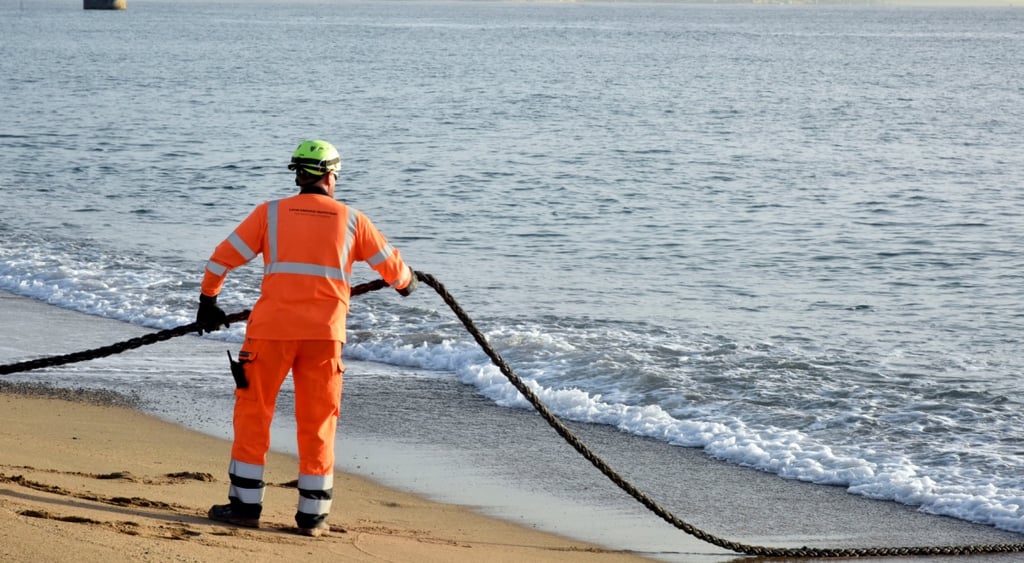
Healey also underlined the UK’s dependency on subsea networks, with around 99% of international data traffic carried by undersea cables, along with pipelines supplying a significant portion of domestic gas.
Hybrid Warfare
These assets have increasingly been identified as potential targets in the context of hybrid warfare.
“The seabed matters, especially for Britain. We are an island nation. Connection is everything, for our economy and our security and beneath our waters lies a vast network of cables and pipelines on which our way of life depends,” he said.

Check if your data was exposed
Find out if your email and related personal information have appeared in known data breaches.
While there is no evidence that the covert Russian operation damaged underwater cables, Charlotte Wilson, head of enterprise for the UK and Ireland at Check Point, stressed that it was also about whether they’re being monitored or tested.
“If a state actor can get close enough, they’re not only in a position to disrupt traffic, they may also be able to intercept or analyze it. That opens the door to surveillance, data collection, and even the groundwork for future cyberattacks,” Wilson said.
“There’s also a wider pattern here. We’re increasingly seeing cyber and physical threats overlap. It’s not just about hacking from behind a screen – it’s also about getting closer to the infrastructure that powers the internet itself."Charlotte Wilson, head of enterprise for the UK and Ireland at Check Point
“If you can influence the cables, you’re not only targeting one system, you’re potentially affecting entire economies and millions of users at once,” she added.
The incident follows broader efforts by the UK to strengthen the protection of underwater infrastructure. The government’s Atlantic Bastion program - announced last November – aims to combine AI-enabled detection systems, autonomous vessels, and traditional naval assets to improve monitoring and response capabilities.
Unlock more exclusive Cybernews content on YouTube.