Developer’s “insights” into where food delivery app fees go is actually an AI-powered scam
A Redditor has claimed that extra fees, which customers believe are intended as a tip for food delivery workers, actually go to the company. While the post caused a debate about the ethics of food delivery companies, the “proof” appears to be fabricated.
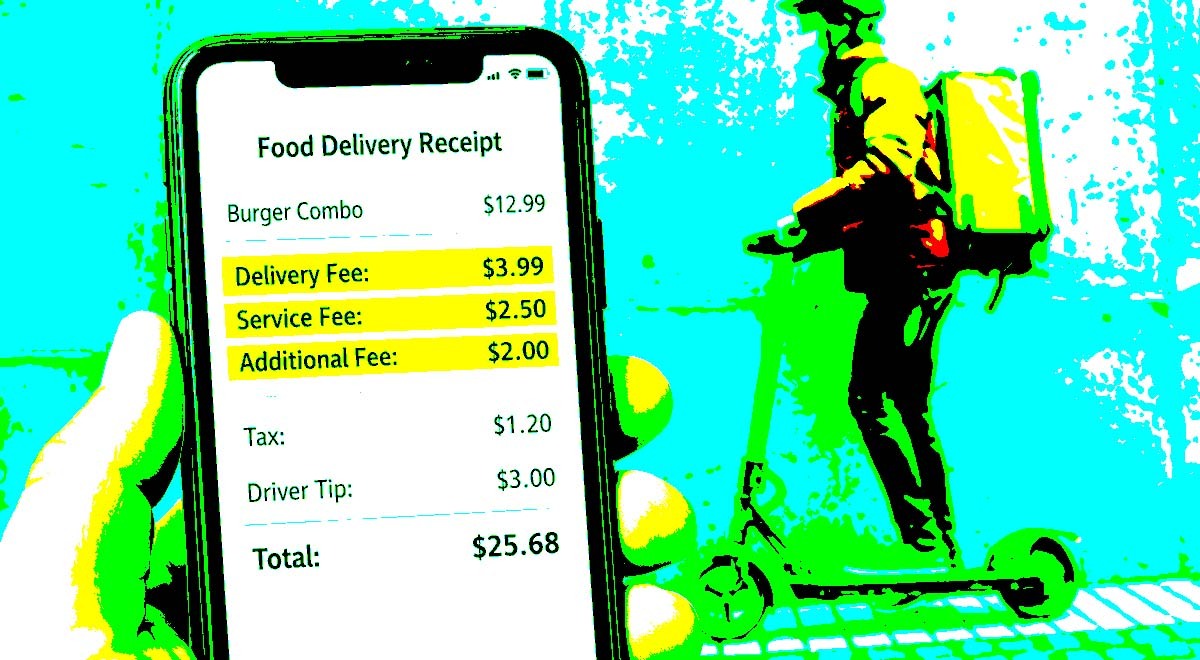
Image by Cybernews

 Follow us
A Redditor has claimed that extra fees, which customers believe are intended as a tip for food delivery workers, actually go to the company. While the post caused a debate about the ethics of food delivery companies, the “proof” appears to be fabricated.
- Claims by a backend engineer that revealed that fees like “priority delivery” don’t speed up orders but instead slow down standard orders to create the illusion of faster service turned out to be a hoax.
- The Redditor claimed that drivers were algorithmically ranked by “desperation,” with those needing money most being offered lower-paying jobs and fewer good tips.
- So‑called “driver benefit” or regulatory fees allegedly go to corporate funds, not directly to drivers, they said.
- Tipping more may not help drivers as intended, since higher tips can lead companies to lower driver base pay, shifting wage costs to customers, he further claimed.
- While the “proof” appeared to be fabricated, it actually revealed another issue.
Key Takeaways by nexos.ai, reviewed by Cybernews staff.
The article has been updated to reflect a recent discovery that the claims shared in the Reddit post were a hoax.
Over time, food delivery services like Uber Eats and DoorDash have become among the most popular apps.
In 2024, food delivery revenue in the US was almost $30 billion, with Uber Eats generating the most revenue by apps, according to The Business of Apps report.




In response to popular demand, the cost of these services has also increased over time.
Users of these apps are aware that when ordering food, they also incur additional fees, including delivery fees, service fees, and small order fees or tips.
Usually, there’s a reason behind such fees: it’s either to cover operational costs for low-value orders, to compensate the staff, or to receive the order faster.
Recently, a Reddit user, who shared that they’re a backend engineer for a food delivery app, revealed the reality of where these additional fees end up once they leave a customer’s pocket.
The shared information and user reactions suggest that a significant change is needed.

What does it take for food delivery companies to increase their revenue?
The Reddit user under the nickname @Trowaway_whistleblow first shared that they’re incriminating themselves since they’re under “a massive NDA.”
Nevertheless, the user decided to share what tricks food delivery companies pull to increase their revenue.
“You guys always suspect the algorithms are rigged against you, but the reality is actually so much more depressing than the conspiracy theories,” wrote the user.
The developer shared that their job requires participating in the meetings where the company’s product managers think of ways “how to squeeze another 0.4% margin out of ‘human assets.’”
In this case, “human assets” are considered to be drivers.
Next, the user shared how “Priority Delivery" service is a “scam” since it doesn’t speed up orders that include such a fee, but rather “delay non-priority orders by 5 to 10 minutes to make the Priority ones ‘feel’ faster by comparison.”
“We generated millions in pure profit just by making the standard service worse, not by making the premium service better,” noted the developer.






What role do drivers play in this scheme?
The user shared that they’re in the process of quitting their job, with the main reason being how the company is treating its drivers.
“We have a hidden metric for drivers that tracks how desperate they are for cash based on their acceptance behavior,” wrote the developer.
Their given example reveals that if a driver tends to accept small deliveries, the company’s algorithm marks them as "High Desperation." The system then no longer shows them the high-paying orders.
The logic behind this is that there’s no point in providing drivers with higher orders if they can complete the lower ones.
“We save the good tips for the ‘casual’ drivers to hook them in and gamify their experience, while the full-timers get ground into dust,” shared the person.
“Tip Theft 2.0:” your money may not go where you intended
When it comes to tipping, the developer explained what happens to the $1.50 that customers spend for "Benefit Fees,” Regulatory Response Fees," or "Driver Benefits Fees.”
They shared that while this sounds like a fee intended to support drivers, in reality, the money goes to a “corporate slush fund used to lobby against driver unions.”
The Redditor notes that while the company no longer steals tips to avoid being sued, it engages in another practice.
The company’s algorithm can predict whether a customer is a higher tipper, so it offers drivers a lower base pay. For example, if a customer tips $10, then the driver’s base pay will be $2.
“If you tip $0, it offers them $8 base pay just to get the food moved. The result is that your generosity isn't rewarding the driver – it’s subsidizing us. You’re paying their wage so we don't have to,” explains the developer.
Community reactions
The post sparked an online discussion, with users speculating which companies could be involved and whether these practices occur in the US.
I’m a developer for a major food delivery app. The 'Priority Fee' and 'Driver Benefit Fee' go 100% to the company. The driver sees $0 of it.
byu/Trowaway_whistleblow inconfession
“It’s probably Uber Eats or DoorDash, right?” asked one Redditor.
“It’s Uber going off the terms for the fees and OPs knowledge of ride sharing (DD doesn’t taxi yet). But DD is probably set up similarly IF OP is telling the truth and not just bullshitting,” shared another user, being among those who questioned whether this situation is true.
While it hasn’t been disclosed which food delivery company is benefiting from the fees, online speculation suggests that more than one company may be involved in such practices.
Cybernews contacted the Redditor to find out more about the situation.
We asked the user whether these practices could be applicable to all food delivery companies, to which the developer shared that “it’s already standard across the industry. Basically, in any major company in the USA, at least.”
While many people had differing opinions on the matter, some were concerned about the user and whether the company would go after them, while others were thinking of ways to avoid paying the fees.
What about the workers? Do they have any clue what’s going on?
“They are mostly unaware, I guess some of them might have some conspiracies about it, but mostly no,” revealed the user.
A universal scam worldwide?
Many Redditors online were in favor of exposing such companies and ensuring that they wouldn’t use drivers to profit, while workers struggle to make ends meet.
While this situation refers to the companies in the US, similar practices seem to be “the norm” around the world, too.
An earlier journalistic investigation in 2025 revealed that similar trends to devalue delivery drivers’ work are not only taking place in the US but also in Europe.
Redakcija, a YouTube channel created by Lithuanian journalists who investigate current affairs, shared the reality of workers at well-known delivery companies, such as Bolt Food, Last Mile, and Wolt.
According to Redakcija, such companies offer people the opportunity to become “partners” who can enjoy flexible working hours and good pay.
However, the investigation revealed that behind such an offer hides practices like no social benefits, no paid vacation, and under-the-table pay.
Is the whole story just a hoax?
The story, which was shared by a Redditor, soon began to go viral, with more people questioning its legitimacy.
While the person indicated that they don’t want to share too much so as not to incriminate themselves, Casey Newton from Platformer contacted the developer to see if they have any plausible proof for their claims.
The developer provided them with what was supposed to be an Uber Eats employee badge. Despite the badge looking real, Newton learned that it was actually generated by Google Gemini.
Next, the Reddit user provided Newton with documents that were supposed to prove their claims, such as the previously mentioned “desperation score.”
After some investigation, the founder and editor of Platformer concluded that the story was fake.
He then confronted the developer, who later deleted their Signal account, through which the two had been communicating.
AI helps make fake stories more plausible
What essentially helped Newton realise that the whole story was fake was the badge.
Even though he was sent additional documents, the investigator wrote: “I wish I could tell you that I immediately clocked the document as a fake. The truth is that it initially fooled me.”
The extensive document was filled with data, charts, formulas, and diagrams. Nevertheless, the more Newton delved into this data, the more it seemed fake.
But “showing” the badge to Google Gemini and showing the shared documents with the ridesharing company engineer that Newton knows cleared doubts about whether the information shared by the Redditor is real or fake.
It’s one thing to receive a hallucination instead of an answer from AI. However, this story highlights that AI can also be used to deceive and scam people in another instance.
FAQ about additional food delivery app fees
Do “priority delivery” fees actually make your food arrive faster?
No. According to the developer, priority orders are not sped up. Instead, standard orders are deliberately delayed to make priority deliveries appear faster by comparison.
Do “driver benefit” or regulatory fees go directly to delivery drivers?
Allegedly, no. According to the Redditor, these fees go into corporate funds, including lobbying efforts, rather than being paid directly to drivers.
How are delivery drivers ranked by apps?
Drivers are reportedly ranked by a hidden “desperation” metric based on how often they accept low-paying jobs, with more desperate drivers being offered fewer high-paying orders.
Does tipping more money always help the driver earn more?
Not necessarily. The algorithm may lower a driver’s base pay when it predicts a customer will tip well, meaning the tip can replace company-paid wages instead of adding to them.
Are these practices limited to one food delivery company or country?
According to the Reddit user and past investigations, these practices are widespread across major food delivery companies in the US and may also be common internationally.
FAQ by nexos.ai, reviewed by Cybernews staff.
Unlock more exclusive Cybernews content on YouTube.