Android developers outraged: Google is making it impossible for app makers
Submitted ID. Paid the fee. Still no publishing rights.
Image by Cybernews

 Follow us
- Google now requires some Android developers to pay $25 and verify identity for wider app distribution.
- New personal Play accounts must test apps with 12 users for 14 days before production access.
- Hobbyist developers say the rules make free or finished small apps harder to publish and maintain.
- Verification may help stop malware and repeat bad actors, while limited device sharing remains exempt.
Key Takeaways by nexos.ai, reviewed by Cybernews staff.
Google is increasingly asking hobbyist developers to navigate a maze of identity checks and tests just to put a small app in front of users. According to some, it’s making their lives unbearable.
For years, one of Android’s selling points was that it was the more open alternative to Apple’s tightly controlled ecosystem. However, the tightening of Google’s environment has made it nearly impossible for small app developers to reach users.
The latest frustration surfaced on X, where a developer going by the name 0xcrypto described trying to return to Android development after an old Google Play developer account was closed due to inactivity.
The developer said they had originally created a Play Store account to make a game, but never finished it. Google subsequently closed the account because it had been inactive.






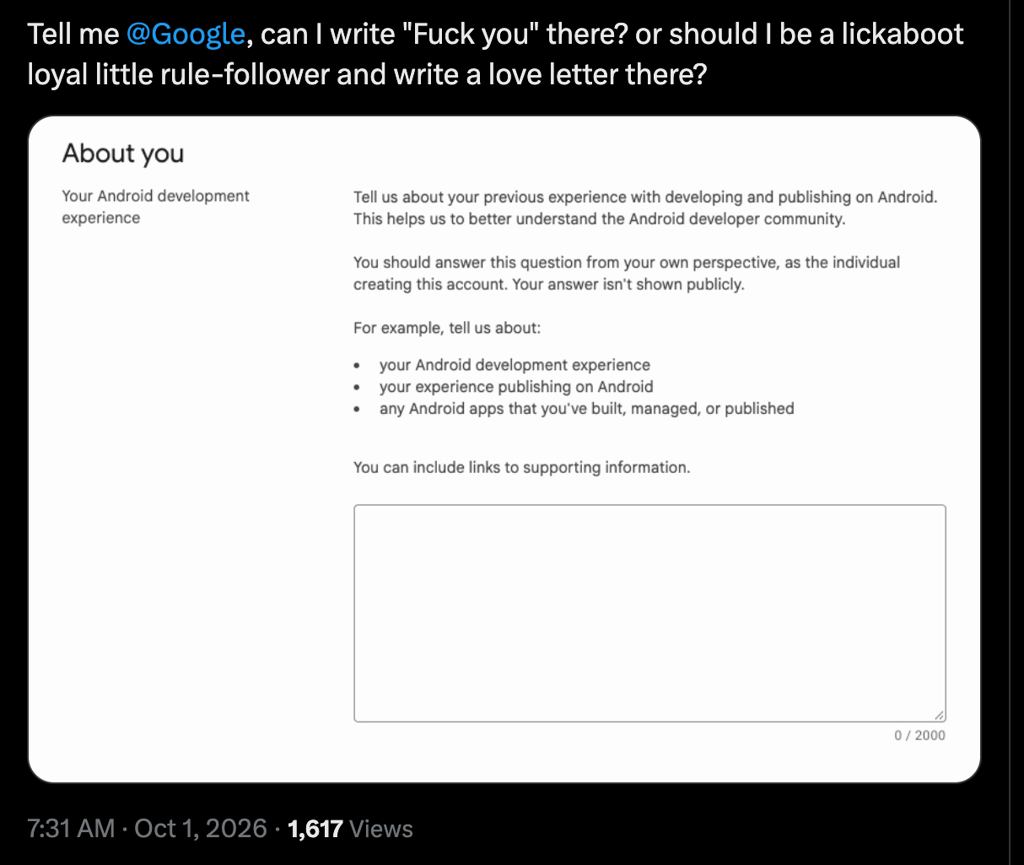
When the developer later returned with a new app, they found they could not simply restore the old account or create another one without paying a fee and completing identity verification.
The developer considered distributing the application outside Google Play, potentially through F-Droid. But Google's new Android Developer Verification system now adds another layer of registration for developers distributing apps outside the Play Store.
The registration fee is $25. While the amount seems insignificant, for hobbyist developers who are publishing apps for free, it is quite a burden. Some hobby projects might never make their creator a single dollar.
"Why should I be paying this tax to Google?" the developer wrote, objecting to paying for an app they weren't even making money from.
“Tell me, Google, can I write 'Fuck you' there? Or should I be a lickaboot loyal little rule-follower and write a love letter there?”
Another issue raised by Android developers is the need to submit government-issued IDs and extensive personal information, which, in the case of an individual rather than a company, means their data may be published alongside the app.
Previously, I started a new Play Store account because I wanted to make video games for Android. But I never got time to finish my game. As a result, my personal play store account was closed by @Google because of inactivity.
undefined ivx 👾💀 (@0xcrypto) October 1, 2026
Now, I developed a new app, let's publish it on play… pic.twitter.com/ryuLuPBfHI
Google wants 12 people to test your Android app for 2 weeks
The complaints are not limited to Android's new developer verification system. Google has already introduced a separate barrier for newly created personal Play developer accounts.
Developers who created personal accounts after November 13th, 2023, must run a closed test with at least 12 testers who remain opted in continuously for 14 days before they can apply for production access.
Google then reviews the developer's application and may require additional testing. Google's documentation says the requirement is intended to ensure apps receive testing before reaching production.
For a software company with a testing team, that may be a manageable procedure. For someone making a free calculator, niche utility, or tiny game on a Sunday afternoon, finding 12 people willing to join a test, install the app, and remain opted in for 2 weeks could be mission impossible.
The requirement was originally even tougher. Google introduced the policy with a 20-tester threshold before reducing it to 12.
Many Android developers are unhappy
But the X user is not the only one facing difficulties. Developers on Hacker News have been venting about exactly this problem.
“It happened to me, too. And they didn't even refund my $20 or so.”
It gets better, I too had my account closed for inactivity, but I STILL get emails from them, which I can't stop because I can't log in to change email preferences,another developer said.
“I got banned from Google AdMob (or whatever it is called now), and they still send me promotional emails.”
“They also love keeping malware apps on the Play Store as well. I tried reporting an app that took over one of my parents' phones. It stayed up for quite a while. I'm sure it's still up.”
One developer described losing an account to inactivity despite having multiple apps published, arguing that Google seemed to treat a finished application as if it were abandoned simply because its creator wasn't constantly uploading updates.
Google does not understand the concept of a finished app, apparently, and requires you to continuously push updates or else you permanently lose your account with no way of reopening it,the developer wrote.
Another said they had an offline game published since around 2014 and had barely needed to update it, only being pushed into changes when Google required things such as a privacy policy or a newer target platform.
Yet Google's systems increasingly treat continued developer activity as part of the price of staying in the ecosystem. But the problems do not stop there. Extensive identity verification is also becoming a burden to small app developers.
Apple’s App Store charges more than Google – $99 per year. However, some developers argue that Apple's annual fee is at least predictable, whereas Google's Android ecosystem may involve additional payments, ID verification, and testing, which can add costs.
I had to submit my ID, private bank statements, and click through a ton of wizards for compliance, and of course, pay €25. Still no publishing rights,one developer raged.
“Now I would just pay some clickworkers on Fiverr to fulfill the testing criteria, but that risks getting my account banned forever. Needless to say, Google now has all my private data associated with my Google account,” they added.
Google has a reason for Android Developer Verification
Google says that developers who qualify for limited distribution can avoid the fee and identity verification.
The company explains that developers who want to distribute apps to a limited number of devices can use a limited distribution account. That option allows apps to be shared with up to 20 specific devices for testing and personal use without additional identity verification or a fee.
But for developers who want broader distribution, the walls get higher.
The tech giant’s position is also understandable. Google has spent years fighting malware and fraudulent applications. Identity verification makes it harder for bad actors to disappear and immediately return under another name.
The company describes Android Developer Verification as an additional security layer designed to make it harder for bad actors to repeatedly distribute harmful applications.
The protections began taking effect on September 30th, 2026, in selected regions of Brazil, Indonesia, Singapore, and Thailand, and will expand more broadly during 2027.
Some developers on Hacker News also defended the approach, pointing out that platforms need mechanisms to push developers toward newer APIs and prevent abandoned or unsafe software from lingering indefinitely.
“How else would they force new API adoption?” one developer wrote.
“Alternatives are having applications in 2026 that use POSIX, like in UNIX System V, or Win32, like in Windows 95/NT 3.51.”